
Crip* Ecologies of Producing Dance

Thursday 19 September
12 – 5.30 pm (Including lunch)
Royal Conservatoire of Scotland (and also online)

Dr. Aby Watson: Back & Forth & Forth & back photo by Tiu Makkonen

A partnership between The Work Room and Royal Conservatoire of Scotland, this event is part of the AHRC Future Ecologies: Producing Dance Network project, which brings together higher education institutions and dance organisations across the UK to scope the ecosystem that supports those involved in producing dance.

We invite disabled and non-disabled artists, producers, researchers, and anyone interested exploring alternative models of producing dance to join us either in person or on-line.

• What kinds of ecologies of producing dance exist, and are emerging, when disability and crip are the focus?
• How do crip ecologies influence practice and approaches to making and producing dance?
• What crip models of producing are currently being practiced?
• What might future ecologies of crip producing look / sound / feel like?

With crip, different ways of knowing, experiencing, and doing, are embraced. The emphasis is on the normality of different bodyminds doing things differently. Crip relates to the affirmative model of disability and has emerged from disability arts and disability pride. An activist term and politicised identity, crip embraces an individual’s impairment as a crucial aspect of their identity and place within disability or crip culture.

If ecology is about relations and systems, with crip ecology we are interested in what kinds of relations and systems support producing crip and disability dance. Are there particular kinds of relations between those involved in producing dance that emerge in the context of crip? What are crip dance practices, artistic forms, rehearsal structures, ways of touring, performer-audience relations etc? And how do crip approaches influence and relate more widely to current ecosystems of producing dance?

Crip Ecologies of Producing Dance will be a relaxed, creative and accessible event with artists presentations, discussions and reflections. The event will be hosted by Dr Sarah Hopfinger (RCS) and Anita Clark (The Work Room) with guest contributions:

Dr Aby Watson
Laura Fisher
Salma Faraji

It is open to anyone interested in contributing to these conversations around crip dance producing.

To register for this event and for further details, please click here.

* Many self-identifying disabled people, particularly in arts and activism, have reclaimed ‘Crip’ as a political term of solidarity, community and resistance to able-ism; conveying shared understanding, celebration and appreciation of what it is to live in the world as a disabled person. This is the intention with which we use it here. We know that not all disabled people embrace this term. You are very much welcome to this event if you are a disabled person who does not identify with the term.

Producing Dance Forum – 7th June FABRIC Birmingham!

Hello colleagues, I am leading a research network project funded by the Arts and Humanities Research Council scoping the state of the ecosystem that has supported/is supporting those involved in producing dance.

AHRC-funded Future Ecologies: Producing Dance Network

From 1.30-5.30 on 7th June we will be working with FABRIC in-person and online at the Dance Hub Birmingham.

Presenters
Raidene Carter – Artistic Director artsadmin
Mark Mallabone – Creative Producer Freelance
Genevieve Say – Artistic Director Birmingham Dance Network

We need your presence and your input to inform and shape our work! Advance sign-up via this form.

In-Person: 12.30-1.30 Arrivals and lunch – 1.30-5.30 as below

Online: 1:30-5.30 Presentations and Interactive Sessions

AHRC Investigators

‘Funmi Adewole, Co-Investigator, De Montfort University
Christopher Bannerman, Principal Investigator, London Contemporary Dance School
Sarah Hopfinger, Co-Investigator, Royal Conservatoire of Scotland
Rachel Krische, Co-Investigator, Leeds Beckett University
Vida Midgelow, Co-Investigator, University of the Arts London
Stefanie Sachsenmaier, Co-Investigator, Middlesex University

Arts Partners

Anand Bhatt, CEO/Artistic Director, Dance City
Anita Clark, Director, The Work Room
Andrew Hurst, Chief Executive, One Dance UK
Suzie Leighton, Co-Director, The Culture Capital Exchange
Eddie Nixon, Artistic Director, The Place
Efrosini Protopapa, Director PG Courses & Research, LCDS
Hannah Robertshaw, Creative Director, Yorkshire Dance
Paul Russ, CEO/Artistic Director, Fabric

Funded through AHRC Award AH/Y002334/1
Developed by Christopher Bannerman, Vida Midgelow and Steffi Sachsenmaier

Hold the date!

In partnership with FABRIC and Birmingham Dance Network the next FE:PDN hybrid event will take place on Friday 7 June at the Dance Hub space, Thorp Street, Birmingham. This is less than a 10 min walk from New Street Station. Parking is available (at a charge locally).

Further Information to be provided soon for attendance online.

Provisional Schedule

12:30–5:00pm

Arrivals and lunch 12:30–1:30

1:30 Welcome – framing of the project and the event – introductions
1:45 First course
2:25 Break
2:35 Second course
3:05 Break
3:15 Third course
3:55 Break
4:05 Final course
4:45 Wrap-up
5:00 Close

Reflections on the Future Ecologies, Artist Forum at Yorkshire Dance

1. Tomorrow is about being in listening mode …

This was one of the actions at the front of my mind, identified in our Future Ecologies network group meeting the day before joining the invited freelance dance artists, working at the coalface of dance practice in West Yorkshire.

Vida, Chris and Steffi created a structure where they facilitated the recalling, mapping, reflection, conversation and an exchange of experience and ideas that lived under the focus of eco-systems – Vida’s blog post below clearly articulates the intention, structure and questions/method used on the day. In the first half of the day, the Future Ecologies team, in a way, test ran the tasks. It was no surprise to me when mapping our team’s eco-system, that the vast web of our professional and personal lives of course intersected and interwove, regardless of the many roles we have inhabited – let’s be honest, the contemporary dance world isn’t super huge – but it set a base for the conversation that followed. What was most interesting for me, was the notion that arose of ‘eco-system-engineering’ – that organisms can create their environments, such as an earthworm enriching their soil. It was an attractive metaphor. Could we begin to think that ‘engineering’ the environment of dance practice/production through (a more expanded understanding or version of) producing, was possible? a potential option? And how might that look/operate/be?

As a co-investigator on this project, at this point in full time employment at Leeds Beckett University, I had many questions that the project brief had provoked on the area of producing in relation to sustainability. Questions that for me had to also include broader economic and political consideration. At this early point in the day, I was reminded of what I often feel when I am with my students. I recognise that 32 years ago, even though I had always struggled financially, as an always employed, freelance dance artist (this drove me to seek a job in Higher Education), I knew that these early years in the 1990’s were halcyon days compared to now. Though it was enjoyable to reminisce about our interweaving professional and personal lives, most of us were speaking right now from the privileged positions of being salaried – we are ‘professional researchers’, which in some respects means that we are paid to conceptualise.

2. It is important to be transparent about what the actual lived ecology is, rather than what, a conceptual (often idealised) ecology is …

So, what is this lived ecology, right now, in post-covid, cost-of-living, Brexit Britain?
The guest freelance artists could easily respond to the eco-system mapping task – picking up a marker pen and making visible on paper diagrams of webs of personal and professional connections, artistic practices, roles, geographical locations, buildings, institutions, organisations, dance jobs and side hustles. Many are self-producing. They were honest, open, caring, invested, pragmatic, generous .. … and humorous …

‘Life is a funding bid’

kicked off the laughter as well as the discussion. And so, in the interests of transparency about lived experience, the following, extracted from the whole group conversation after the exercise of putting marker pen to paper, has particularly stayed with me:

‘I spend a lot of time looking for resources rather than actually doing the art’
‘I am overwhelmed by the sheer amount of things that I have to do’
‘Choice has been replaced with survival’
‘My geographical area has become my eco-system – geographical proximity makes my artistic practice viable but, I do not make a living out of making art’
‘Maybe my art should be a hobby – the utopian ideal, because it is artmaking without conditions’
‘Imagine if we stopped’

Still?
And I repeat – I recognise that 32 years ago, even though I had always struggled financially, as an always employed, freelance dance artist …… these were halcyon days compared to now.
I shall admit here that I felt utterly sad and depressed about the state that we (our sector), are still in. A surefire solution in my mind would be another utopian ideal – UNIVERSAL BASIC INCOME.

But, what really broke my heart was the following:

‘I know that ‘art’ is at the bottom of broader societal concerns. And dance is at the bottom of ‘art’. And community dance – what I practice – well, that is at the bottom of dance.’

This was then countered with something along the lines of:

‘But I start the day thinking this, then I go and spend 2 hours in the evening with my community group and return home feeling fulfilled and inspired and in love with what I do and in no doubt that it matters’

It was clear that an ecology exists and that these artists lived their current ecologies. And that these lived ecologies also involved positioning within a field of perceived respect, as well as different power structures that dictate the circumstances of their lives, their bank balance, their housing, their health and their mental health more broadly. Therefore, how can we create the conditions to ‘engineer’ a different, more equitable, more sustainable eco-system? What might that look like and how can we do it? What is sustainability in action? Can ‘recovery’ be built into this? How can producing develop and support this? What form does/can producing take to develop and support this?

3. Ecological adaptation …

Building stronger relationships between Higher Education, seen as a secure and robust area, and the professional, freelance sector of dance practice, was a prominent feature that I understood to be underpinning this Future Ecologies Project when it was written – hence my involvement as co-investigator, because I was also tied to a university. But at the time of this first forum, notions of resilience from ‘joining forces’, were already beginning to seriously wobble in my own experience. Although at that time still under wraps, dance was literally beginning to be dismantled at my own institution. We were not the only ones. Dance provision in HE was (and is) toppling like dominoes around the country. The part we play, our ‘producing’ role in the web of providing both a broad dance education and the side-hustle, part-time jobs for dance artists, is fast disappearing. The irony of the timing of this project has not escaped me as I take Voluntary Severance.

My own professional history has included 18 years of freelance practice prior to being registered on an institution’s payroll. Even after 15 years in HE, I never once, in all that time, presumed my future was safe or assured – the freelance experience leaves a deep, ingrained, psychological mark. Perhaps the mark is actually one of resilience anyway, after all, I did manage to somehow get this far. I leave this project as the representative of Leeds Beckett University, but I remain with this project as an independent artist. The job of thinking about re-creating or re-engineering our producing environment, in order to help figure out what a future dance ecology might be, is no doubt timely. Doing it comes next. Ecological thinking and a resulting evolving ecology, in communication with its environment, fundamentally involves adaptation … which of course we do well … and is always about movement.

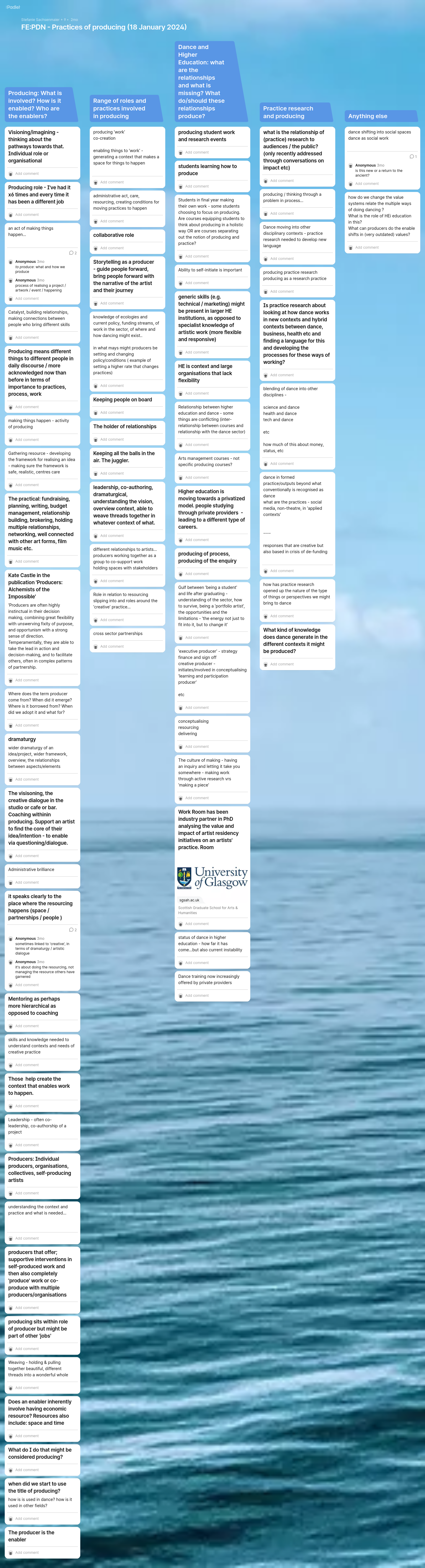
18 January FE:PDN Meeting

At this meeting of the network we began to share and discuss the experiences of producing dance and how they have, or might in future, intersect with HE. Anecdotally there is copious evidence of such links but they tend to be personal-professional and ‘below the radar’ of dance as an academic discipline; so one key aim of the FE:PDN project is to extend the range of dance in HE so that it encompasses the people, processes and products of producing. As we prepared the AHRC application that is supporting the network, the literature review revealed just how bare the cupboard is in relation to research related to dance and producing – we hope to begin to address that gap in our work.

Another related aim is to develop a better understanding of the dance ecosystem, how it functions and its current state in these unstable and challenging times. Both aims informed this day as we begin to gather the views and reflections of a group of leaders of dance organisations spread geographically but with UK and international networks. Steffi Sachsenmaier led the session and captured some of the discussion using online padlets.

Considering Ecosystems

I’ve often wondered how things can exist outside of an ecosystem… doesn’t everything need connections, relationships and diversity to thrive? Having worked in dance for over 20 years, I have become part of an ecosystem, one in which I’ve had many roles, built many relationships and developed many partnerships. Now leading a dance organisation, I know that it’s nearly impossible to remove one thing and it NOT have impact on everything else. This is true of, but not limited to, projects, people, spaces, funding, roles and programmes of work.

The current strain on the ecosystem is a direct result of diminishing resources, where the loss of say, an undergraduate dance course, has a direct impact on the local dance ecology in relation to workforce development, which then has a direct impact on project delivery and artistic development which then has a direct impact on producing roles, programmers and audiences. Put simply, if you remove one thing from the ecosystem, there is potential collapse.

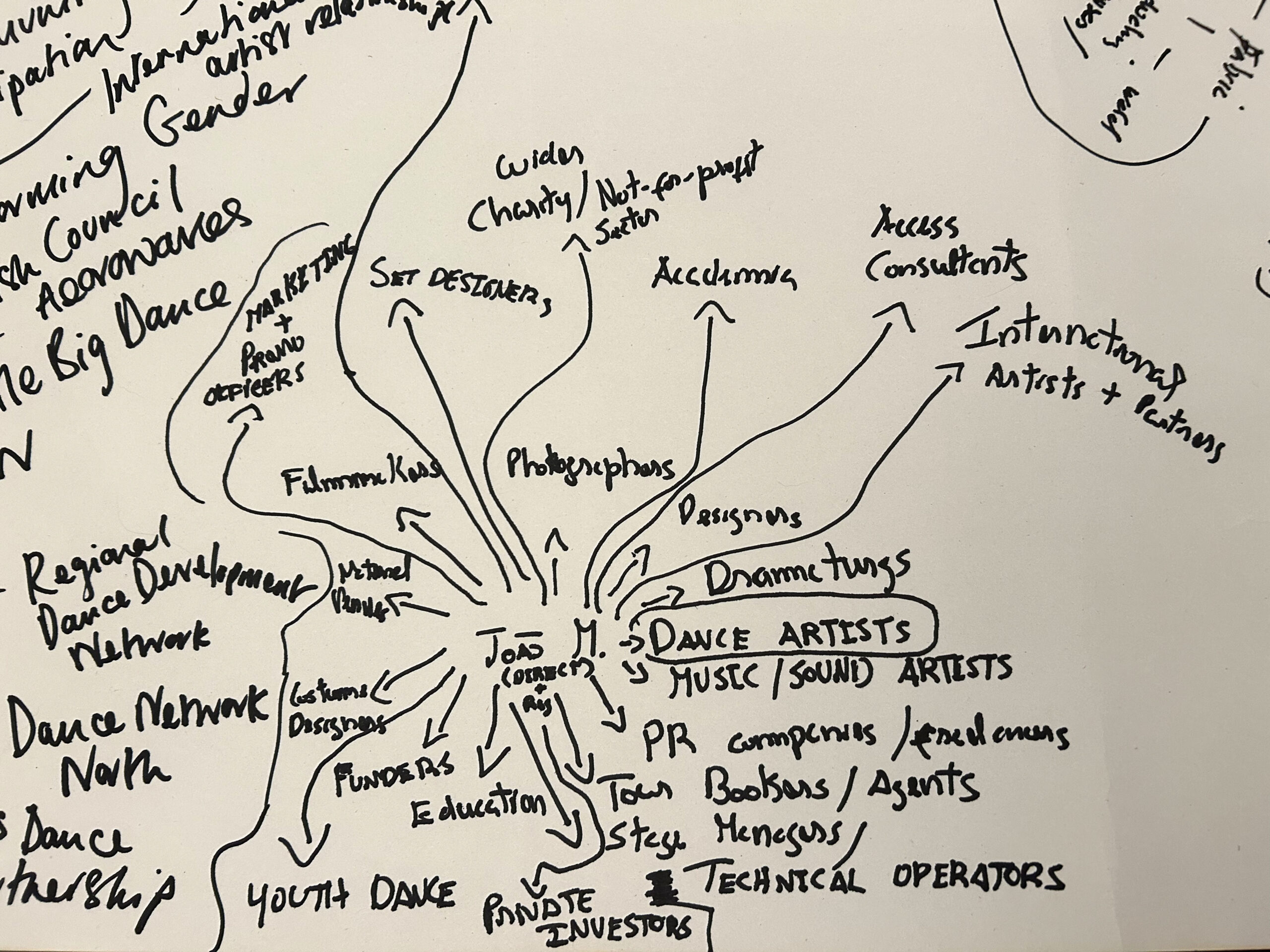
So what does a robust ecosystem look like and what does this look like for dance? Within the Producing Ecologies network, it’s clear that the dance ecosystem seems vast. From a simple mapping task of relationships, a complex web of people, places, events, projects and collaboration emerged. Amongst this lots of co-dependencies were described – ‘when I ran the space that you were in residency in’, ‘when you fundraised for the project I led’, ‘when we collaborated on research’, ‘when you employed me’, ‘when we developed that festival together’, ‘when we taught together’. It became clear that those in the network had also held multiple roles within the dance sector; dancer, choreographer, producer, researcher, fundraiser, teacher, facilitator, organiser, leader. It also became clear that many of these roles had intersected, and continue to intersect at various times, in numerous spaces and with overlapping relationships. These relationships aren’t limited to dance sector professionals but also extend to filmmakers, photographers, dramaturgs, costume and set designers and other technical roles, further extending the dance producing ecology to encompass a wider range of arts professionals.

Beyond the complexity of human relationships underpinning the work of the sector, also lies the ecology of resources required for the dance sector to continue to be ambitious and progressive. This includes research, development and rehearsal spaces, access to professional development and training, digital development and resources, statutory and non-statutory funding. When we’re discussing dance producing, nearly all of these resources begin to intersect, in the pathway from creative idea, to realisation.

Another aspect touched on, was that participatory engagement in dance with communities is increasingly critical to audience development and engagement, alongside its importance in artistic development. The shift in the way we consider and think about audiences for dance is ever changing, with an emphasis on creative people and creative communities aligned to Arts Council England’s ‘Let’s Create’ strategy, and with the increased opportunity to present work in non-conventional/non-traditional dance spaces. The community of people engaging with dance, through classes, workshops, participatory projects and often as part of research, development and co-creation practices, are therefore intrinsic to the dance producing ecology, as opposed to sitting outside it or in parallel to it.

Whilst the ecosystem can feel vast, I also think it’s useful to recognise that we are a relatively small sector. The mere fact that we hold so many intersecting relationships is perhaps evidence of this. The result can be that a negative impact in one area of the ecosystem can be felt across the whole. There are also additional challenges in a smaller ecosystem which relate to diversity and the subsequent evolution of artistic practices. As a small(er) ecology we need to keep considering new ways to expand and open up the possibilities for new thinking, new creativity and a greater diversity of artistic practice.

Hannah Robertshaw, Creative Director, Yorkshire Dance

Reflecting on the Open Forums at Yorkshire Dance

While thinking about the dance sector as an ecosystem, one must recognize the inter-dependency of the entities within it – understanding how changes to one of its parts, impact all of the others and therefore the wider ecosystem.

During the Open Forums at Yorkshire Dance, it was clear how the on-going reduction of arts funding and funding for arts subjects and courses within the Education Sector impact the wider sector, particularly artists who rely heavily on arts funding and income from working in Education settings to have enough financial ‘sustainability’ to enable them to continue to develop their artistic work.

Through the generous contributions of independent artists to the discussion, it was clear that the dance ecosystem is partly sustained through the low-paid work of young dance artists having to continuously secure short-term engagements that offer no financial sustainability or prospects of career progression.

Some artists articulated strategies around the above, including decisions as making their income from work in other sectors to allow them to demonetise their artistic practice, recognising the advantages both to their financial sustainability and to the development of their artistic practice with integrity.

Other independent artists underlined how the cost-of-living crisis, the highly competitive arts fundraising landscape and the decline of arts subjects and courses within the Education sector have impacted their lives. It was clear that the challenging landscape artists operate in contributes to the on-going loss of experienced and specialist talent in the dance sector, due to the negative impact on their finances and wellbeing.

Despite following the same structure, the two open forums felt very different. The first open forum included academics, directors from dance organisations, creative producers and administrators and second group was made up of independent artists.

Independent artists responded to the same prompts in a very different way, often referring to their lived experiences of the sector and how those impacted their livelihoods and careers. This meant that the conversation with this group had higher mental and emotional strain and felt more urgent and less of a conceptual exercise in opposition to the previous open forum with a group of academics and creatives in salaried positions.

Independent artists identified how triggering these conversations are, further evidencing on how the changes to the dance ecosystem impact their livelihoods directly and acutely.

The analogy in between the current dance ecosystem in England and the desert kept emerging and it made me wonder: as resources continue to disappear, will artists be the first ‘species’ to go extinct?

João Maio, Artist Development Producer, Yorkshire Dance

Dancing Ecologies

A few notes following ‘Opening the Space’ with freelance dance artists at Yorkshire Dance, Leeds, November 24th 2023

In the lead up to the network gathering at Yorkshire Dance in Leeds, Steffi, Chris and I had meet to design the sessions. As our first open session we were keen to leave plenty of space for playful exchange, visualising and reflection as a basis of understanding artists perspectives on our questions.

In seeking to manifest and discuss various aspects of dance ecosystems we sought to address:
Who are the key agents and what are their relationships? What are the qualities of connections between agents? What sustains or disrupts these relationships?

What feeds into and drives our ecologies? What are the landscapes in which our ecosystems are operating?

The 2 hour workshop with the Leeds based dance artists began with a very (very) short statement about ‘ecologies’: The simplest definition of an ecosystem is that it is a community or group of living organisms that live in and interact with each other in a specific environment.

Plus a couple of notions about dance / performing arts ecosystems:
Ecologies are not already there, ecologies must be performed. Flat ecology is thus about a positioning within a power field, diagramming and scoring possibilities that can be enacted, having in mind posthuman justice, which is at odds with modern, capitalist, colonialist, and imperialist world-making projects that perpetuate domination of life. (Nikolić, PhD Submission)

The arts ecosystem is ‘a self-organising, intricate, dynamic network of numerous agents looped together, competing for but primarily sharing resources, mutually evolving and responding to emerging innovations, and without a governing consciousness.’ (Gallasch, Art in a Cold Climate: Rethinking the Australia Council)

Ecological thinking in this project seeks to enable us to take note of the physical and social ‘habitats’ in which we seek to make, study and produce dancing. It helps us recognise the features, atmospheres, connections and disconnections of how dance, dancing and dance research meets ‘the world’. What are the social structures, creative and regulating practices through which we activate dance?

I am interested then in the patterns, threads and shapes our dance ecology: How are they are shaped, what makes some threads more or less robust, what are the characteristic’s of our ecologies? In asking these questions, and in seeking to understand shapes, the questions are inherently political in nature.

The session is divided into a series of short tasks, the first of which seeks to open up a shared understanding of ecosystems.

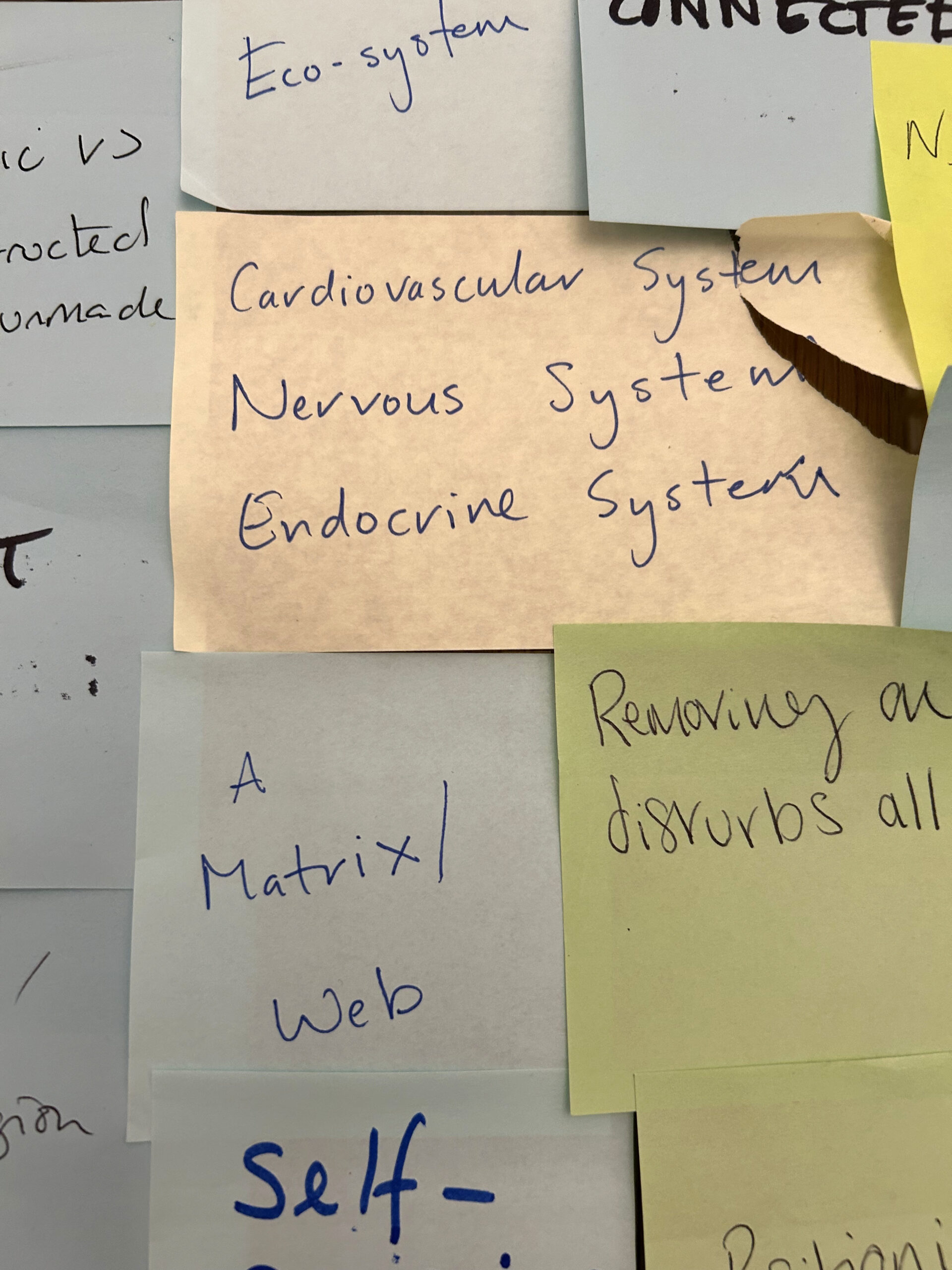
TASK: Collecting terms and resonances: Use the chat function or sticky notes to list terms or ideas that in any way come to you in relation to the notion ecosystems or arts as an ecosystem


Sticky-notes capture ideas and lists of words are made:

Relationship
Friendship
Interdependence

Evolving
Changing
Movement between
Oscillation
Cycle
Seasonal

Agency
Dialogue
Communication
Performed
Bodily
Fascial
Mycelium
Nurturing
Care
Collaboration

Self-governing
Pragmatic coalition

Resources
Funding

Crisis
Fragile
Instability
Tough
Hardship

In my grouping of words above I’m struck by the largely generative nature of many of the words – the sense that ecologies arise in co-formed ways and that they are also (always) changing. I wonder as the session continues about the last set of words – from Crisis to Hardship – and the extent of agency that is or isn’t possible by independent dance artists in these ecologies and how spaces are made for the increasingly wonderfully particularized approaches to dance practice.

The next task opens to the dancer’s experience and places the emphasis on how individuals interact – opening us to a discussion as to the landscape in which these interactions take place.

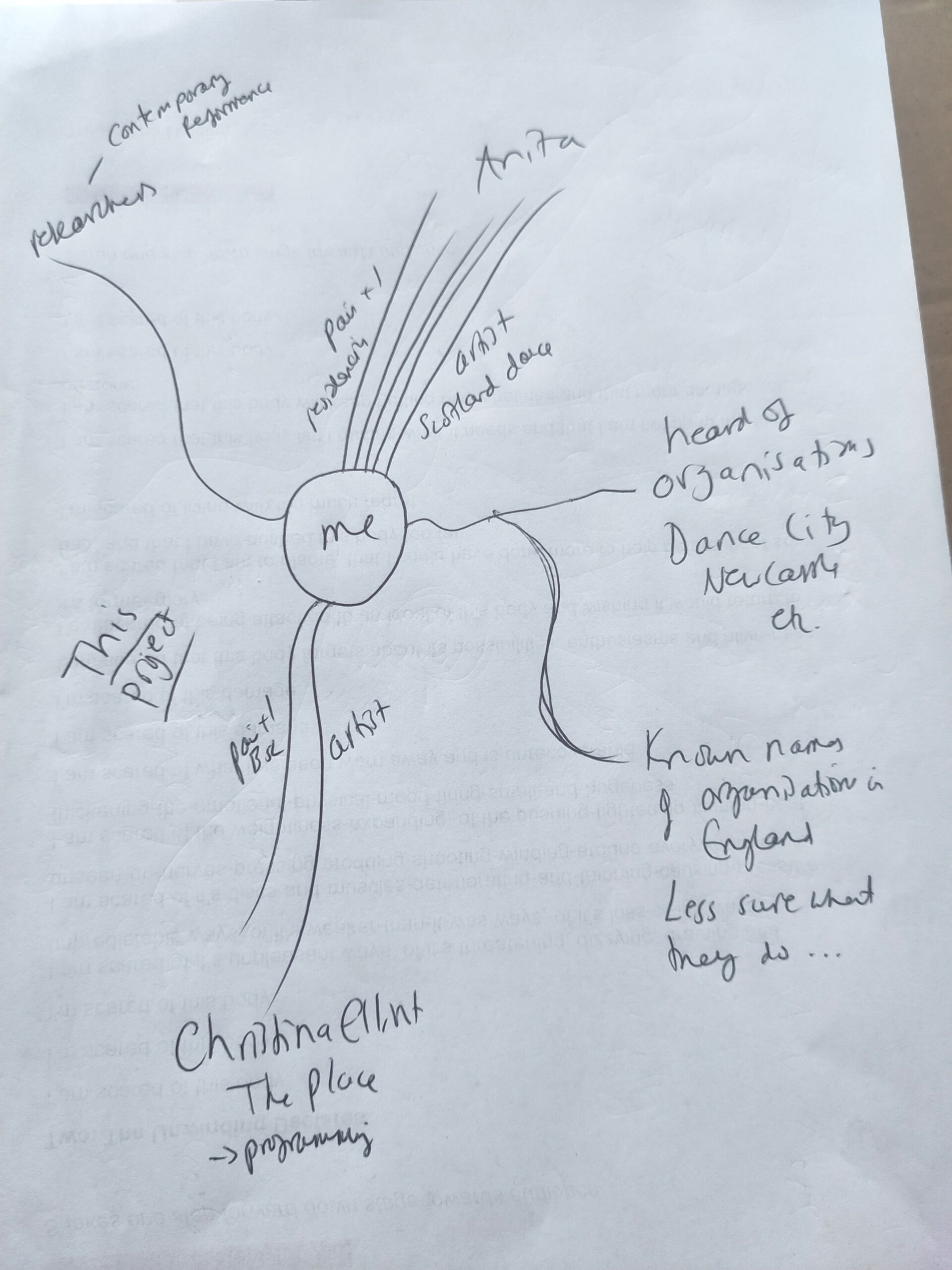
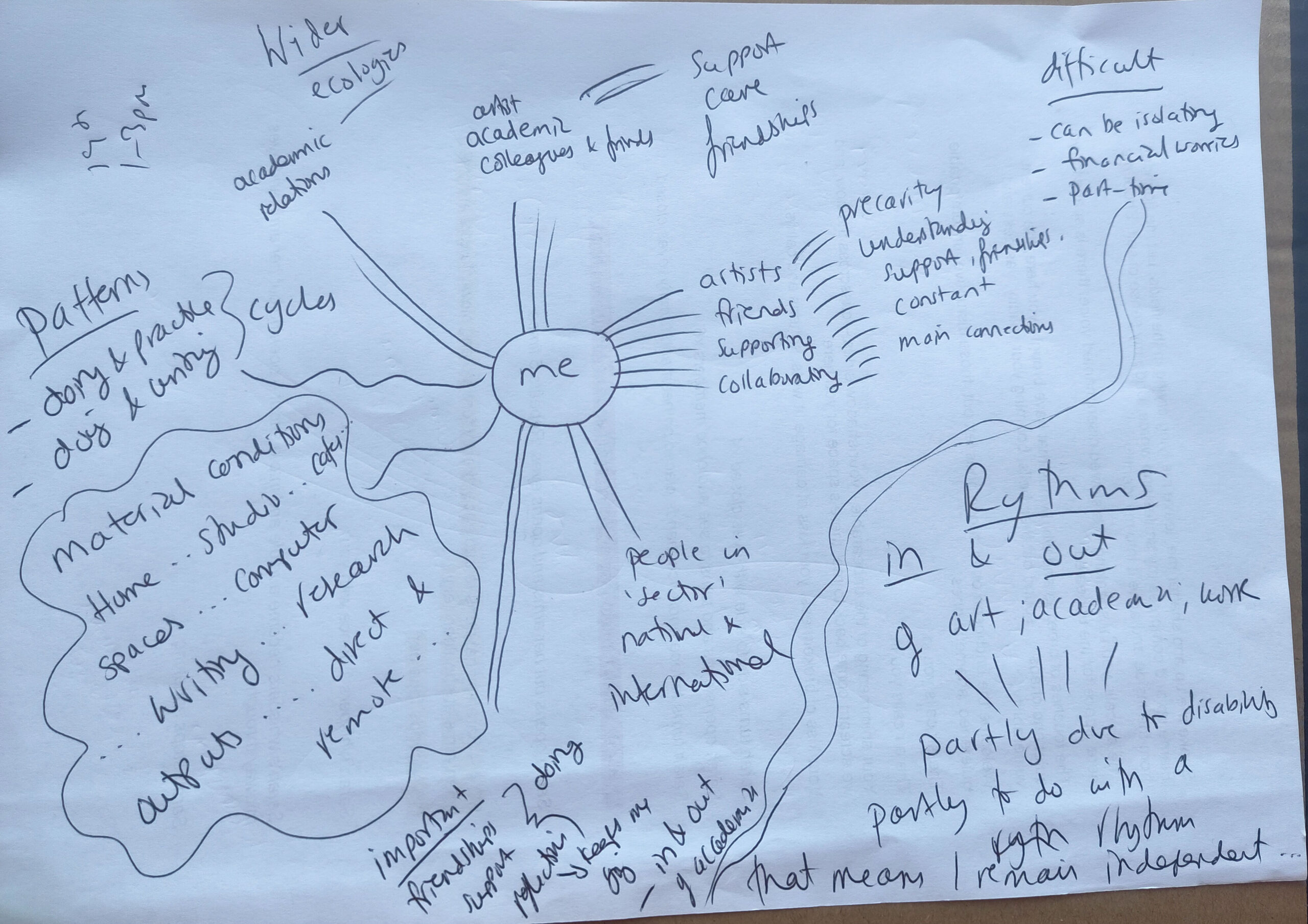
TASK: Visualise ecosystems in which you work: Map the systems through which your work operates.
What resides in your ecosystem? What is close/distant? What shape, rhythms, patterns or pulses does your ecosystems have? What are the characteristics of the material and social context of your dance ecosystem? Is the ecosystem in movement? What is important/difficult?


Words and images appear across large sheets of paper. Threads of connection, trees, plants and structures, columns and spirals, roads and maps.

roles (teacher, facilitator, researcher, producer)
activities (from performing, to making, to teaching, to producing, to shows, to touring), different types of practice (somatic, film, yoga, coaching),
venues and institutions (school, arts, galleries, HEI’s, NHS),
funders, communities and participants, research, collaborating,
working with partners and networking, commissions and funders.

Webs meshed and intertwined – patterns that allow a dance artist to exist in patterns that strive toward healthy balance and for self-care, yet these ideals sit in contrast to the striving to access resources to live, to dance, to facilitate creative practices in meaningful and sustainable ways.

I wonder when listening about how metaphors are. The landscape feels like a desert – but like all deserts a rich life is still present, even if often hidden, specialised and adaptive to the environmental conditions.

Vida Midgelow

Opening the Space – 1 at Yorkshire Dance

24 November 2023

One key aim of our network is to build stronger relationships between HE and the arts sector both through discussions between the members and by reaching out to include those who also have a place in the producing dance ecosystem. This approach also allows us to use a relationship-building strategy which suits our focus on practice – we create a network built on strong relationships by working together, and by reaching beyond the network members to take the ‘temperature’ of the wider dance sector.

We started this process by working with Yorkshire Dance on a day divided into two sessions, the first with Network Members, followed by a gathering of artists from across the region and joined by those online.

The work at this point takes the form of a scoping exercise – one which begins with almost no literature and little in the way of publicly available records that might offer insights into the current state of the art. But even at this initial stage we hope to make a meaningful contribution by making more visible the work of our arts partners, hearing the voices of the sector and gathering evidence of the trends that are emerging.

The day at Yorkshire Dance was lively, as the documentation which follows reveals – and the focus on the voices of the artists provided an important perspective for our work. Thank you to everyone at Yorkshire Dance and to Rachel Krische from Leeds-Beckett University who worked to make it happen.

Please follow our investigation over the months ahead and please also add your perspective, thoughts and comments.

Professor Christopher Bannerman

Introduction

The process of writing and submitting this application to the Arts and Humanities Research Council (AHRC) meant meeting the deadline of mid-March 2023 and starting work in October 2023. We were virtually certain from the outset that the impact of the challenges we identified were continuing and that turbulent times were coming. And unfortunately, so it has proved, with both the Higher Education and Arts sectors facing potentially existential threats from socio-economic headwinds, prevailing discourses and instability in the political space.

In essence our proposal is simple: we in dance need to bolster and formalise connectives between higher education and the cultural and creative sectors in terms of the currently deeply interwoven, but largely undocumented ecologies we inhabit and represent.

Our focus on producing dance is designed to focus attention on those who are best placed to address the challenges and identify new pathways and opportunities for the dance sector as a whole. This goes beyond the professional roles and related ‘producer’ job titles, to reveal how producing might be seen as central to the dance ecosystem, vital for sustaining artists and creative and embodied knowledge generation, and thereby extending and reframing understandings of practice-research to include many ways that dance reaches and engages a range of audiences.

Producing, taken conceptually and holistically, encompasses multifaceted processes of making things happen, of negotiating across constituencies to bring something into the world, of discovering, revealing and activating learning and new insights in, about and through dance. Producing also encompasses the creation and curation of meaningful engagements across a range of contexts that address broader social and cultural issues of equity and inclusion.

We plan to address another important absence in these turbulent times: there is no road map to sustainability, or model for even understanding the dance producing ecosystem despite the urgent need to consider and evaluate emerging developments to promote resilience and renewal. By encompassing a diverse range of dance cultures and research practices, we seek to identify new opportunities for the professional dance sector, to expand approaches to future dance research, to inform policymaking for dance and to demonstrate an ecosystem that is inclusive and dynamic.

These are ambitious aims in particularly challenging times, but we hope to hear your voices and to make a difference.

Professor Christopher Bannerman