

The ArtsCross London 2026 Blog which follows is now presented chronologically as an archived blog narrative.


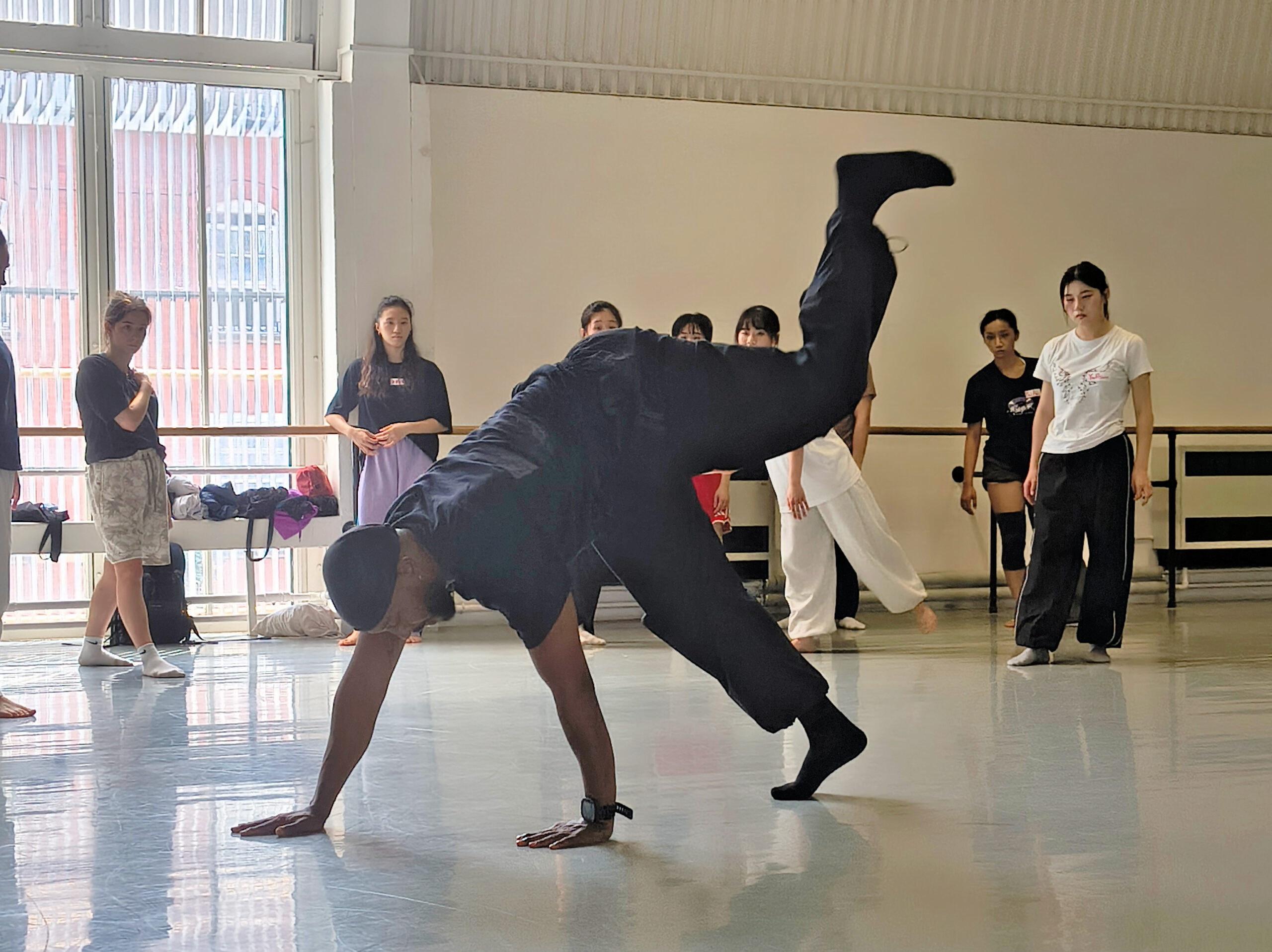
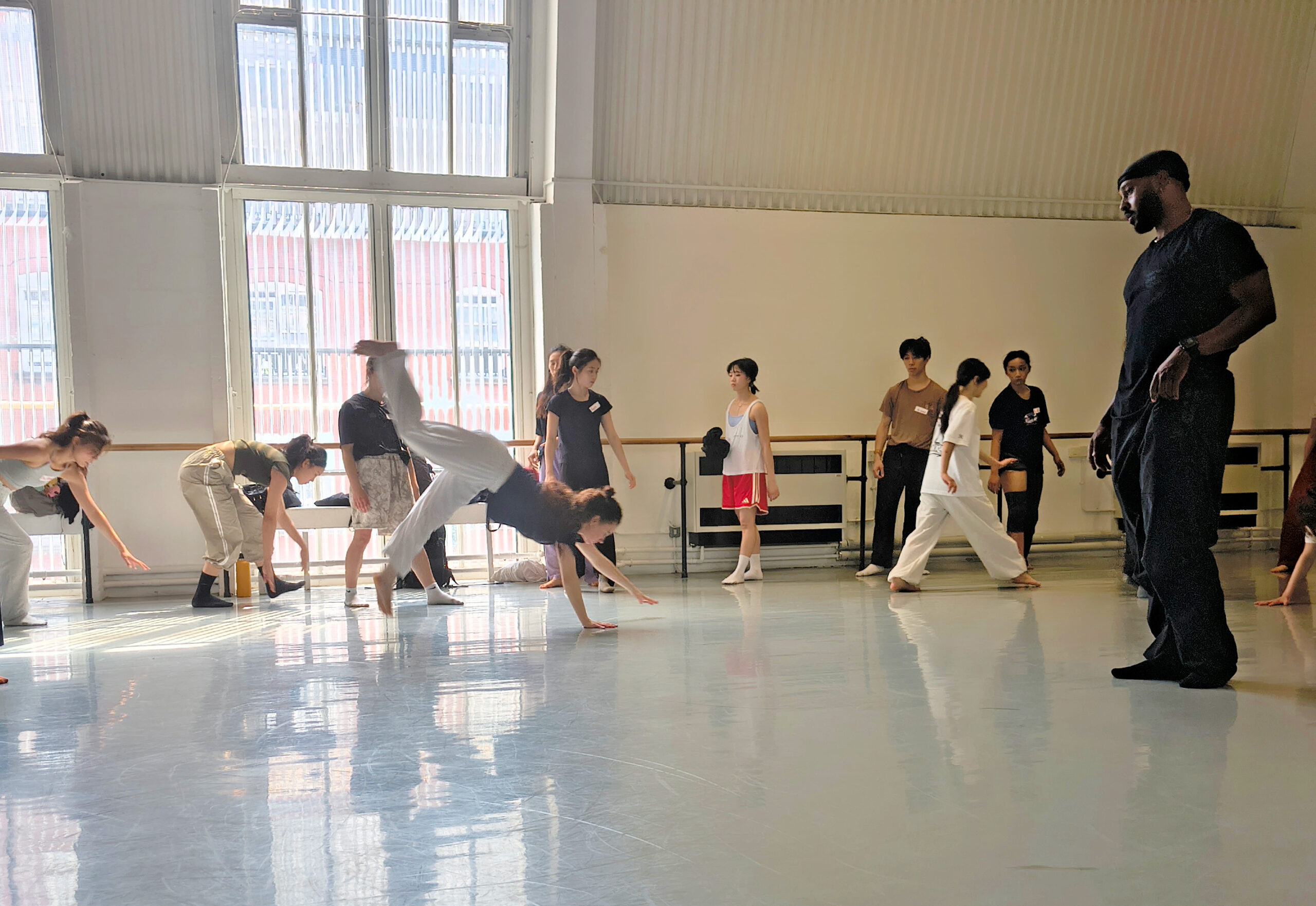

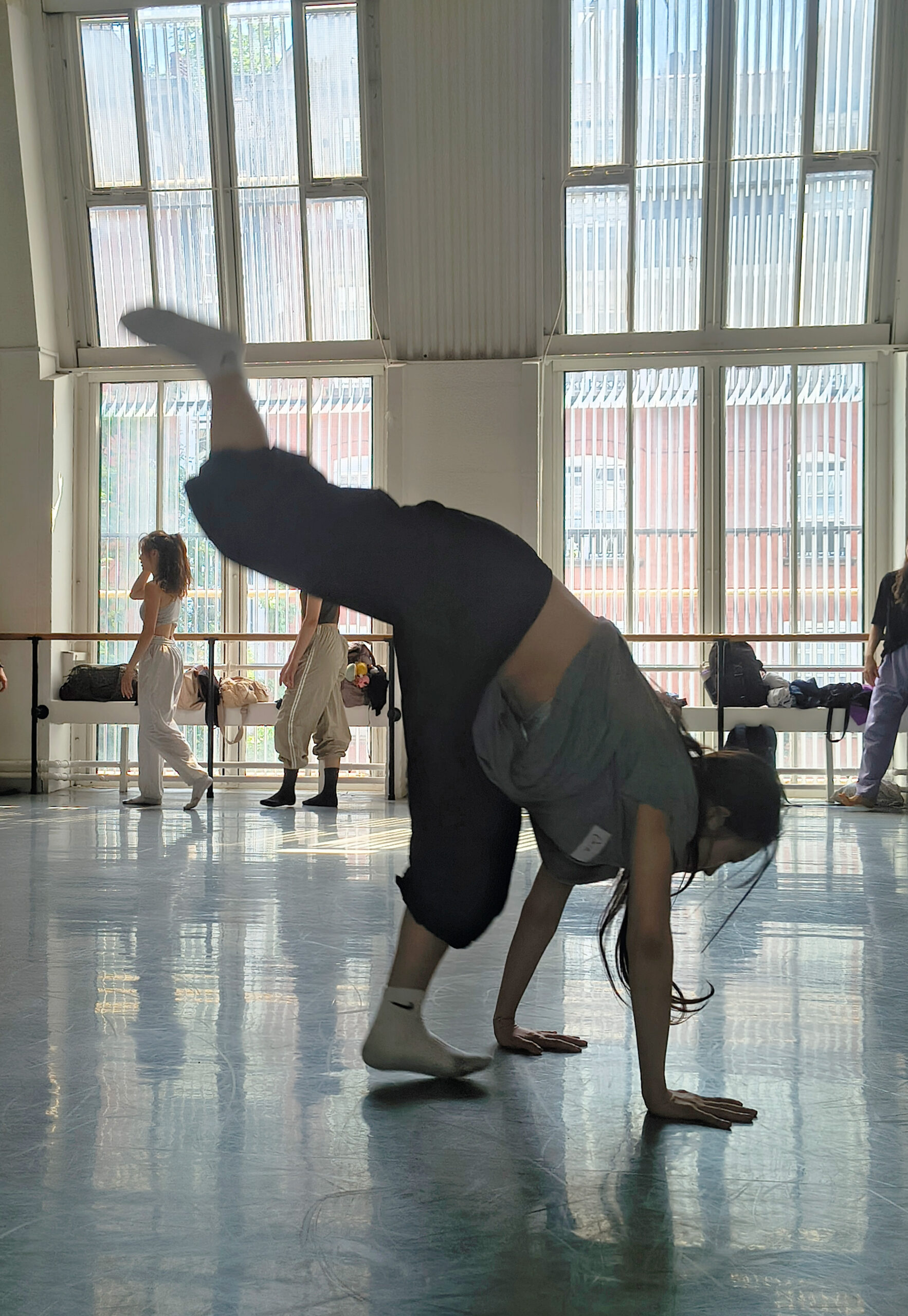
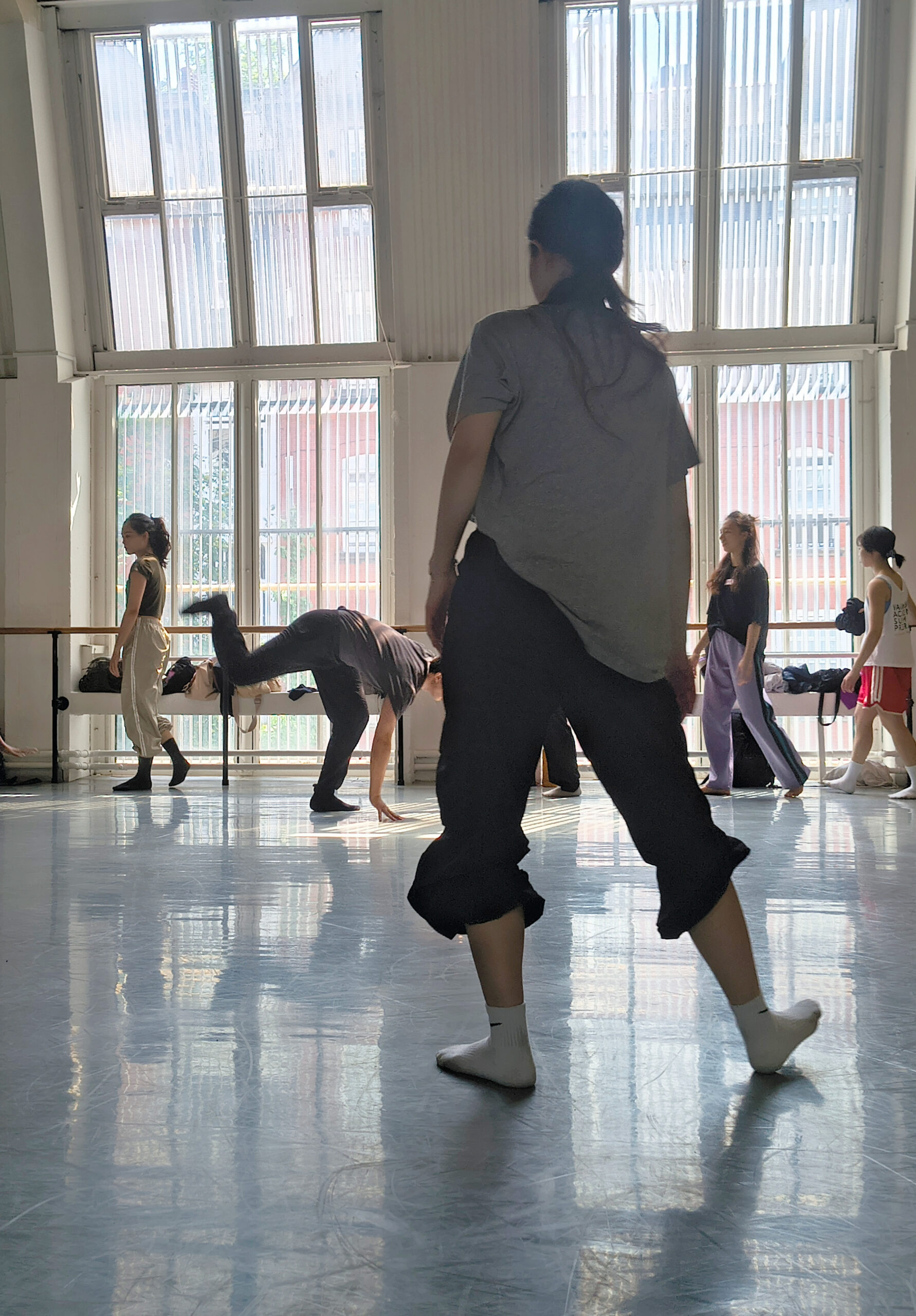


22.06.2026 Dancer selection
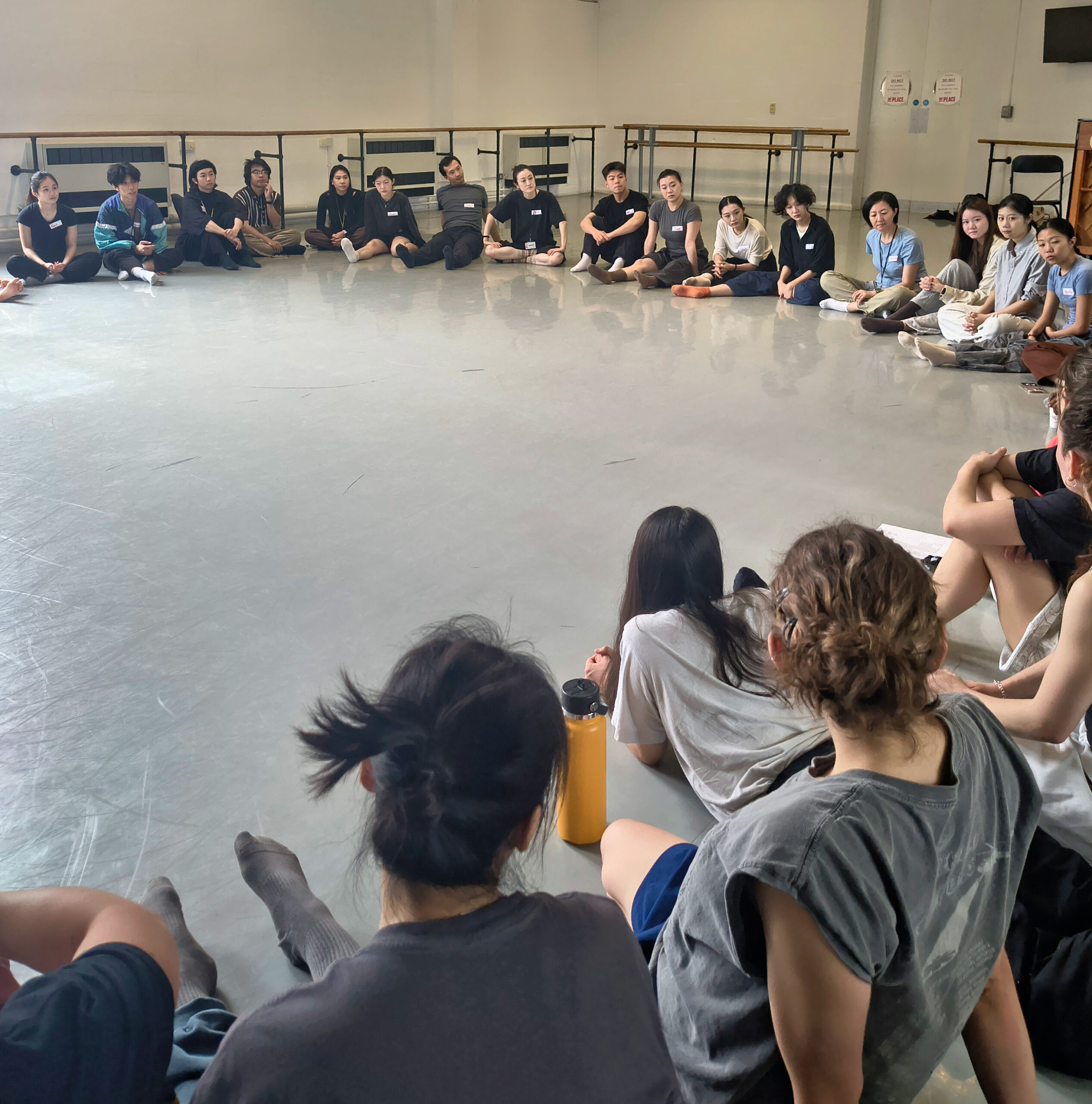
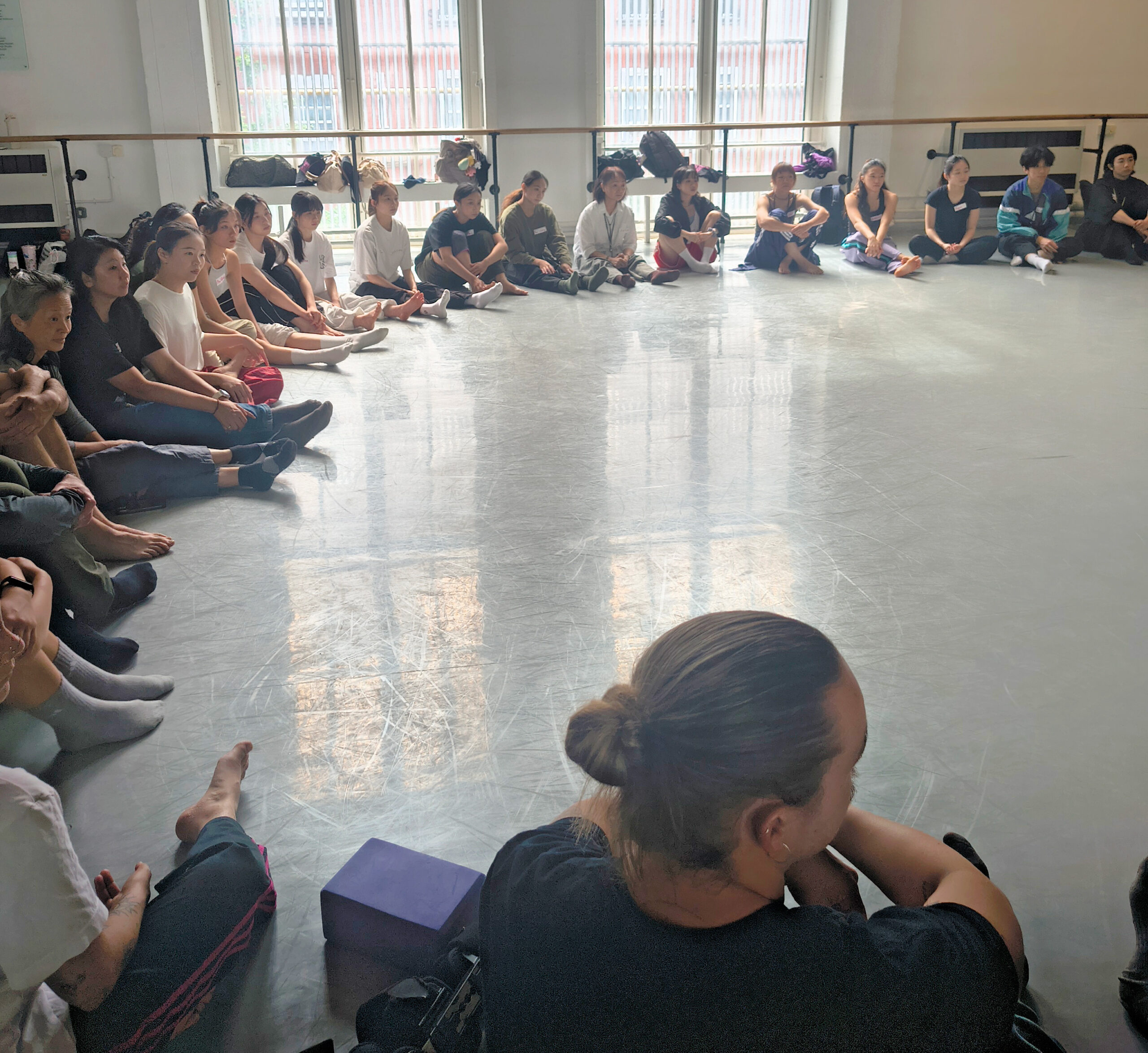
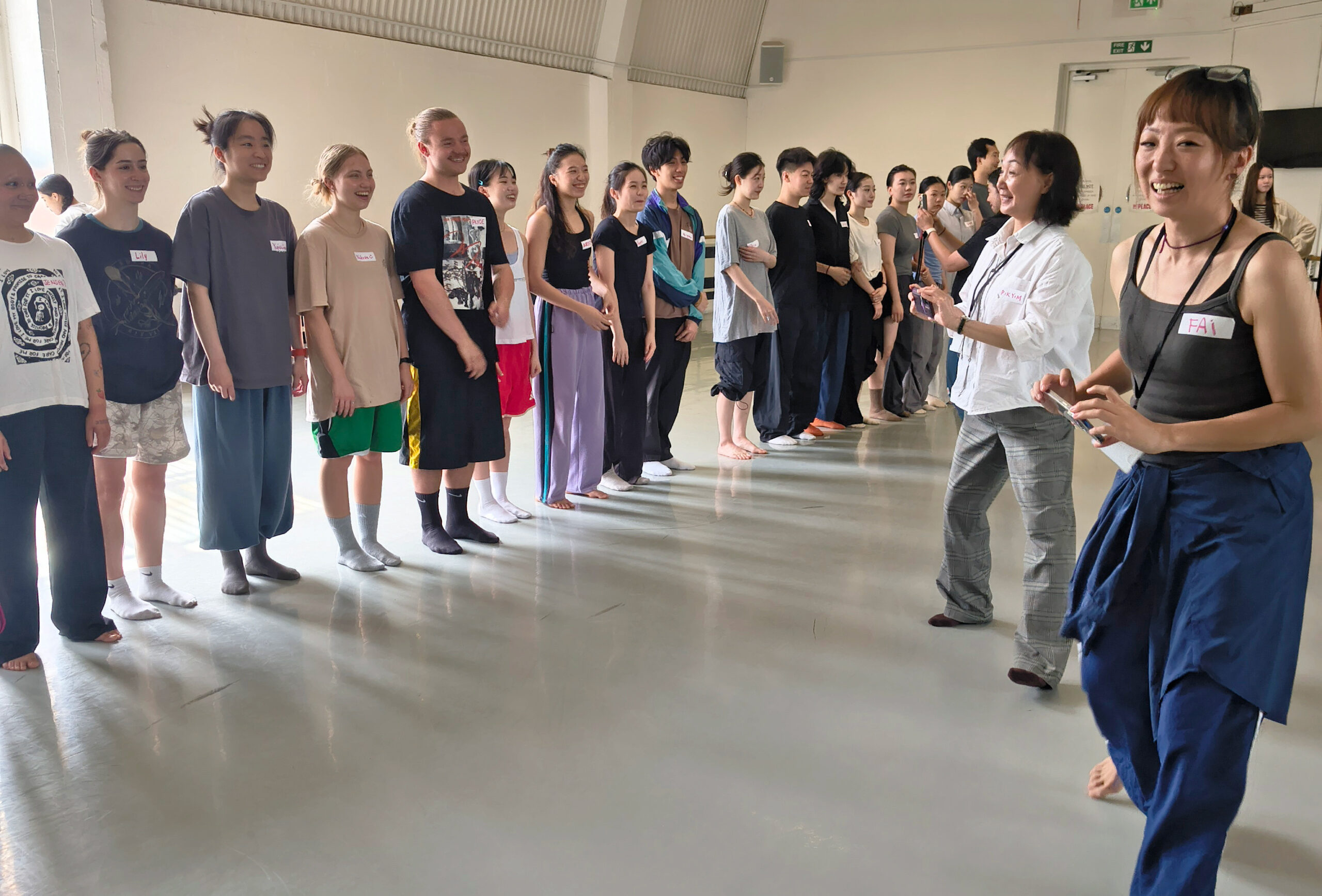
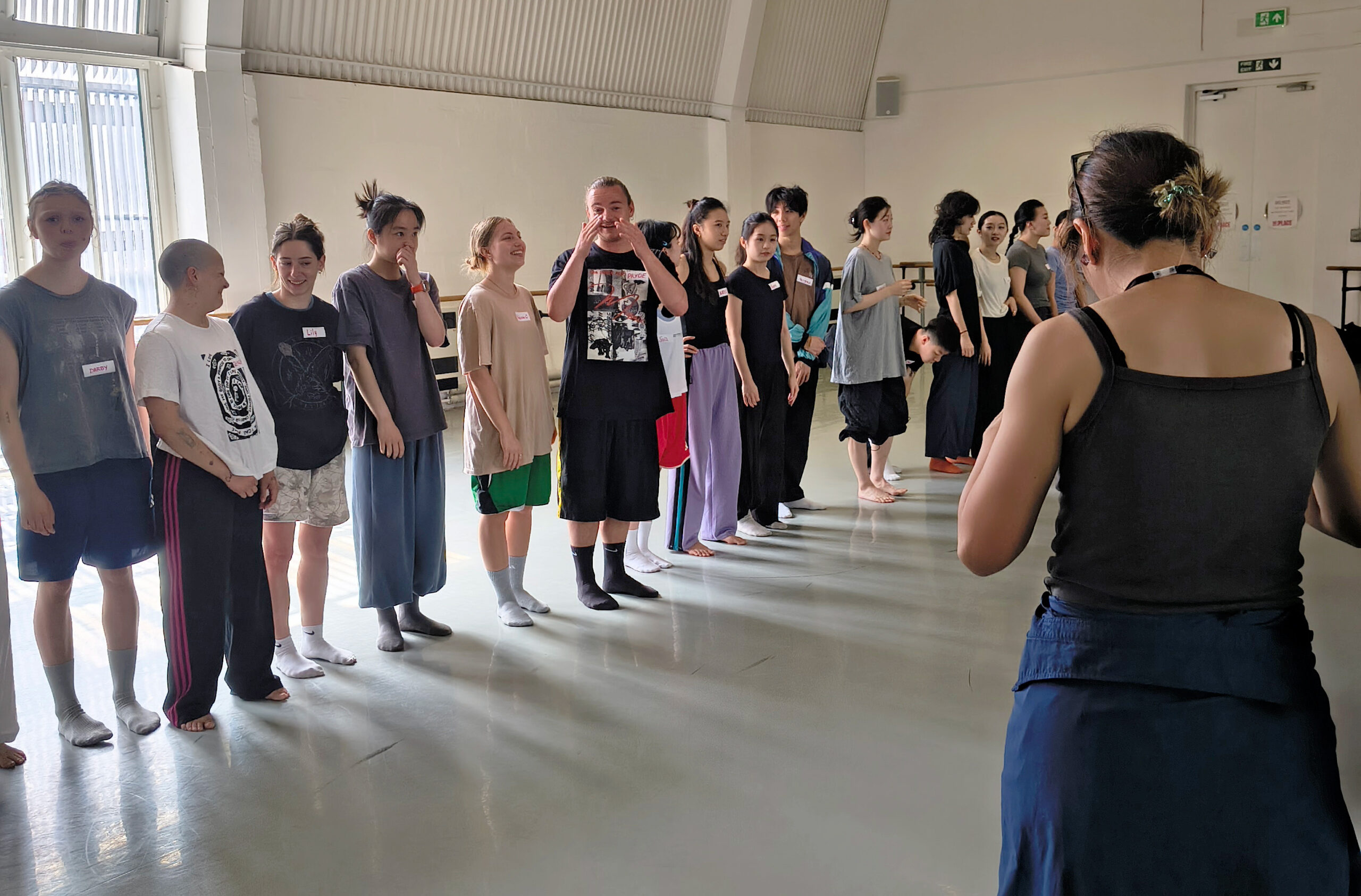
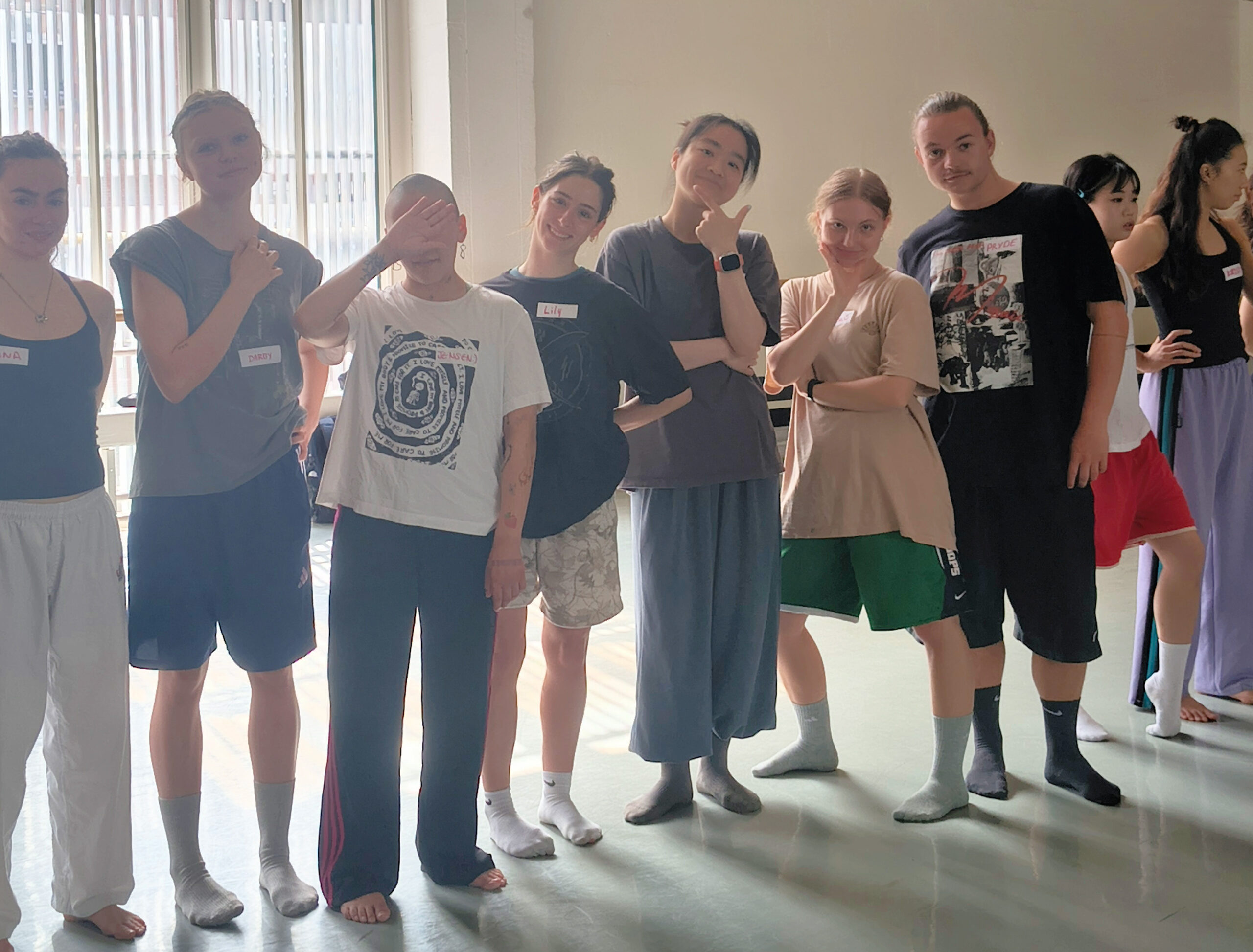
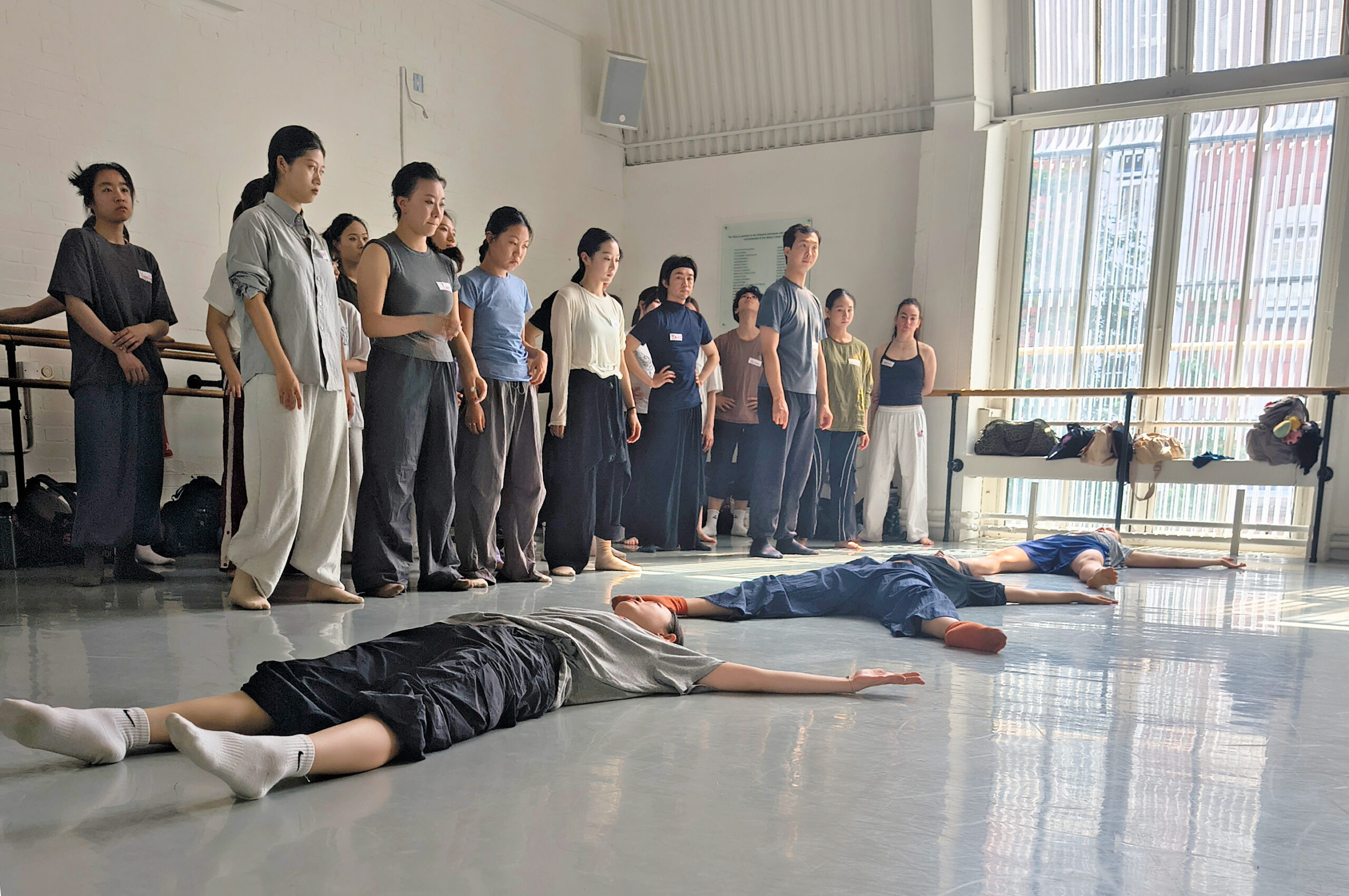
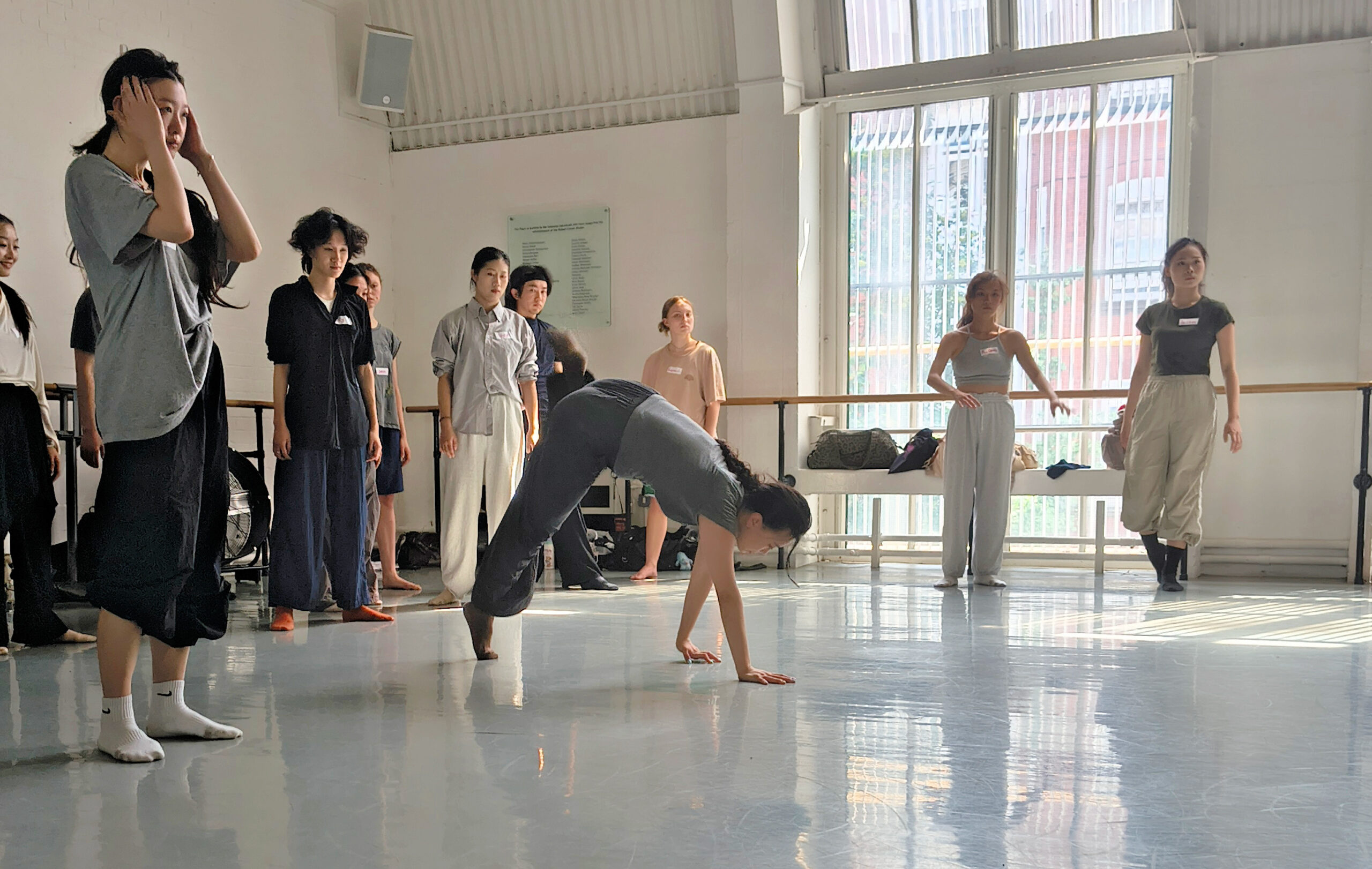
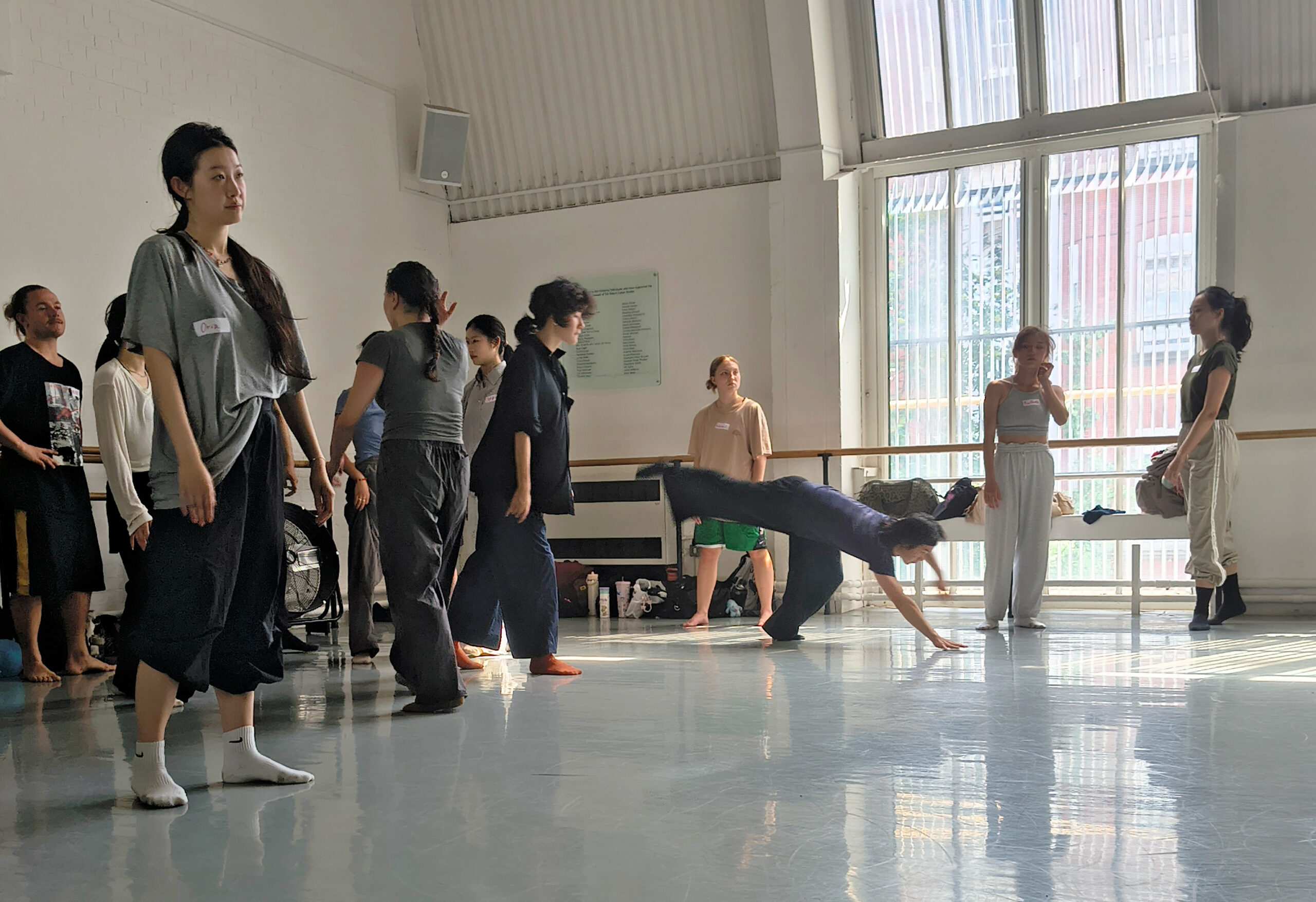
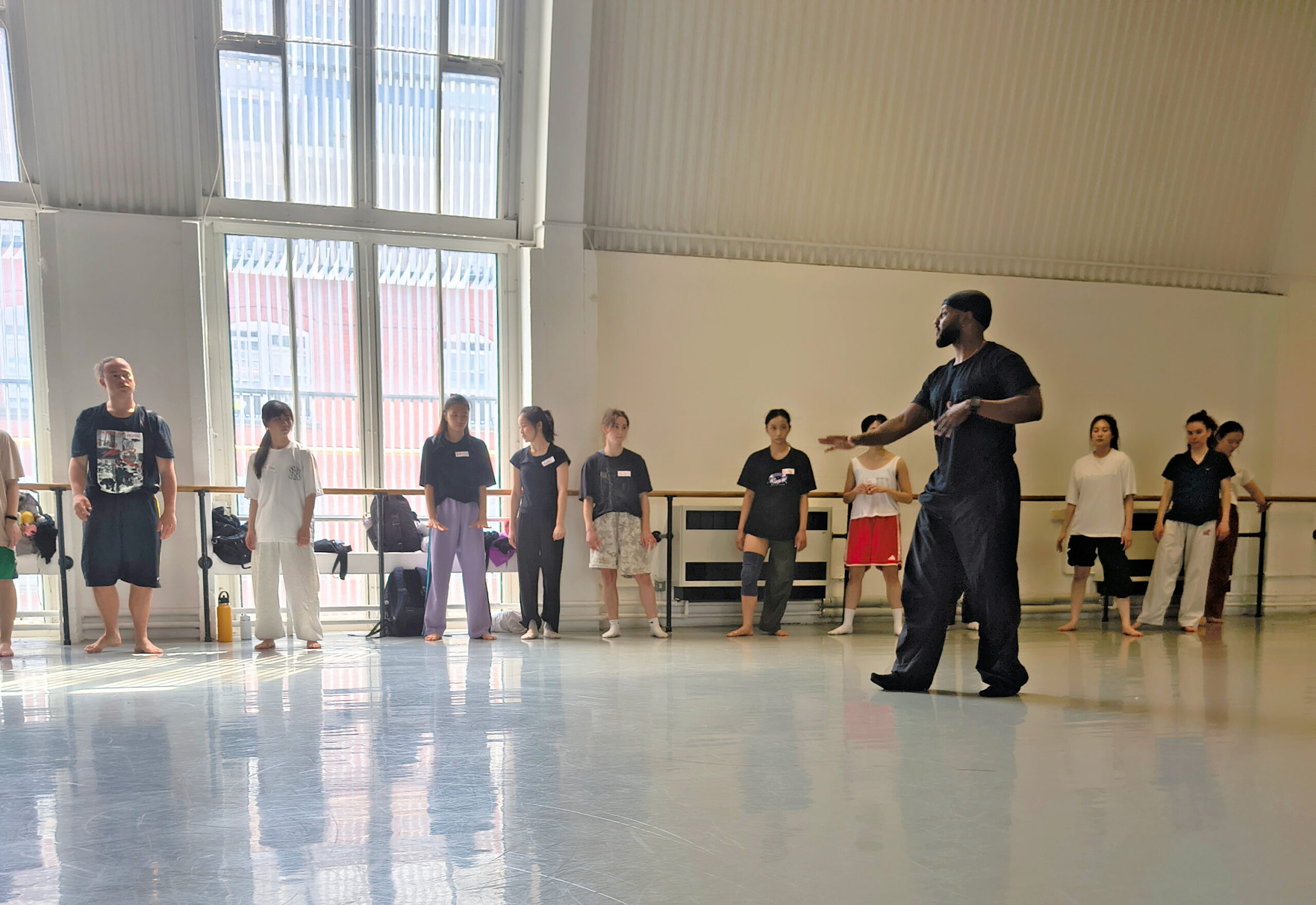
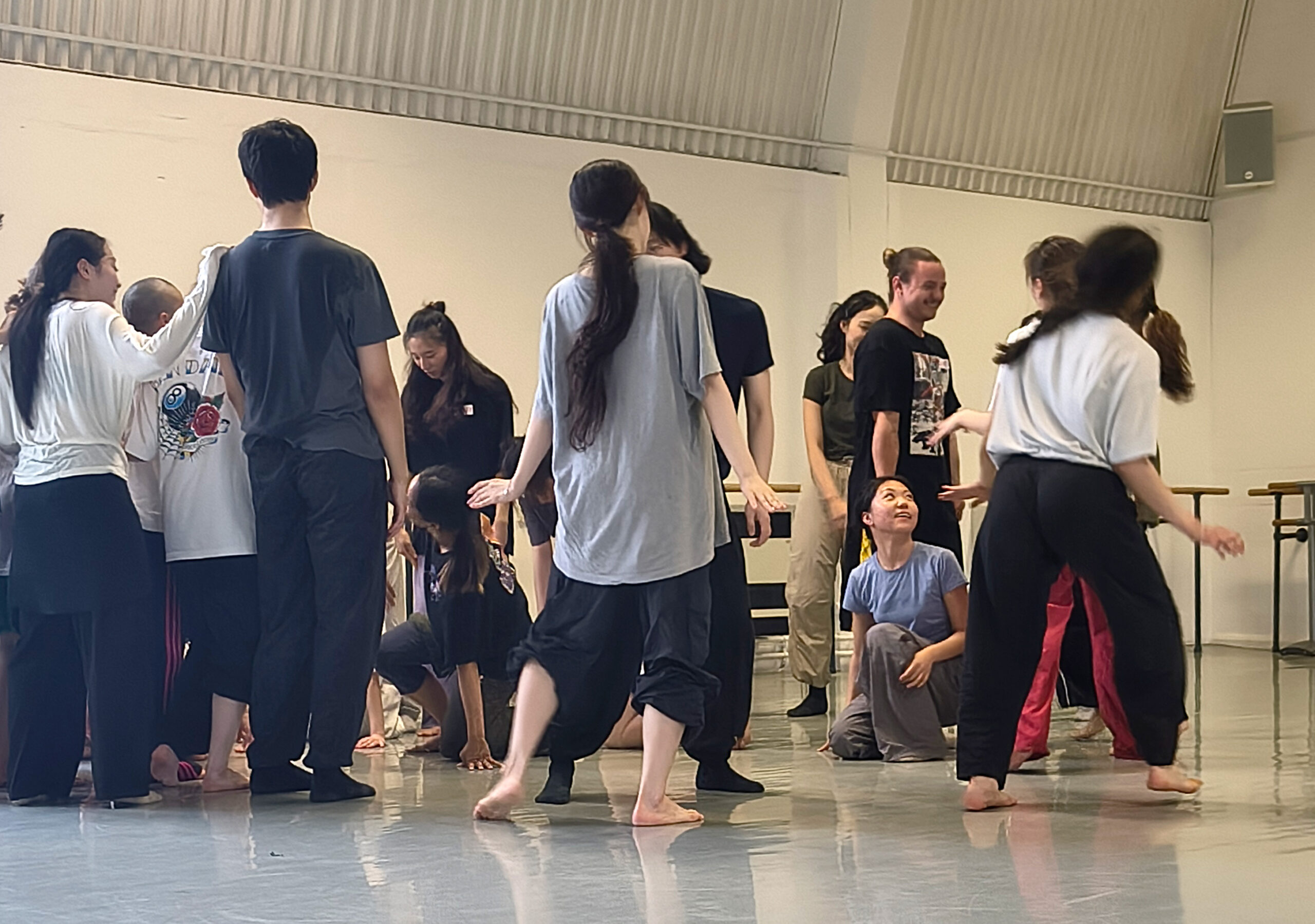
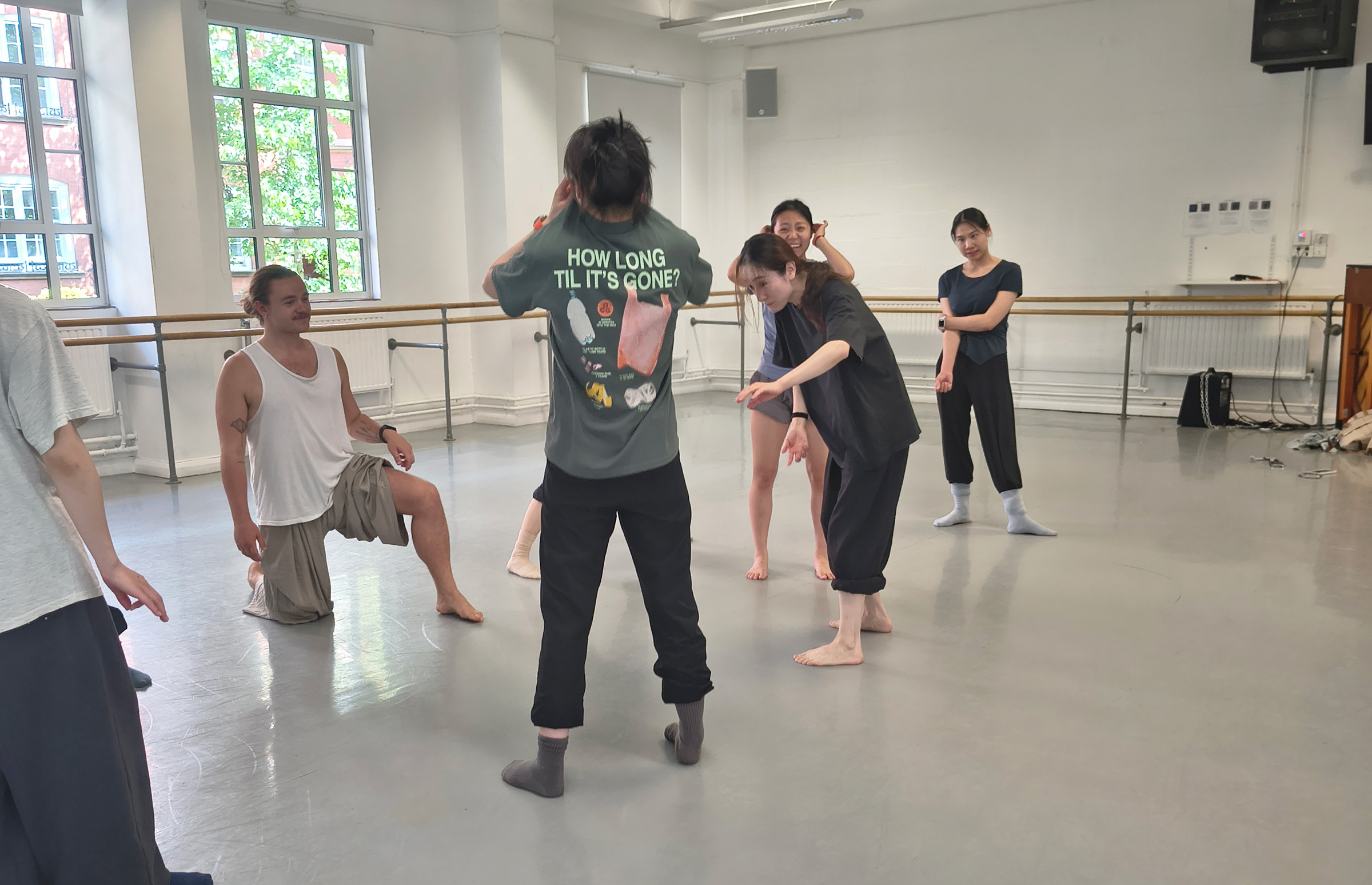
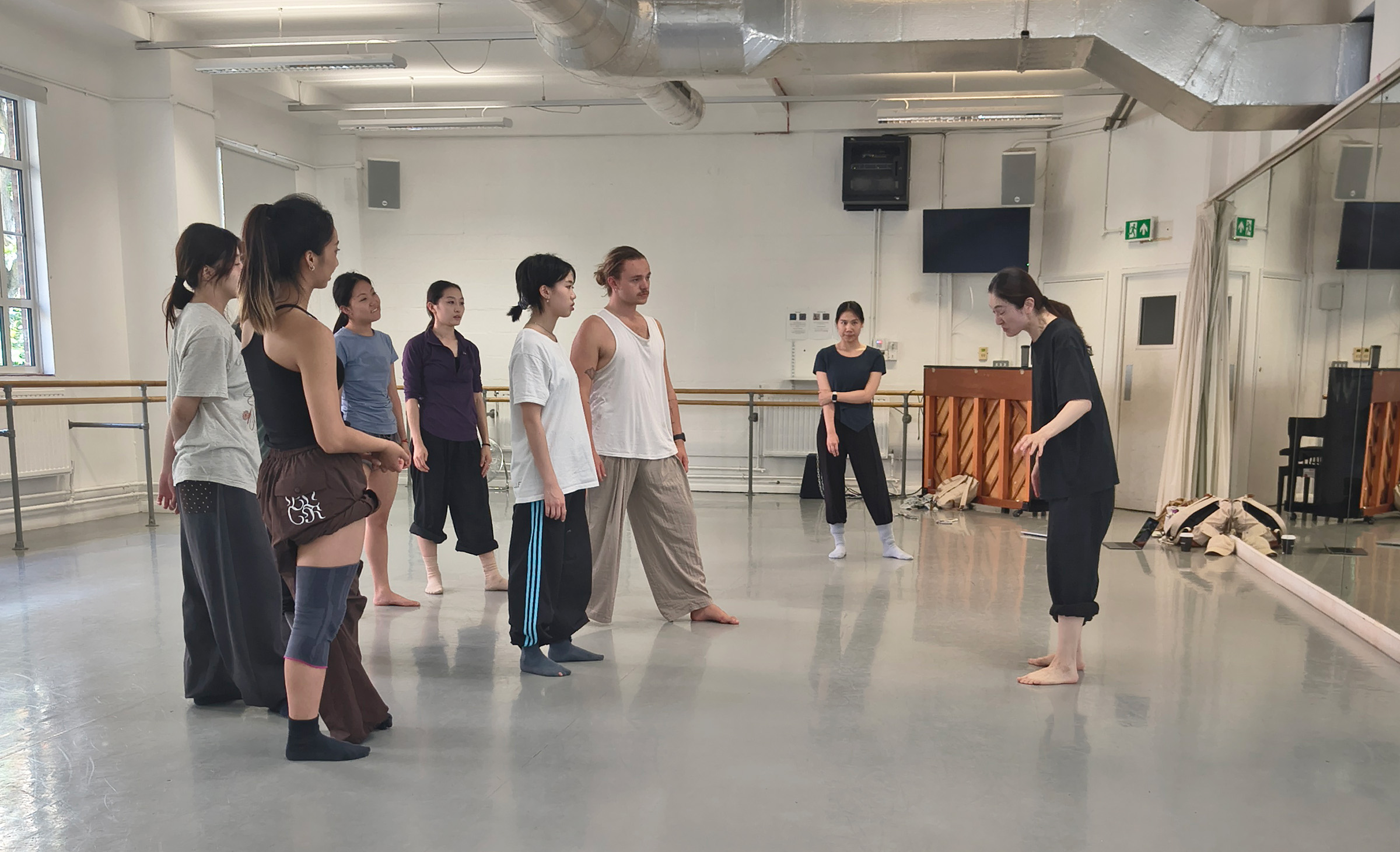
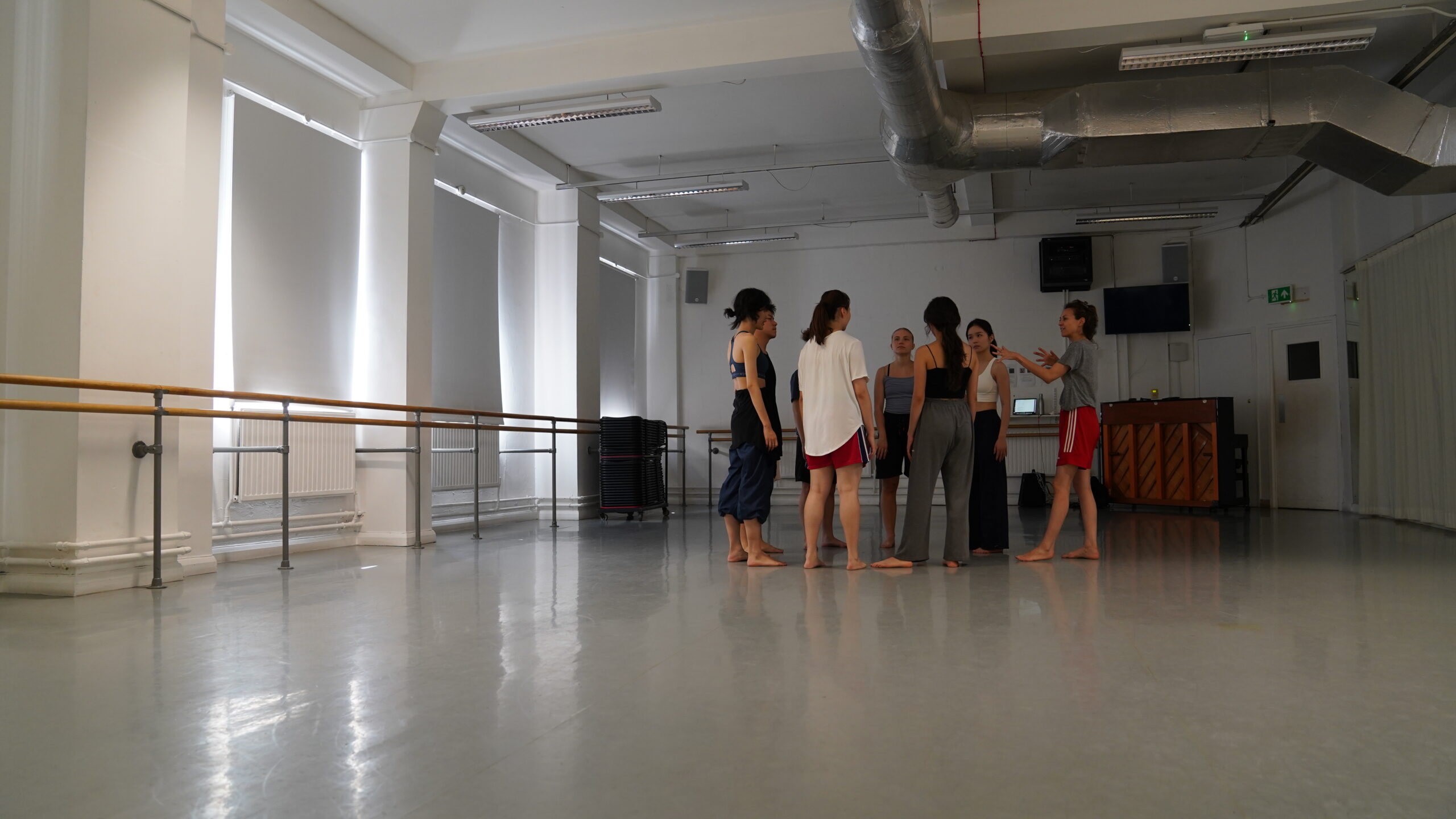
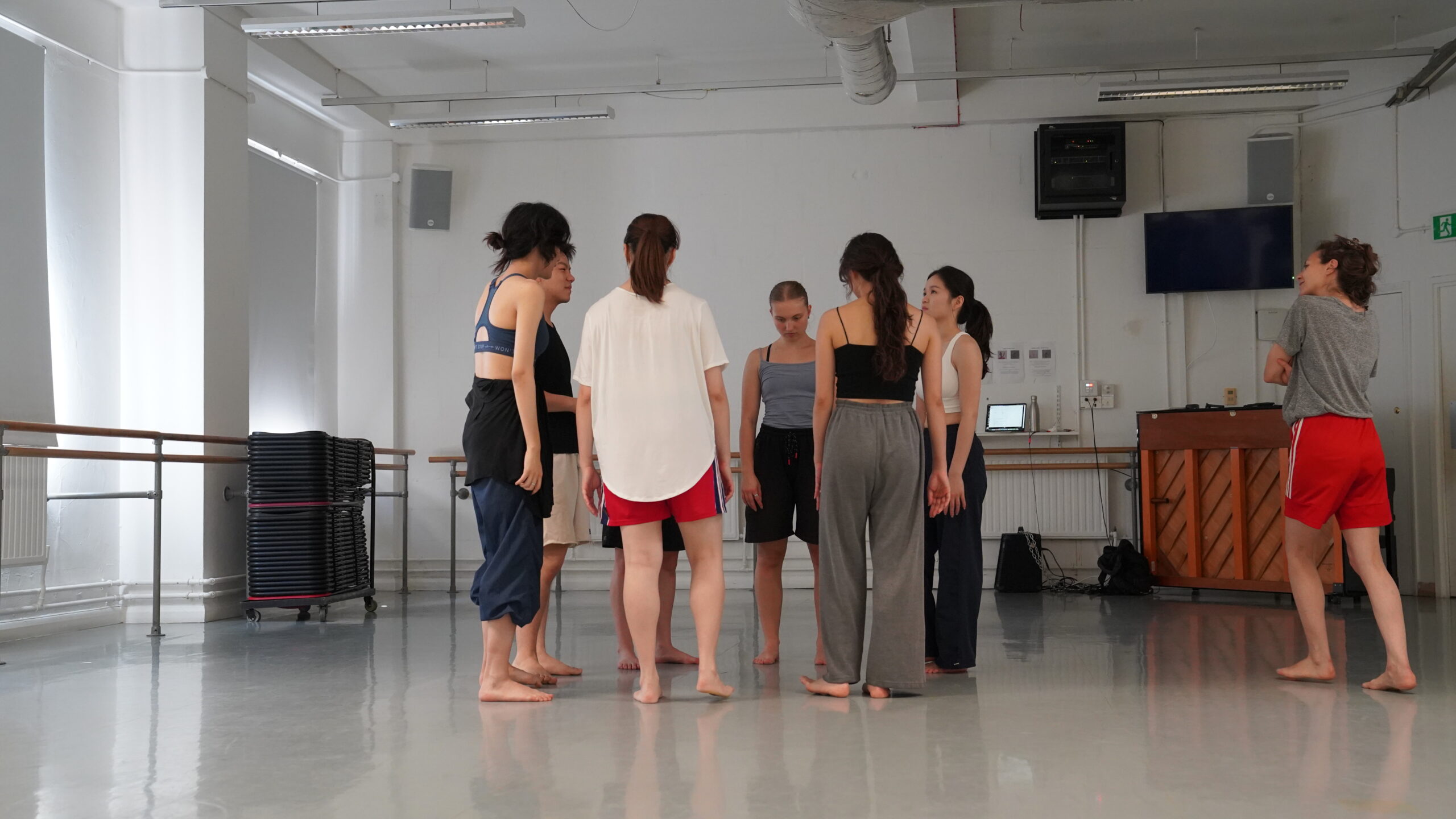
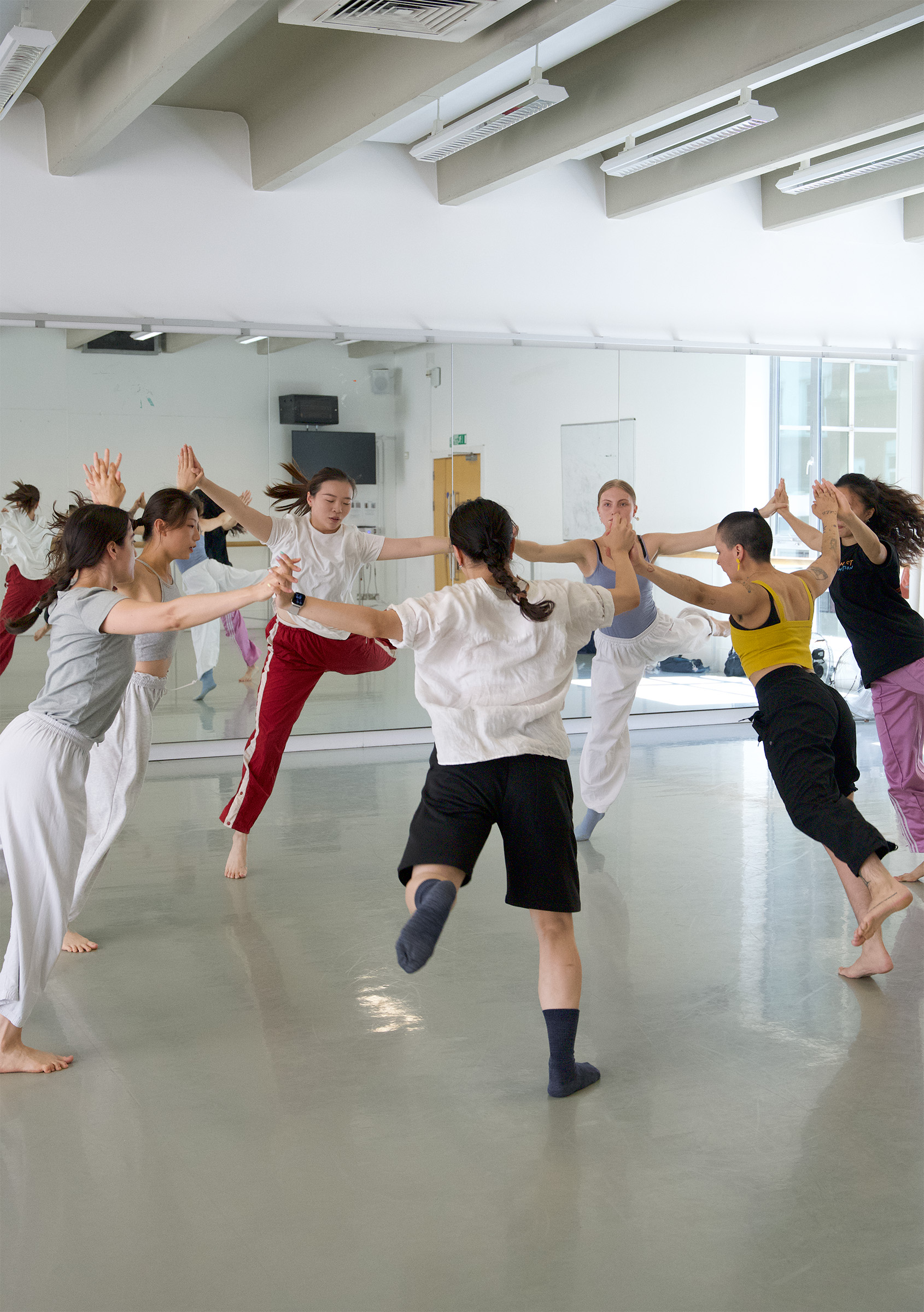
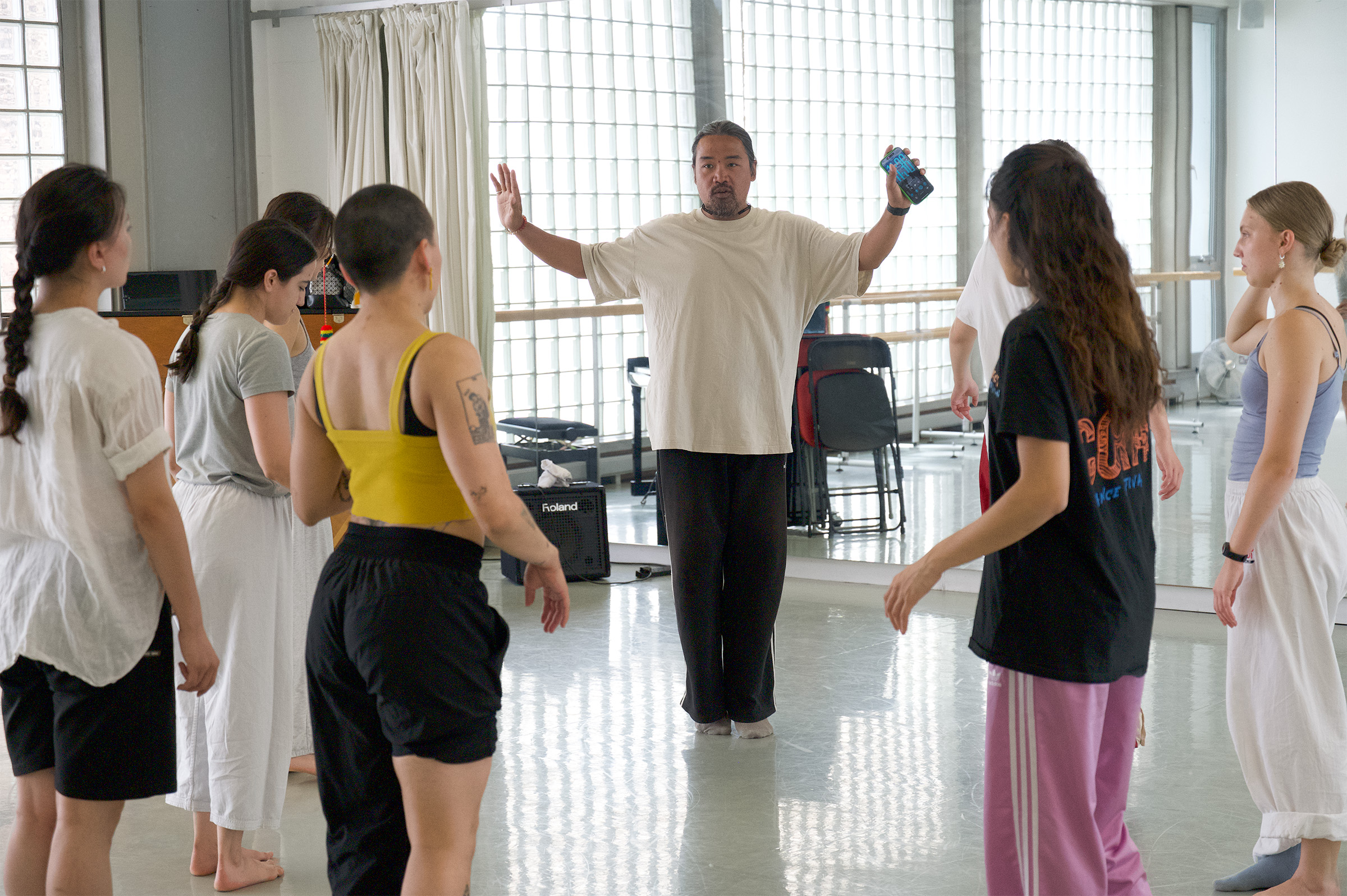
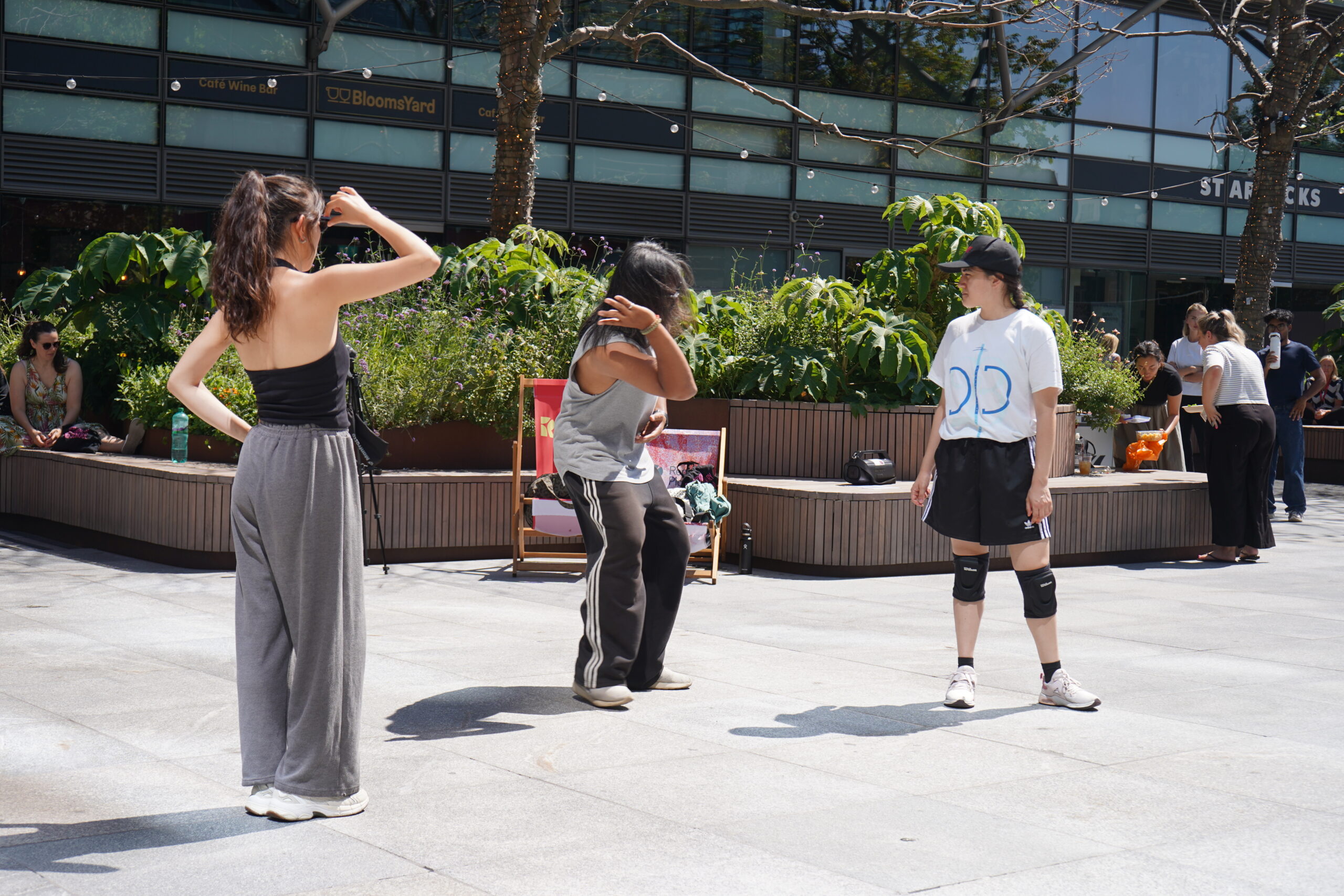
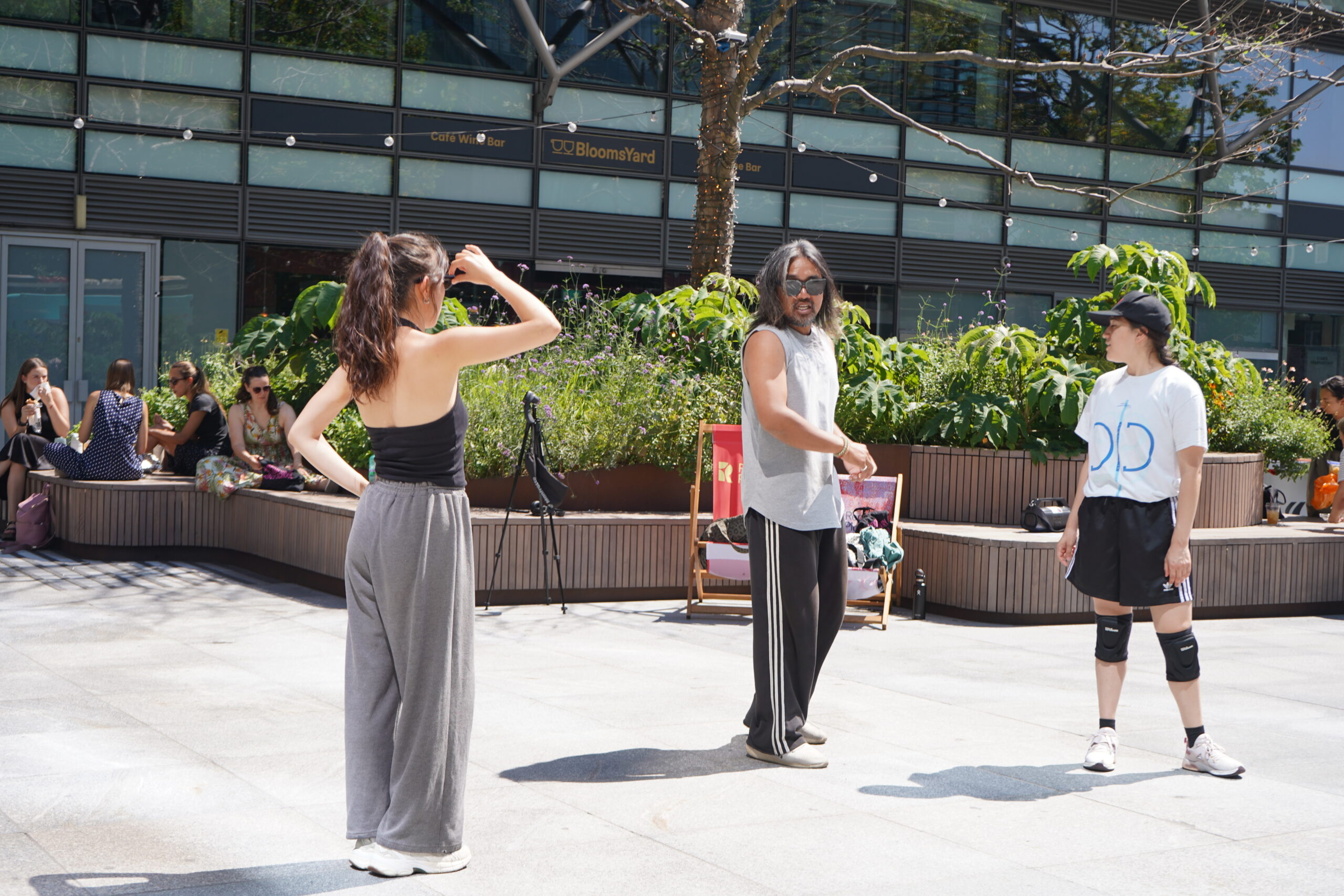
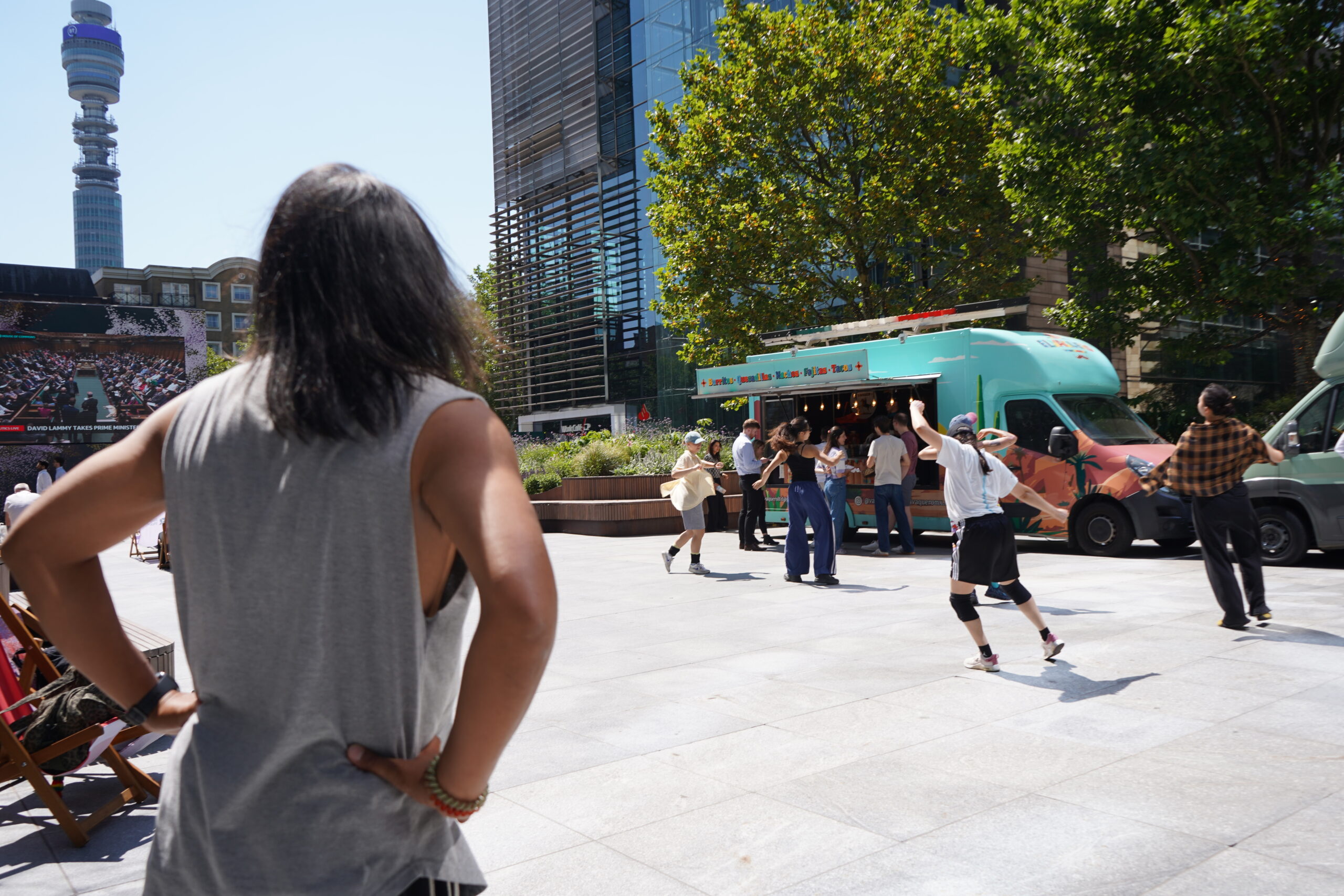
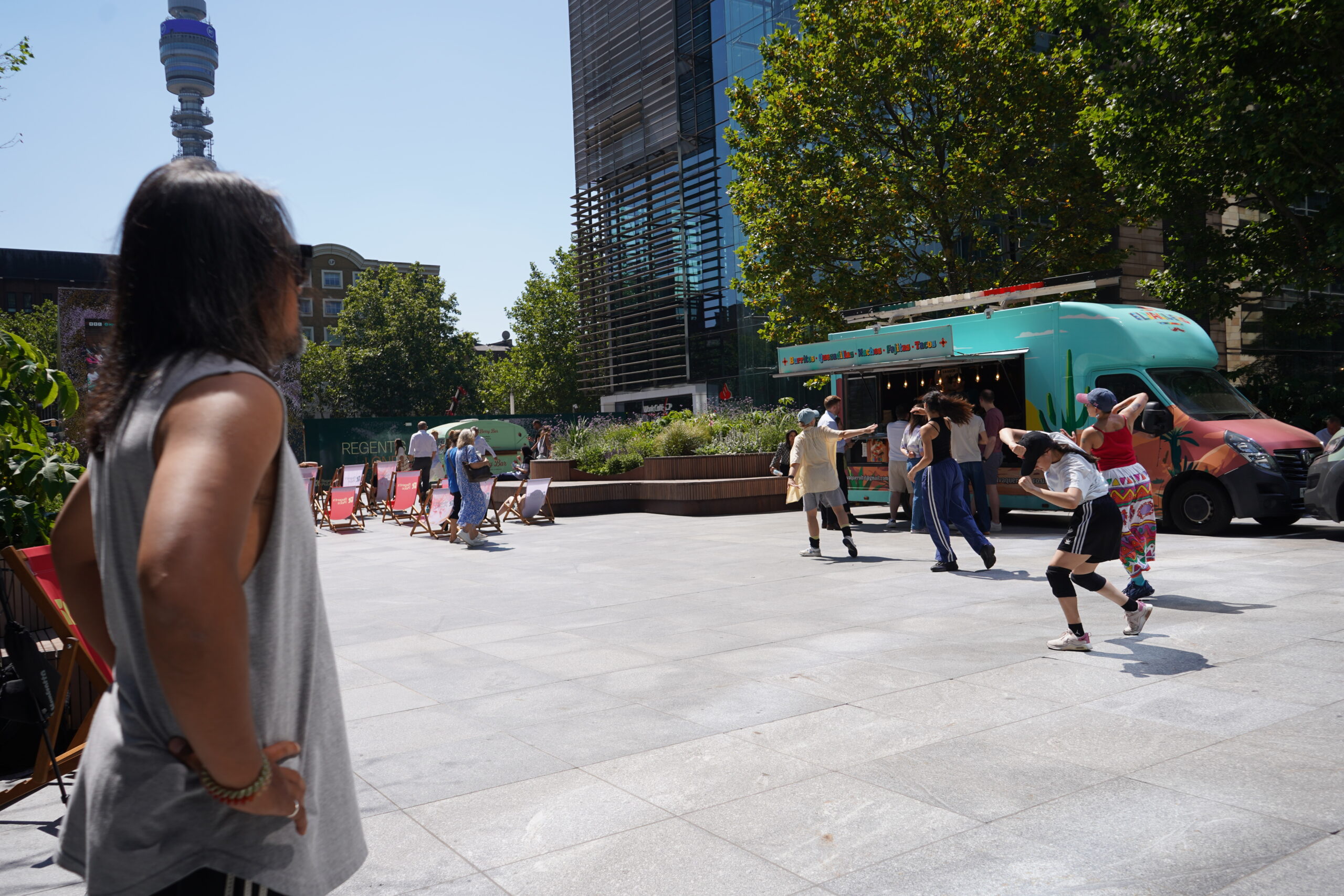
On a 30°C day with no air conditioning but a big fan operated by dancers and choreographers ArtsCross 2026 gathers for the first time for the dancer selection run by Waddah Sinada (Fubunation) and Léa Tirabasso.
Waddah’s class has the space grooving. As the session develops, you might catch dancers grooving to the tunes on the side, choreographers nodding along, researchers tapping their feet.
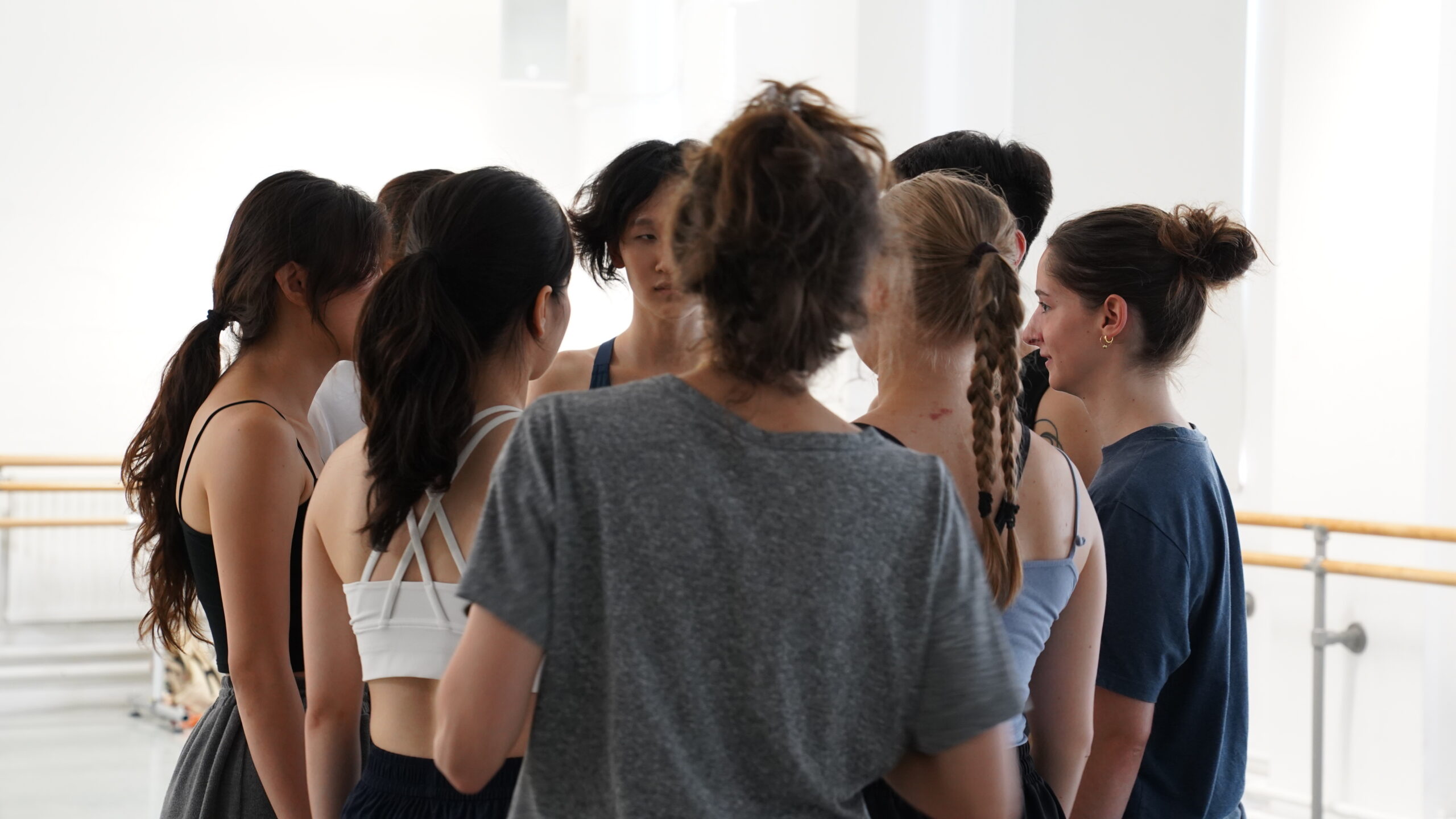
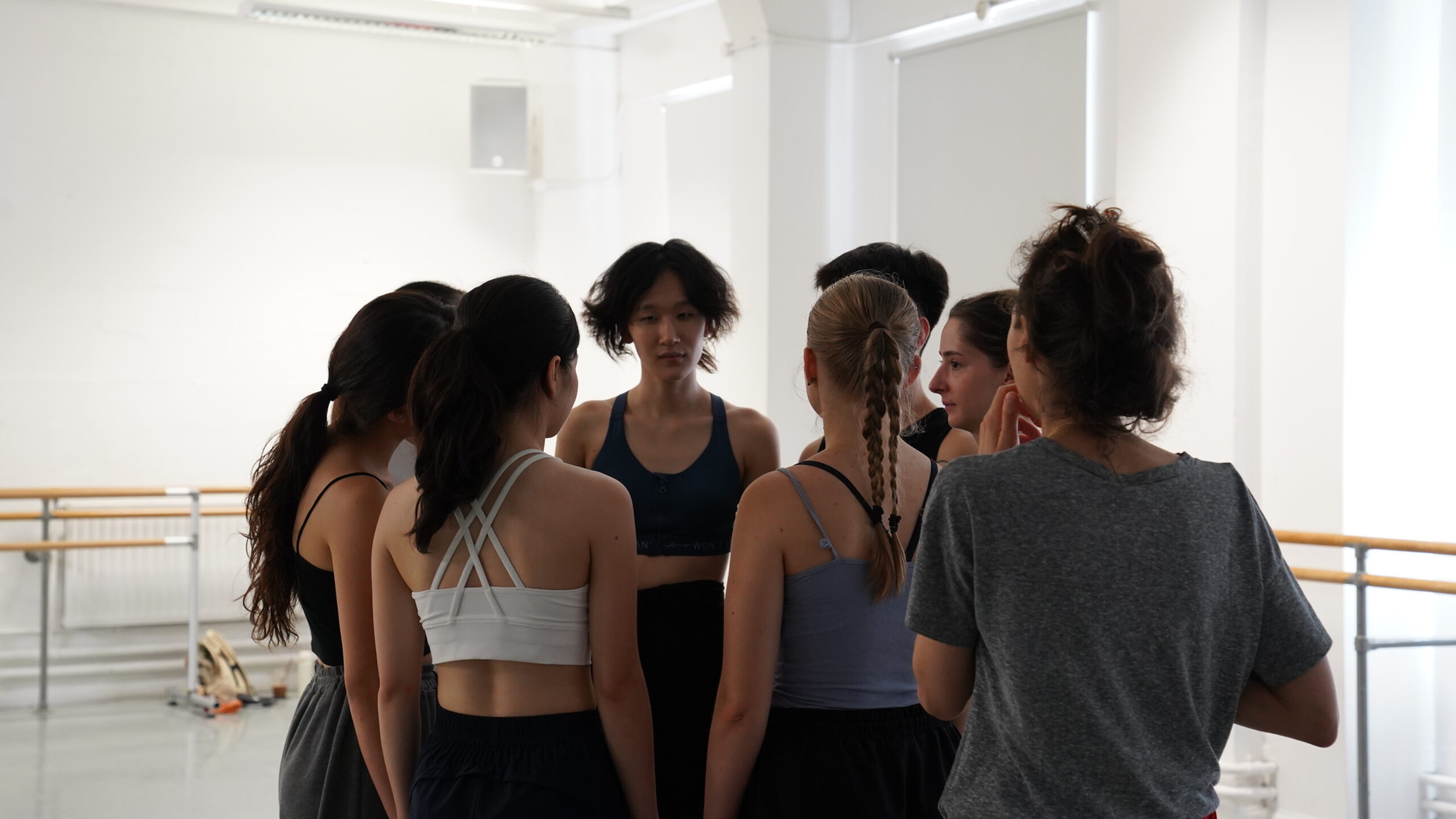
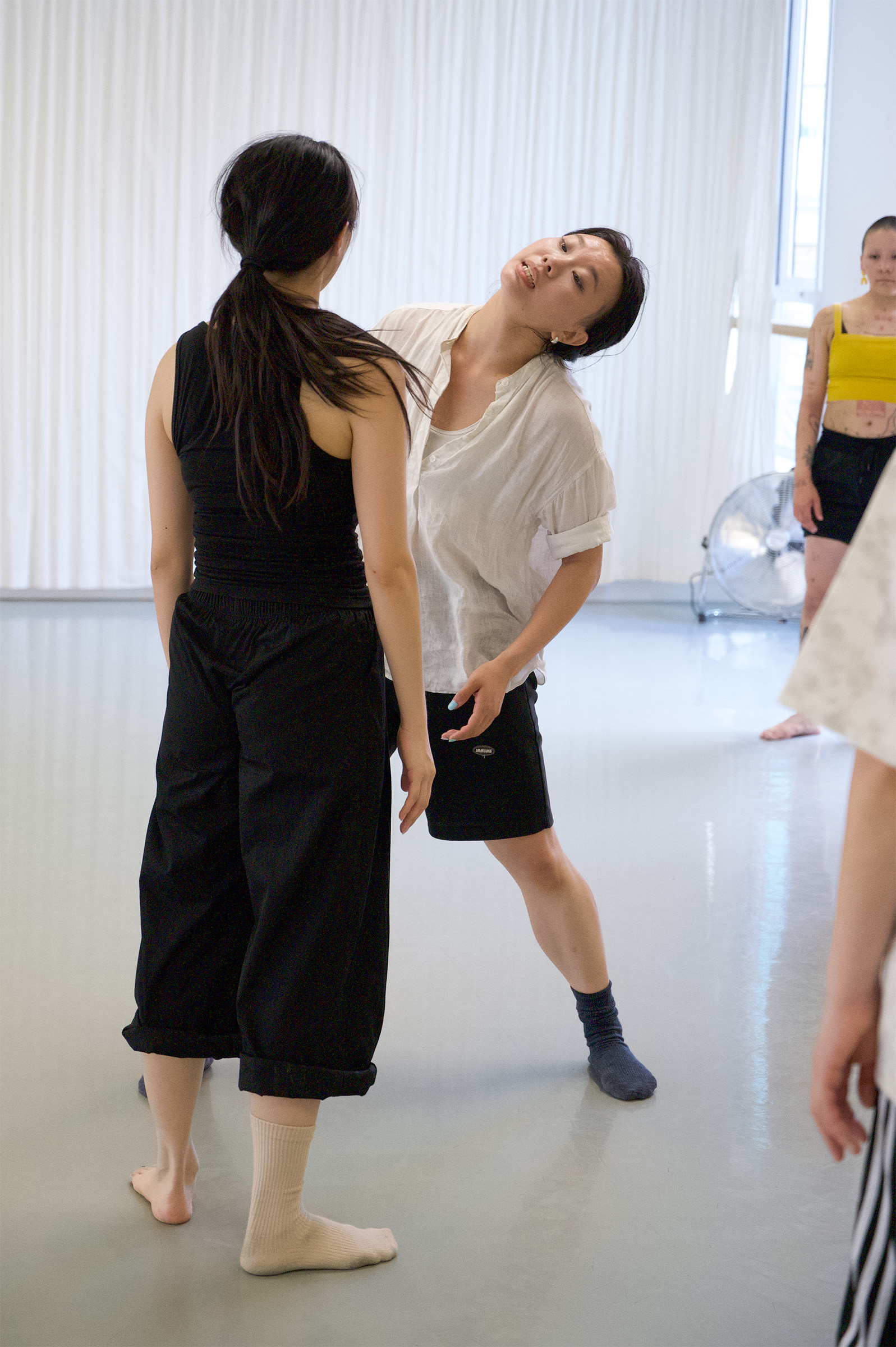
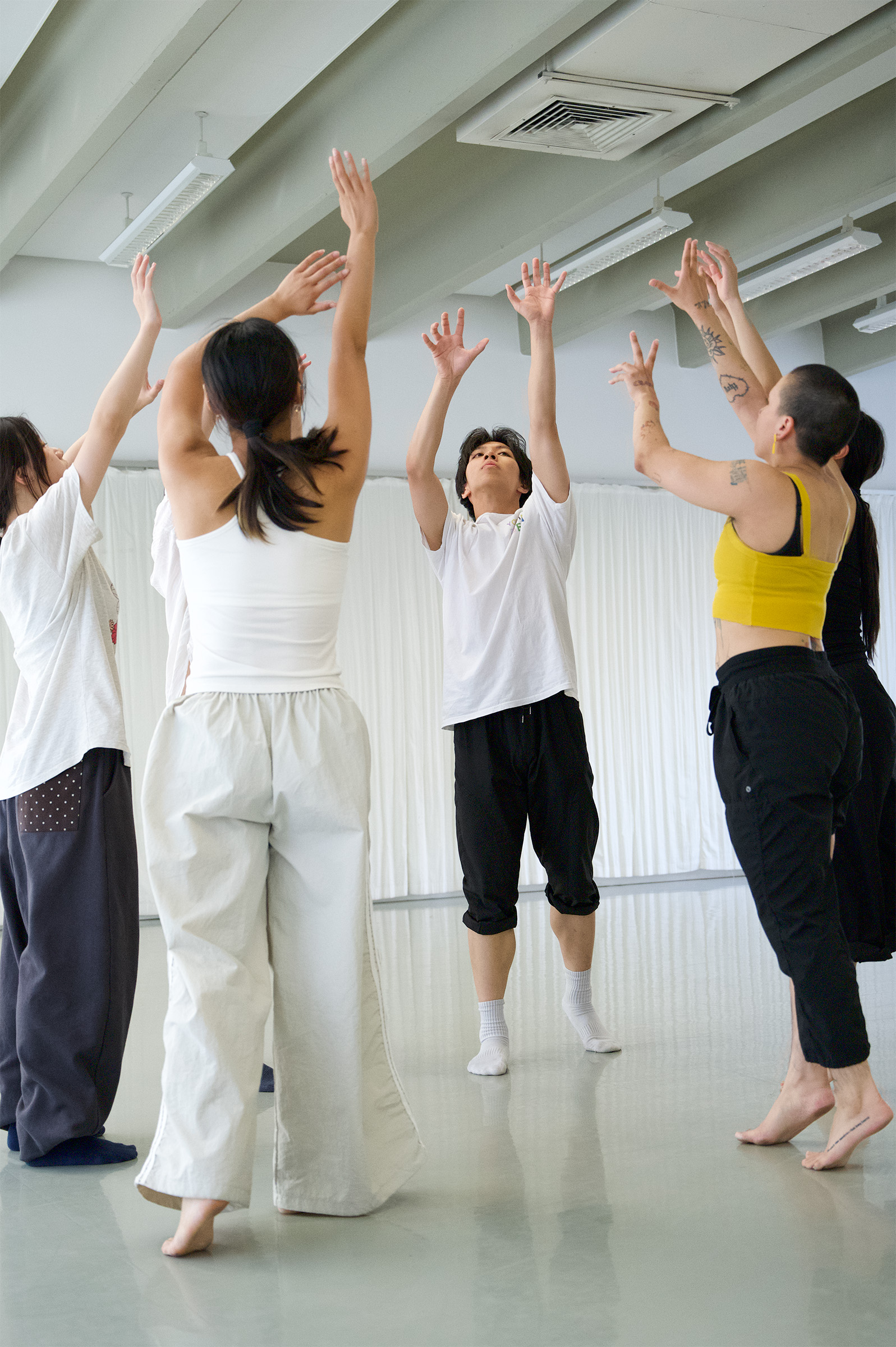
Léa quickly unlocks the laughter. As the dancers pass movement to each other through the circle, dancers start to loose whatever shyness they might be holding onto. Excitement starts to bubble, rise up the chest as the dancers start to embody. Zero stakes. Voice emerges. And when the voice is lost, you feel the void in the space.
Adriana Garcia Pinilla (Documenter)
Day 2: Rehearsals, 23 June – 1
Ma Nan (Beijing)
Tsang Wing Fai (Hong Kong)
Léa Tirabasso (London)
Wang
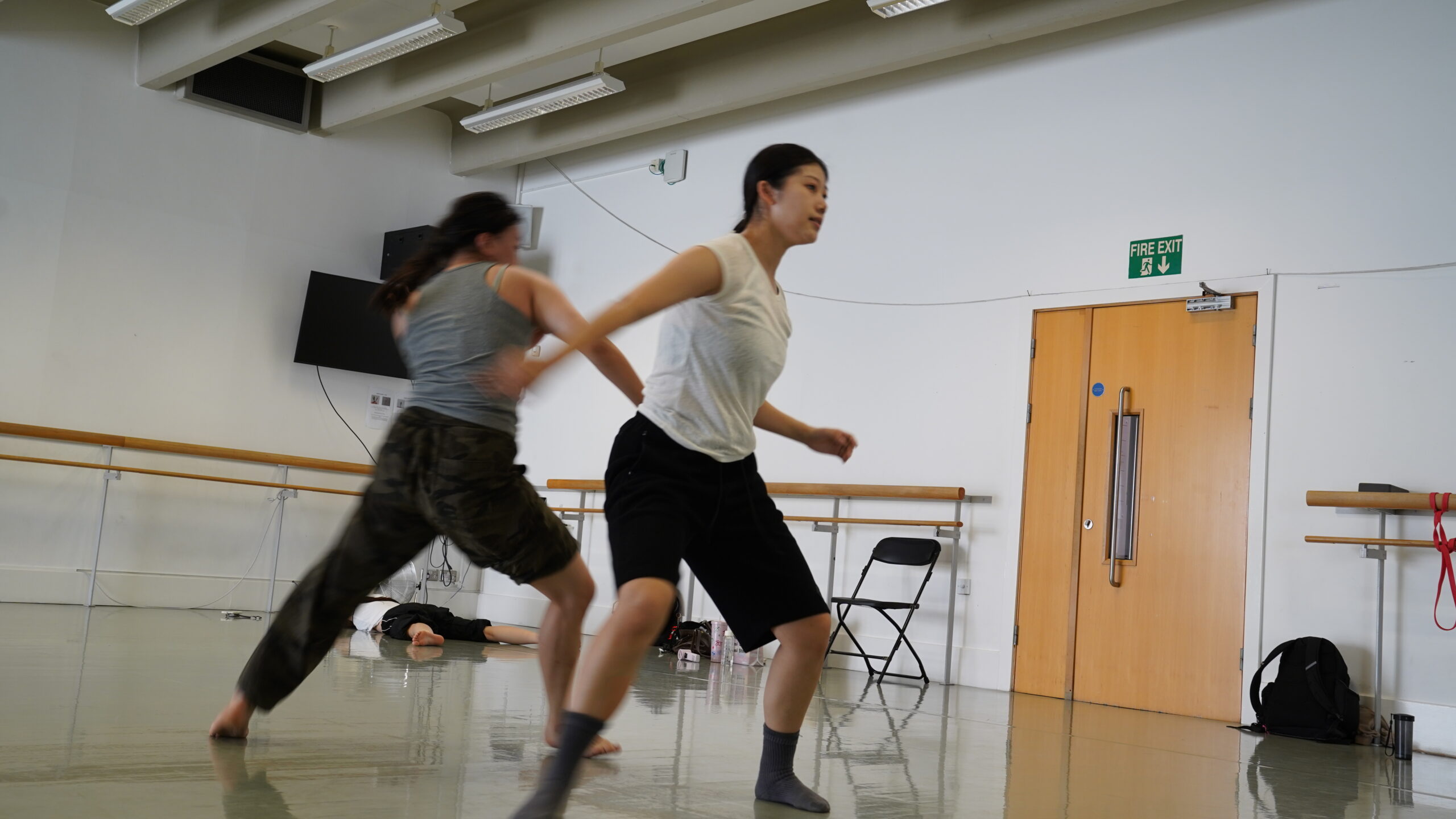
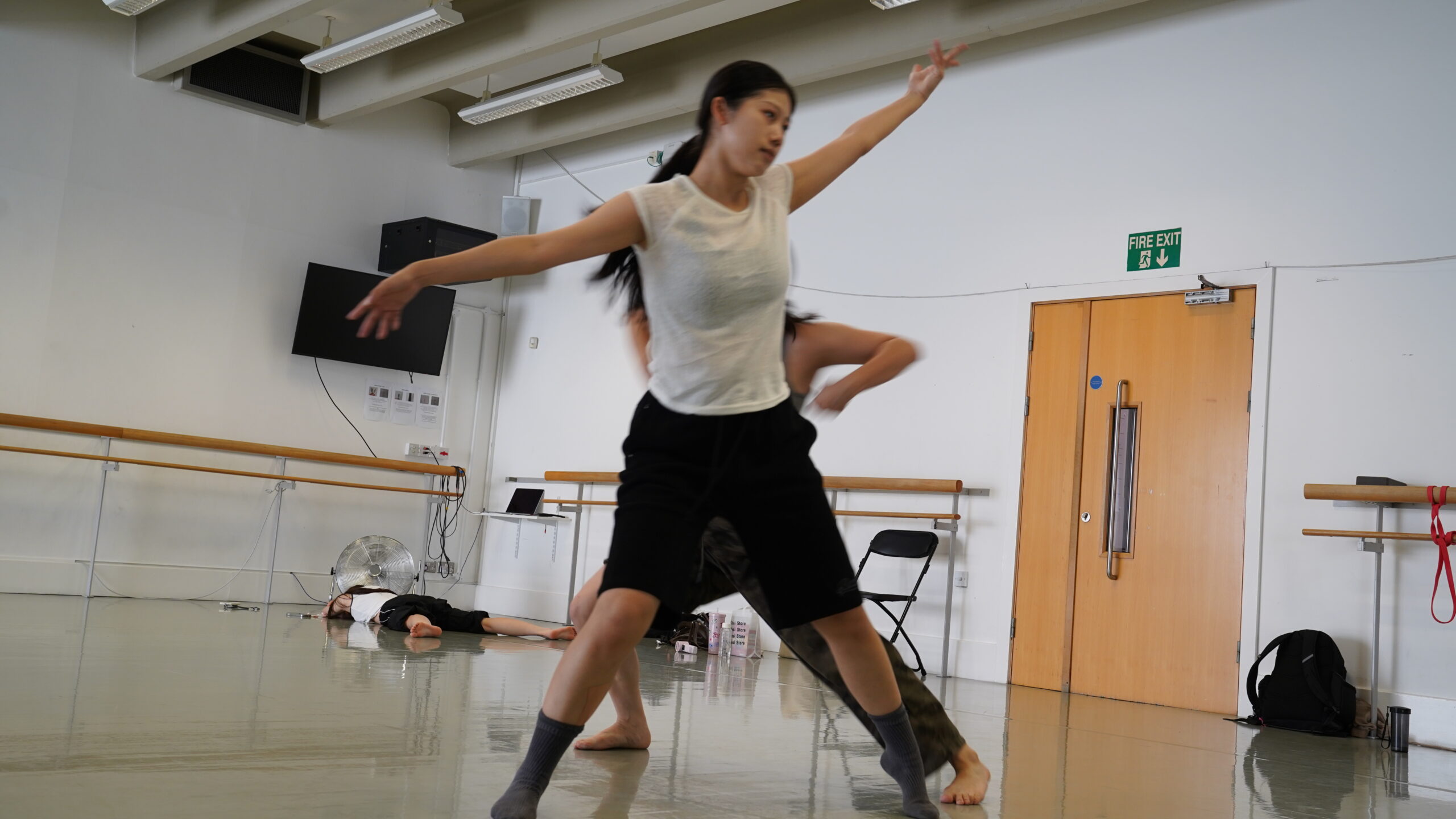
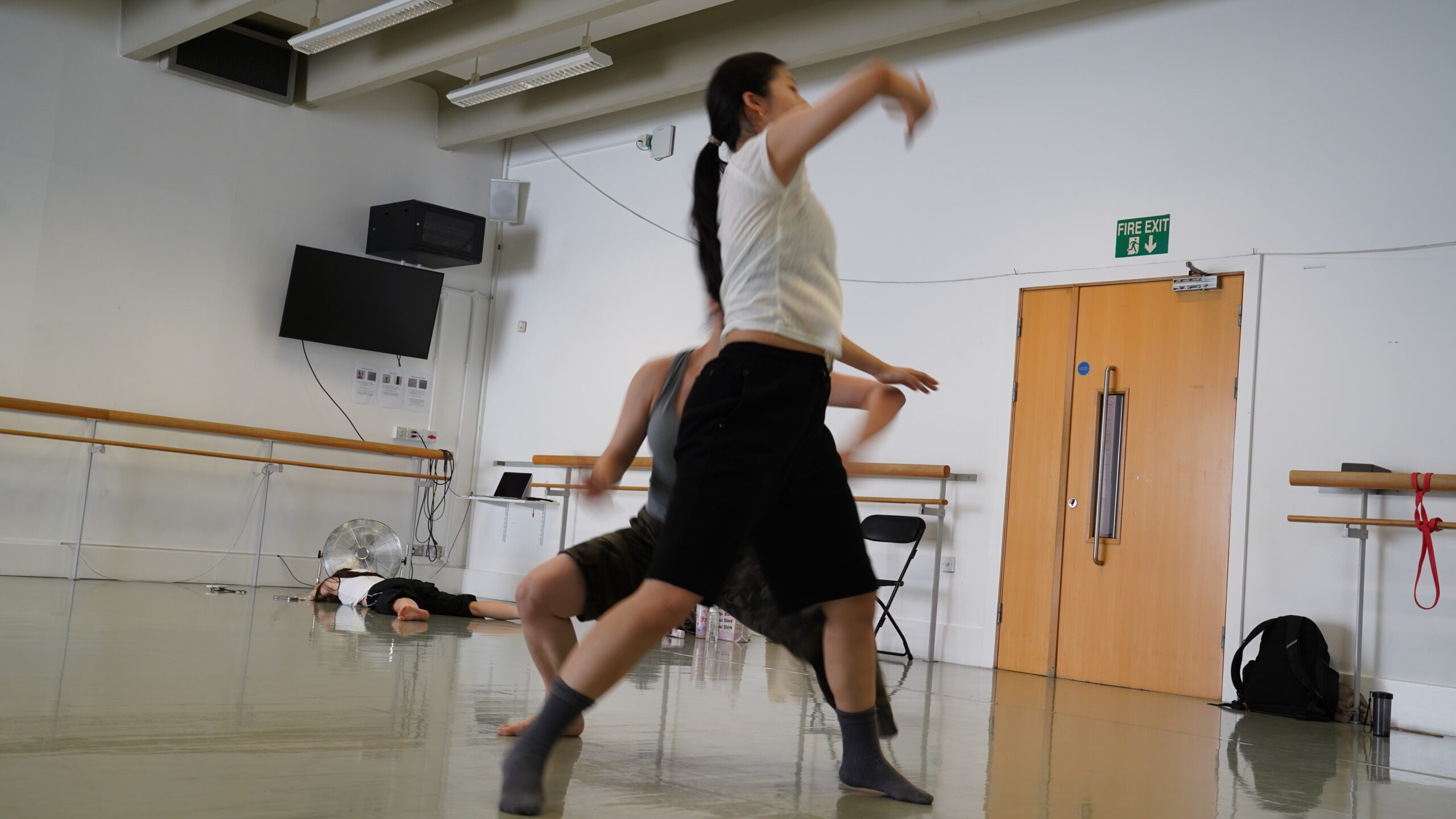
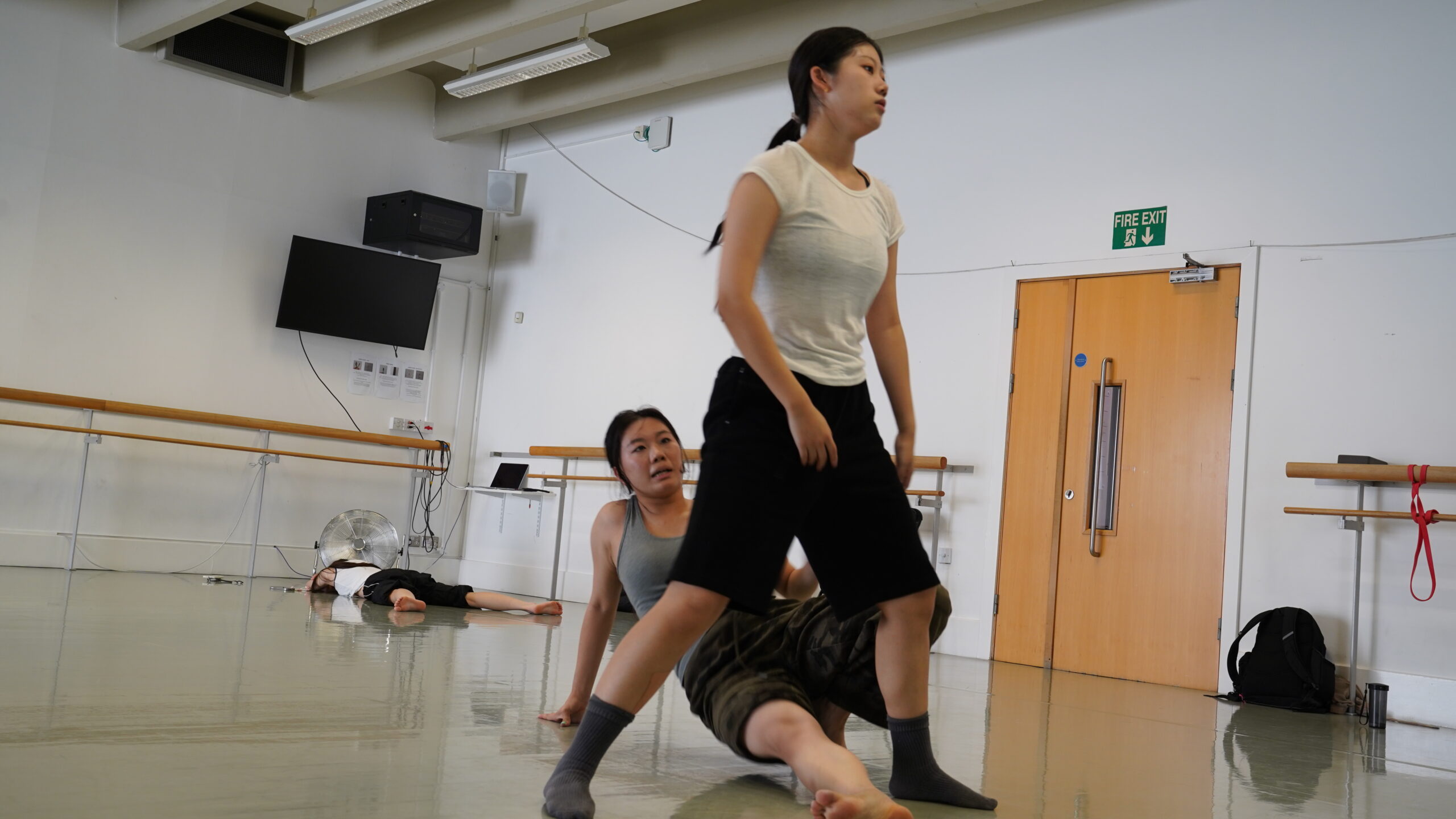
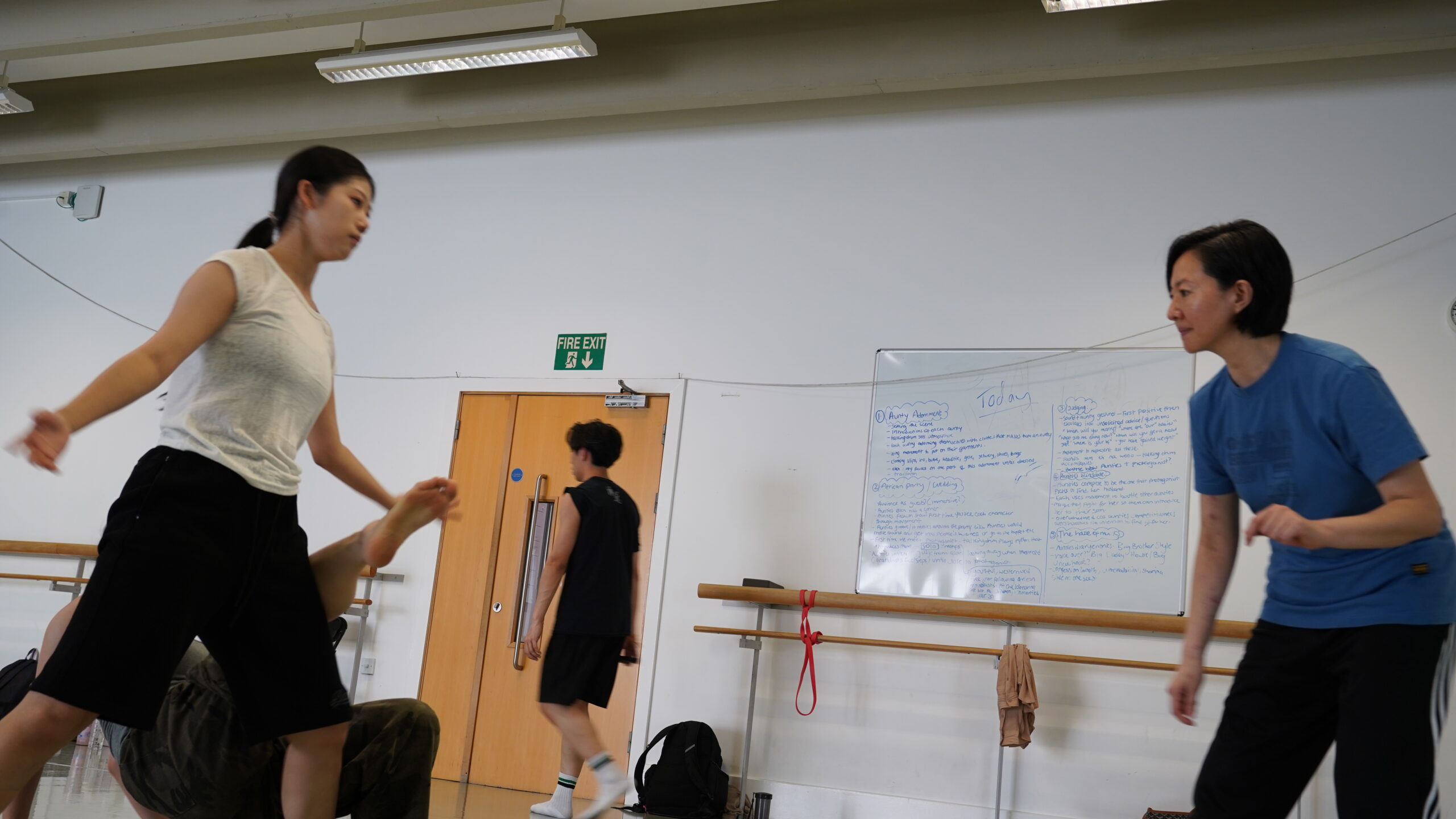

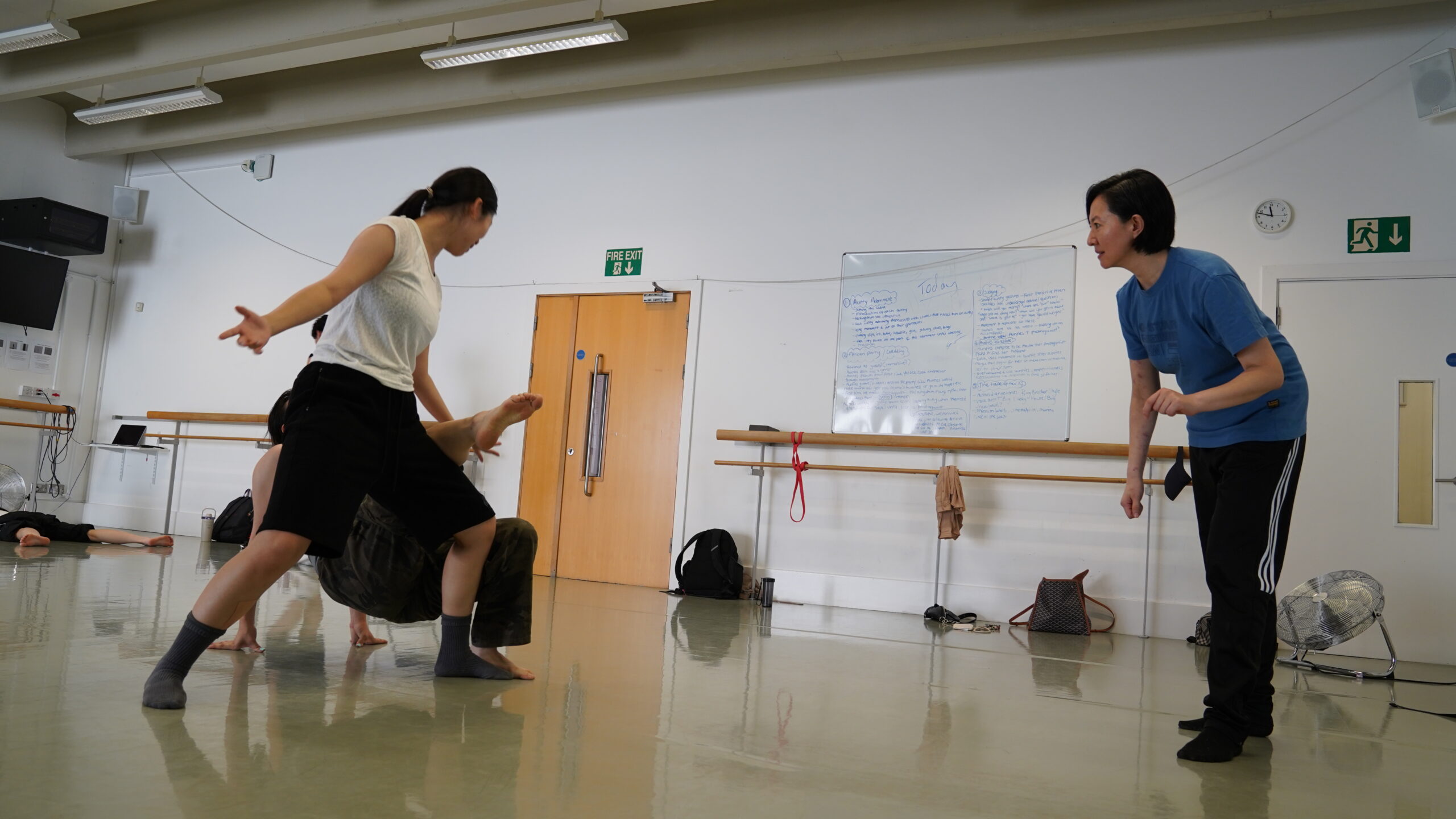
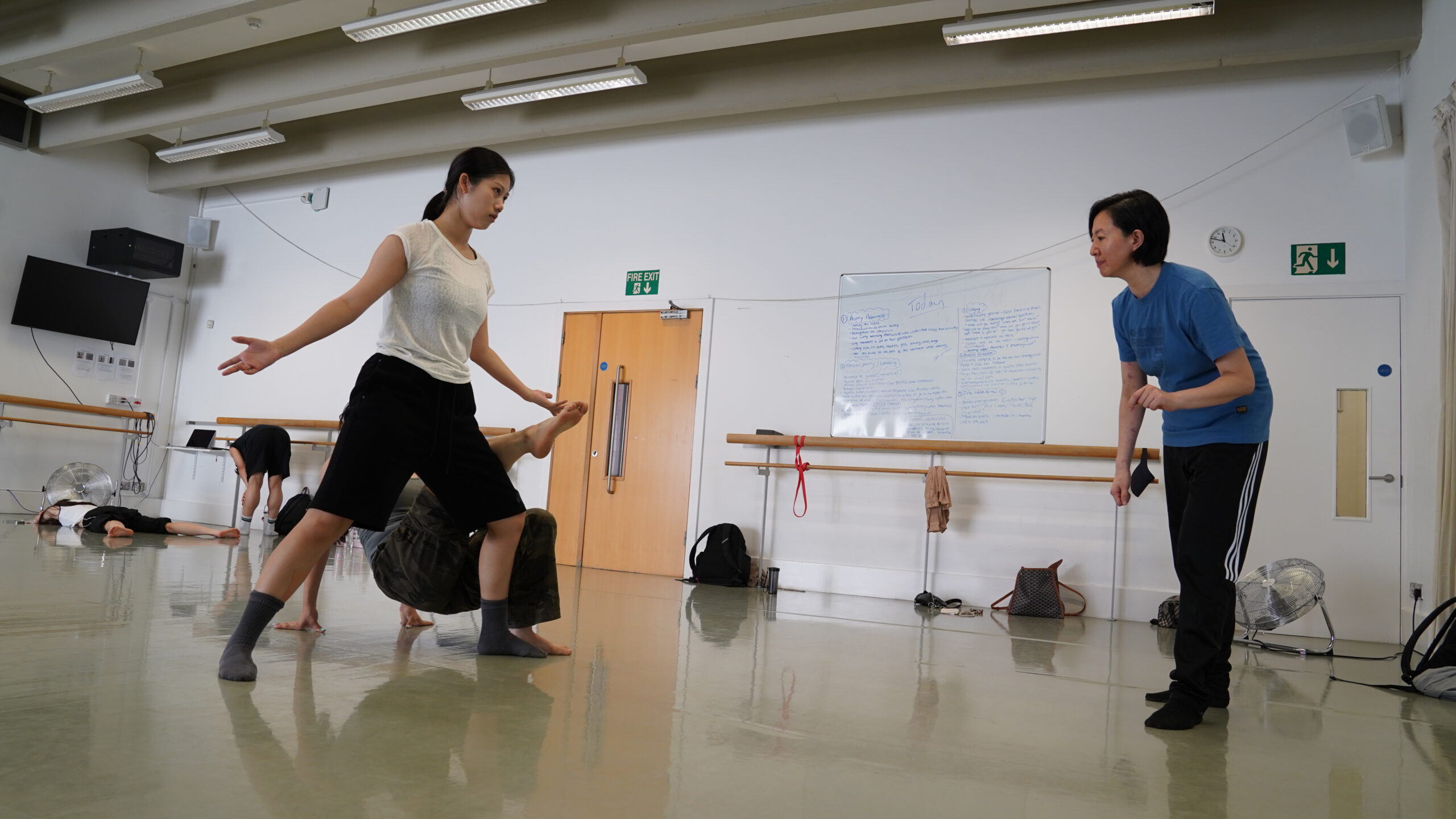
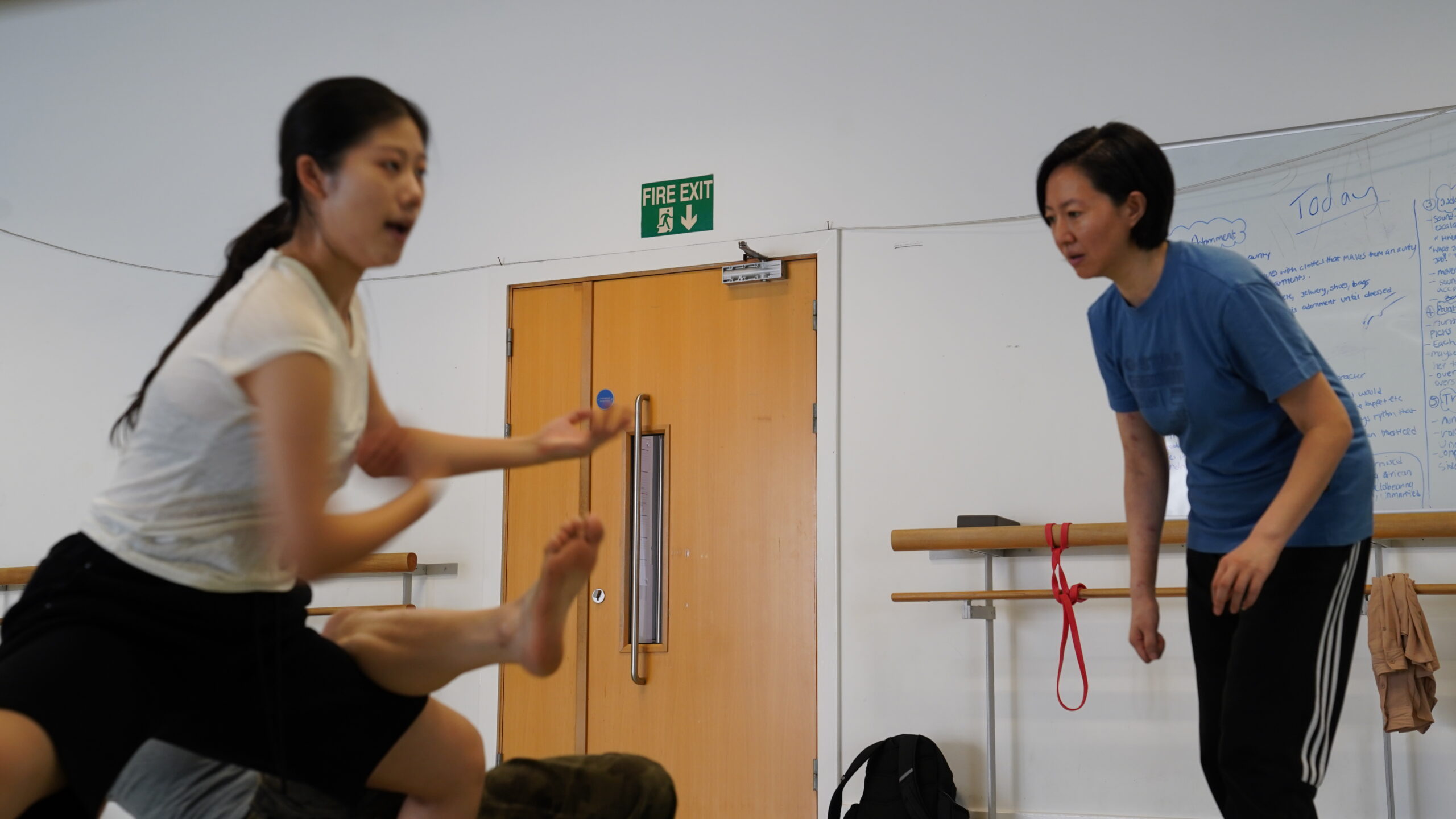

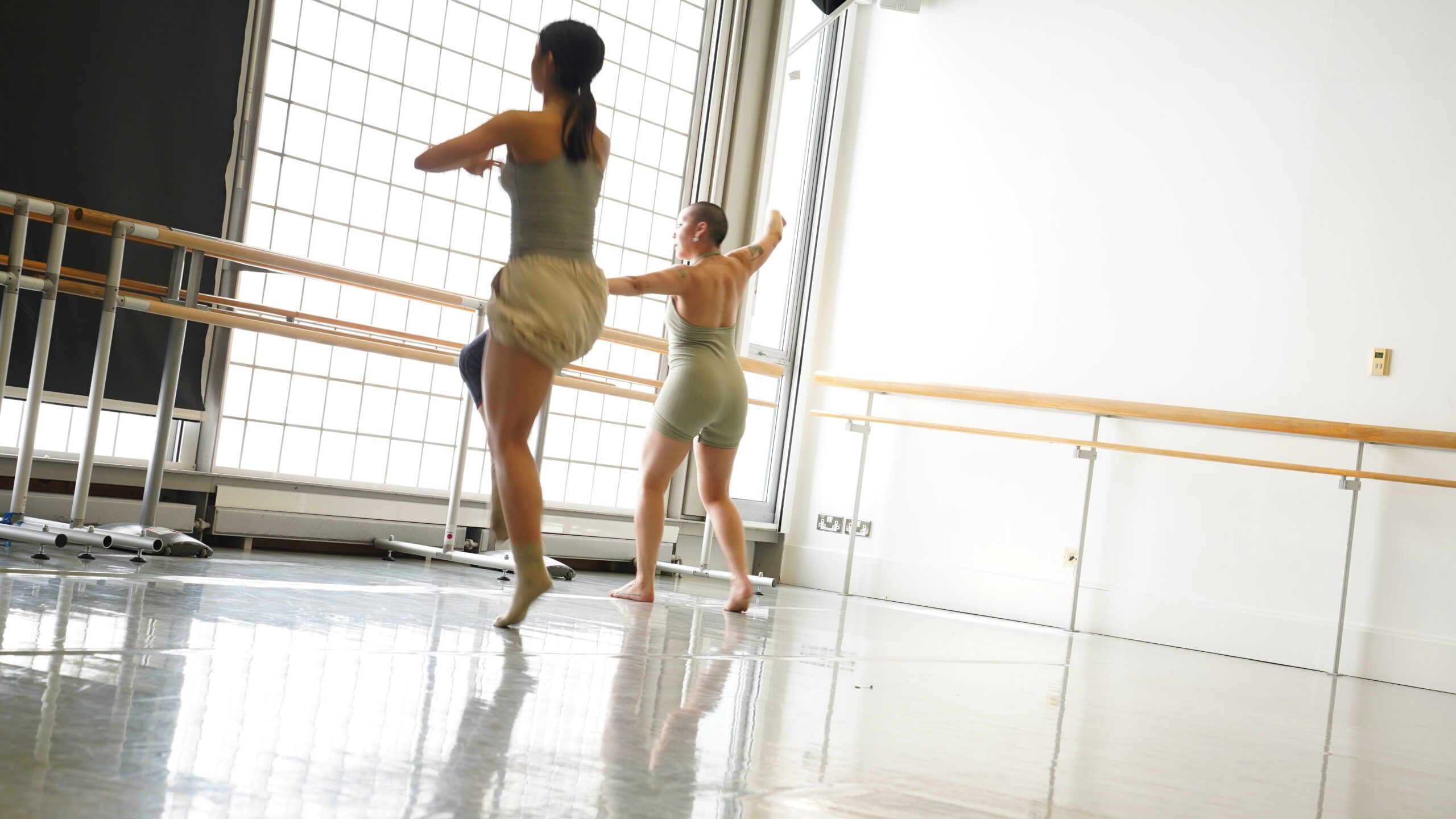

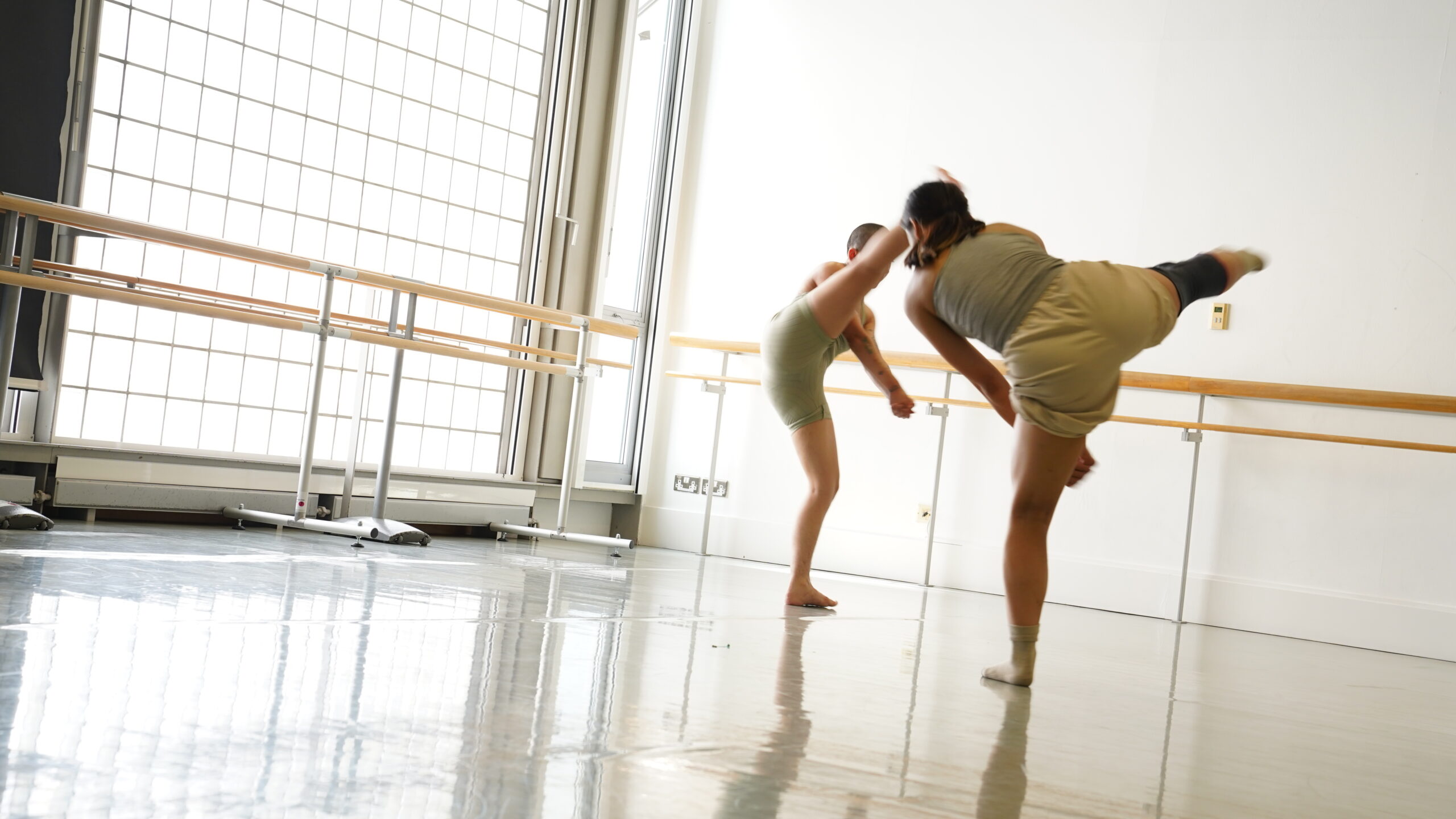
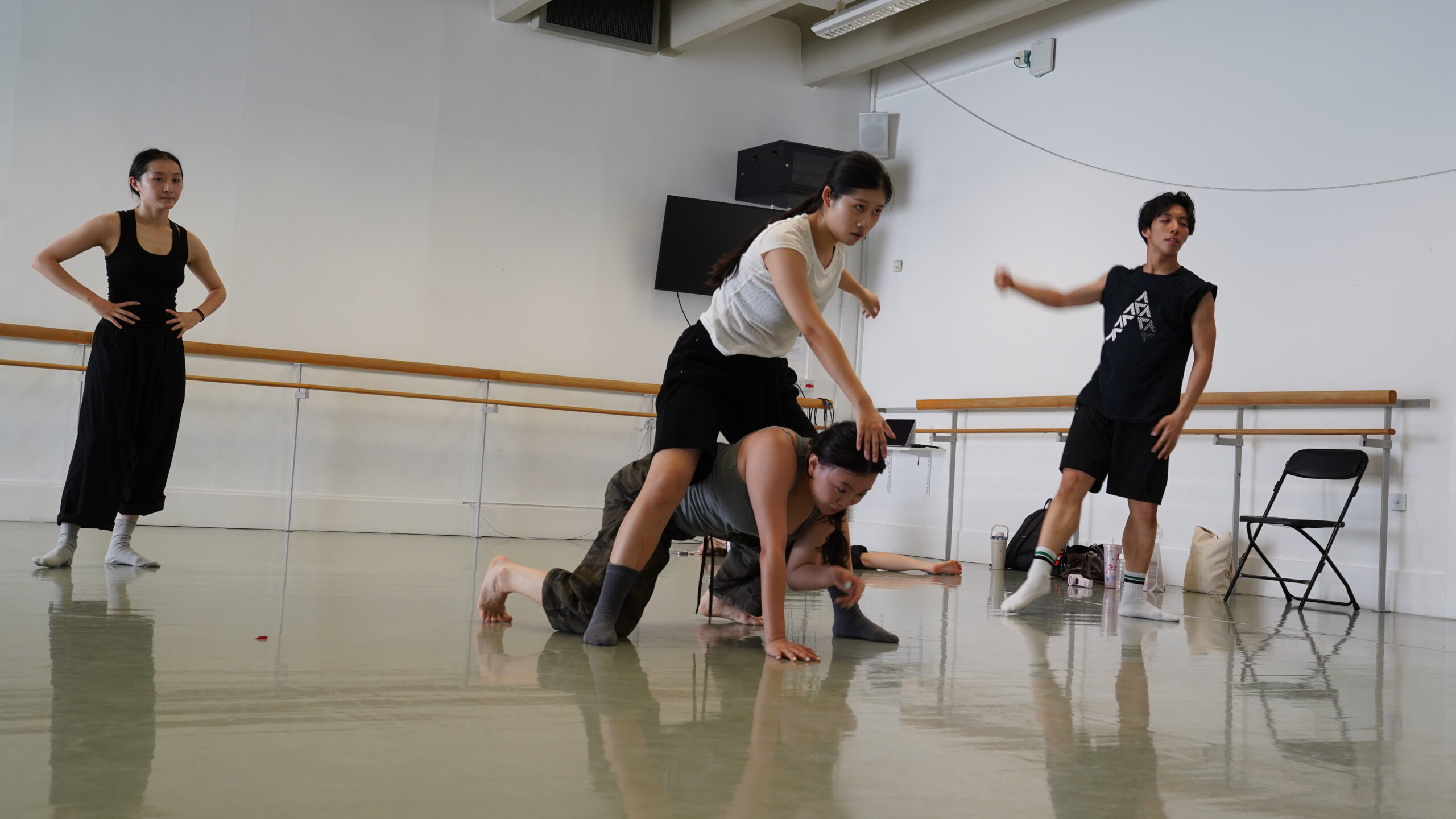
Day 2: Rehearsals, 23 June – 2
Fangas Nayaw (Taipei)
Yu Pik Yim (Hong Kong)
FUBUNATION (Waddah Sinada & Rhys Dennis) (London)
Chen Yongping (Beijing)
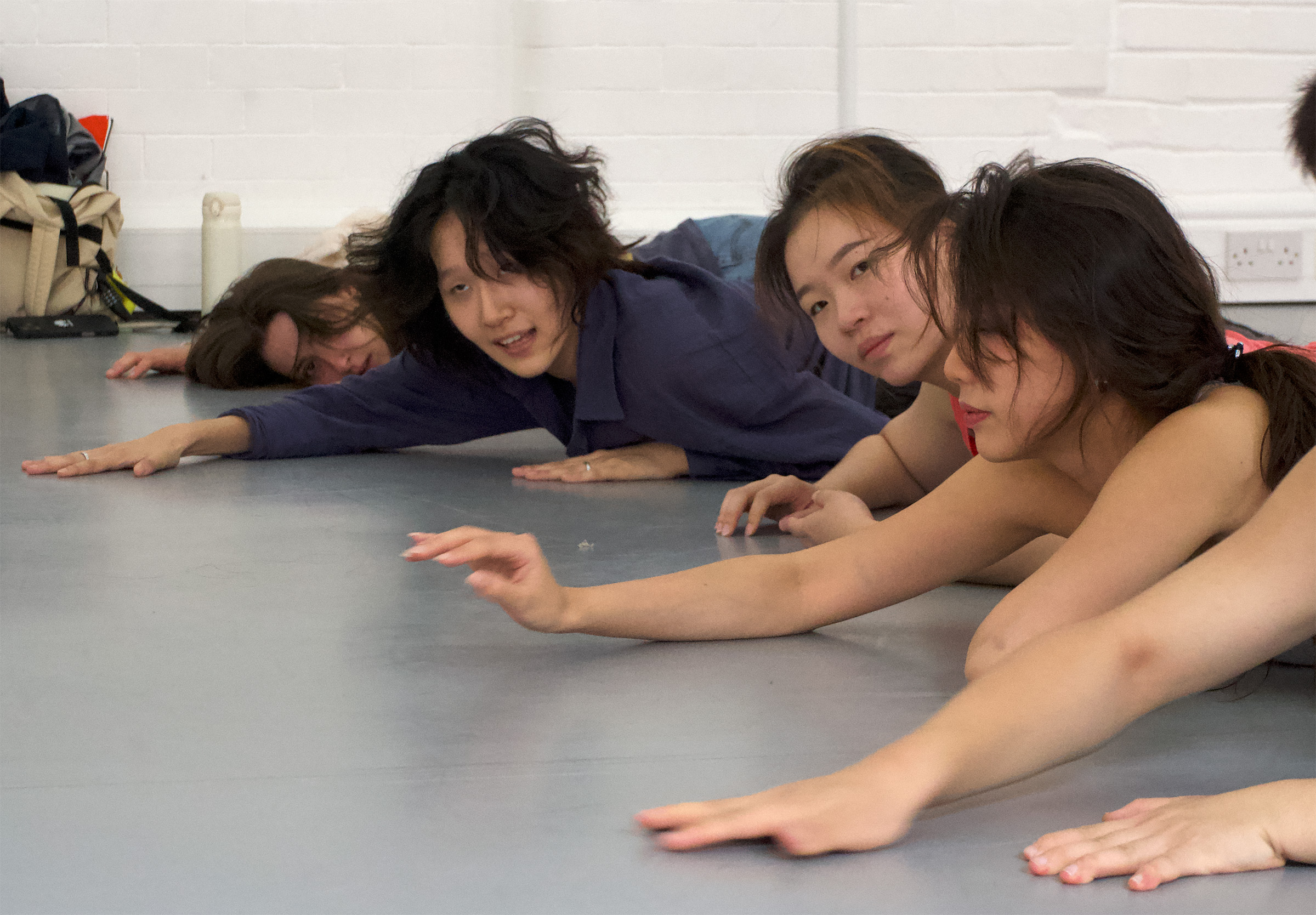
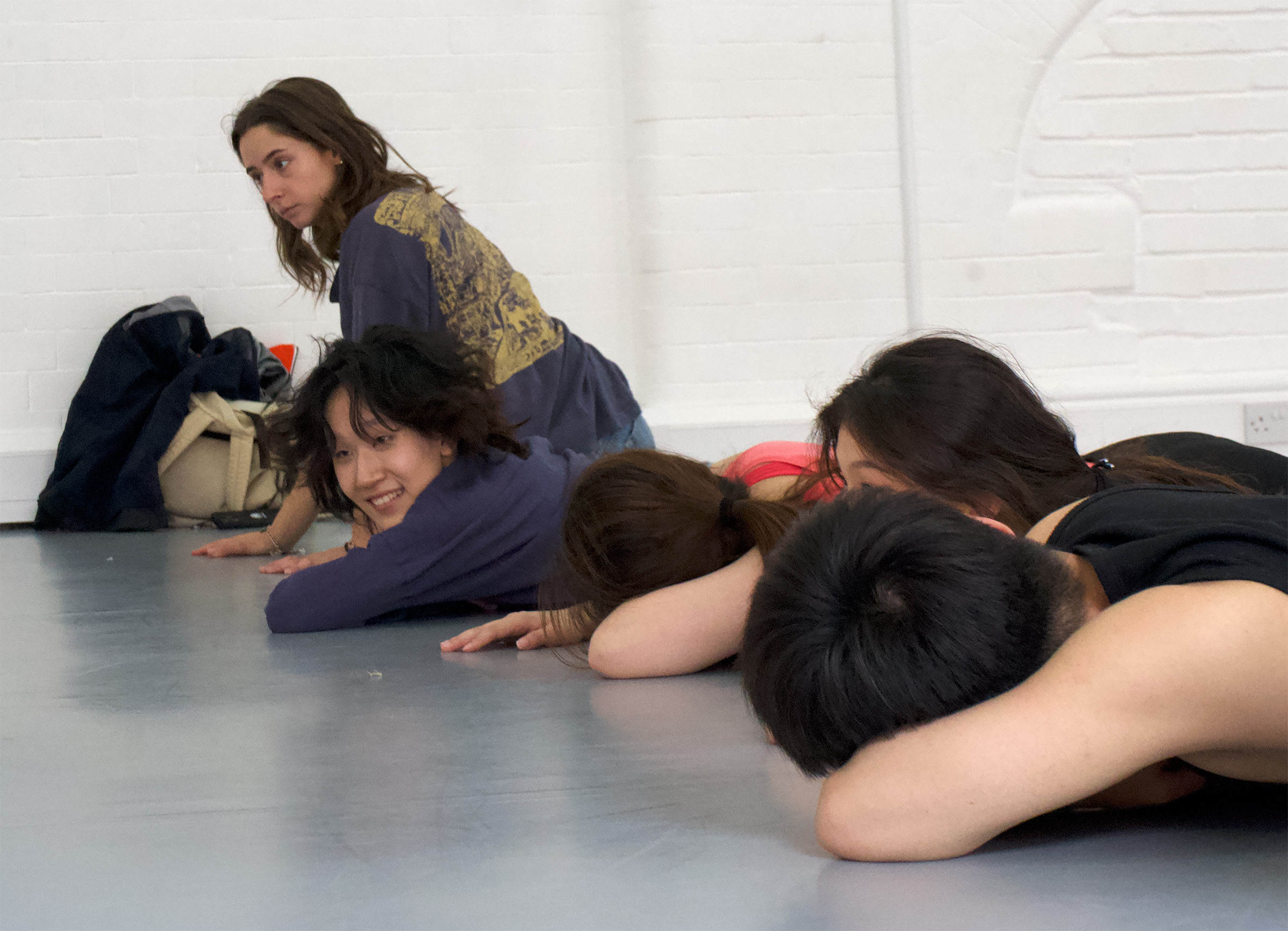

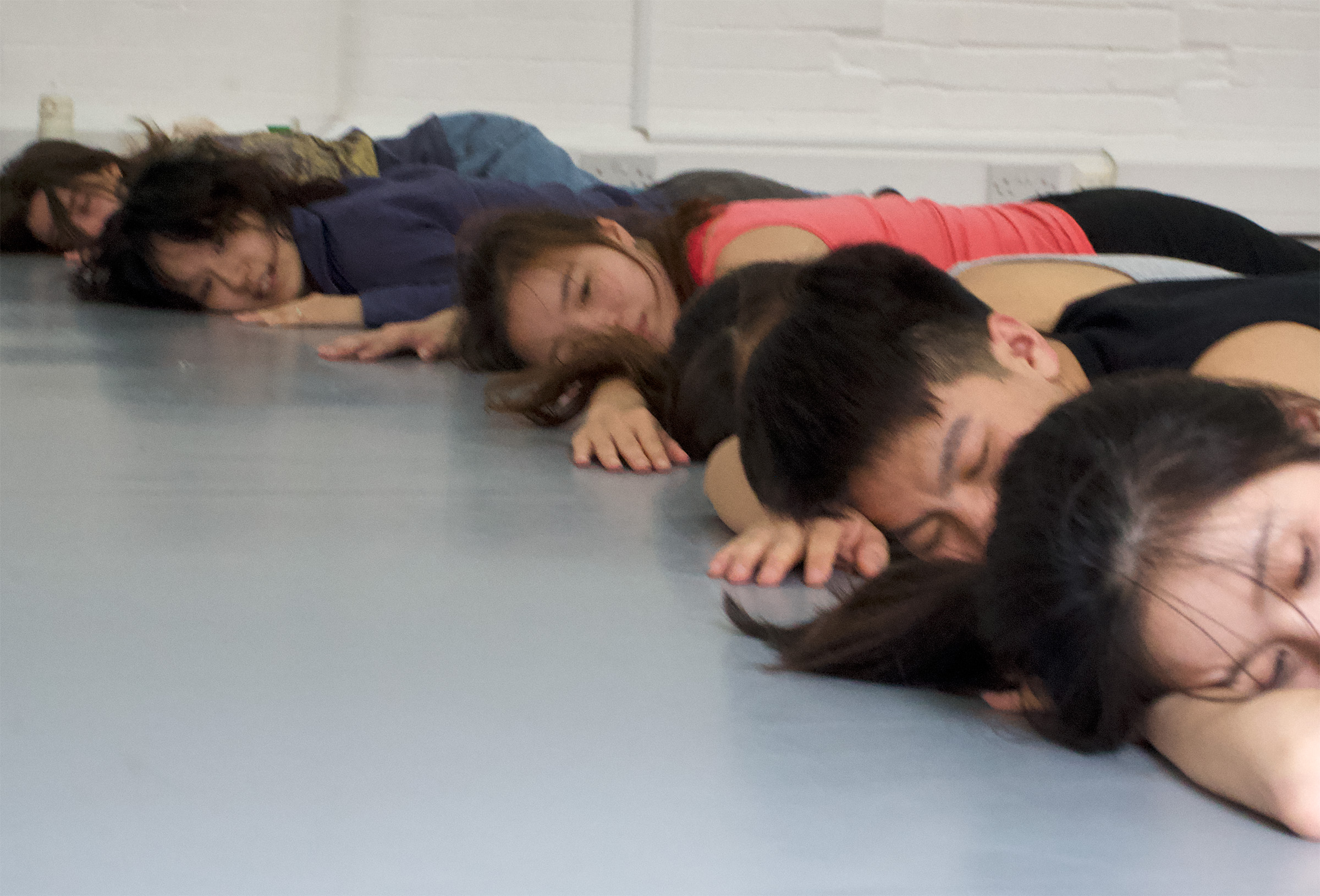
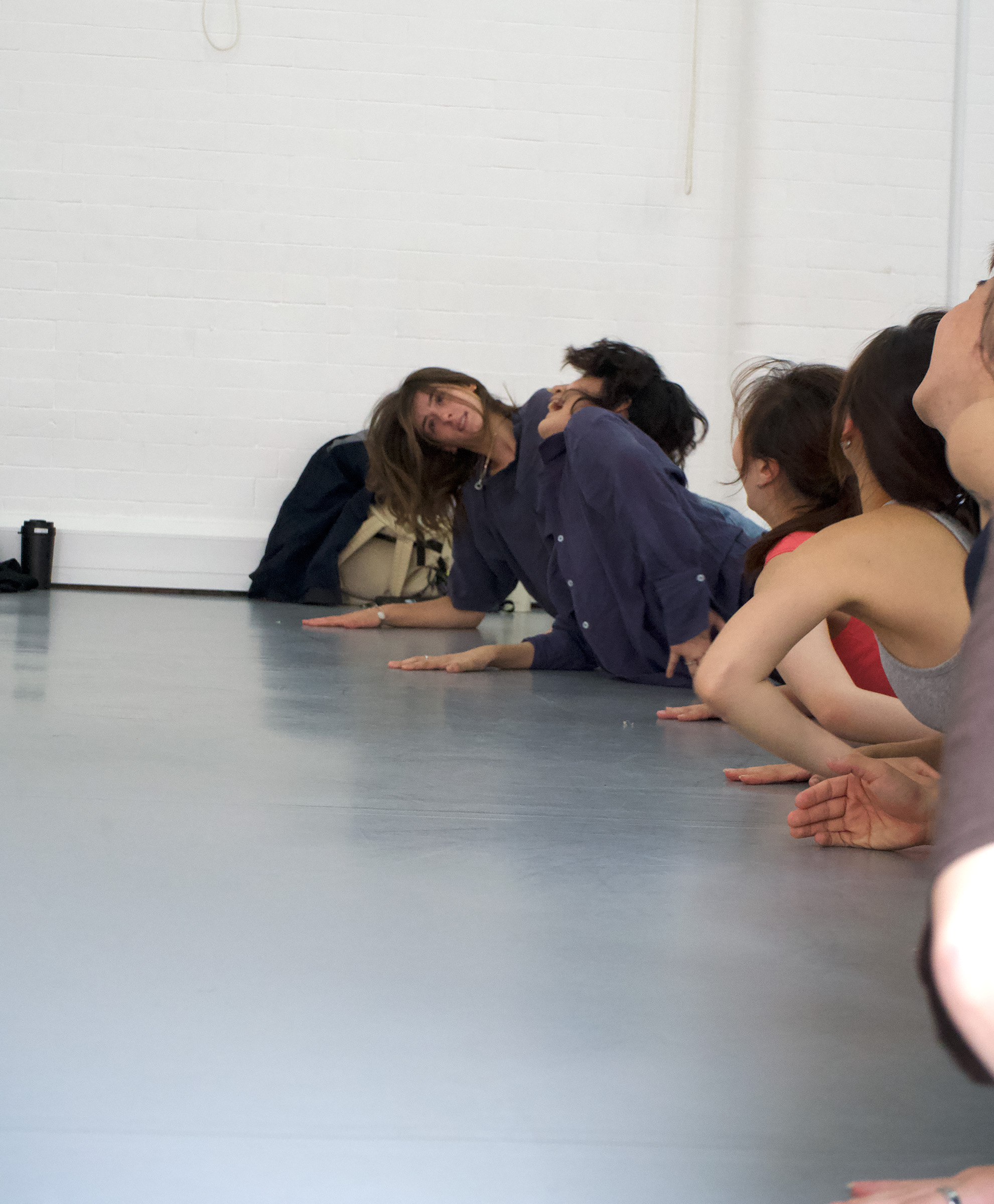


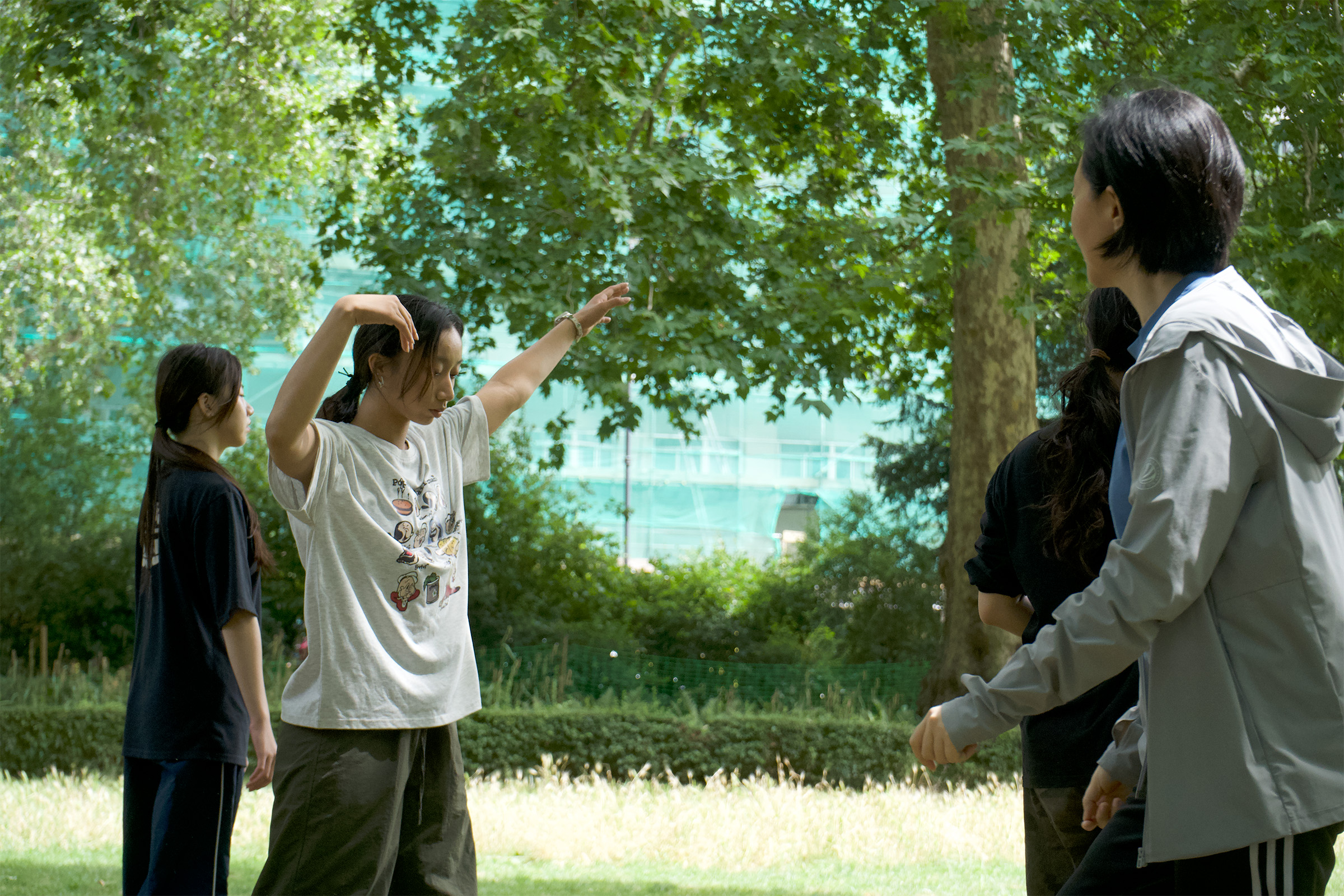
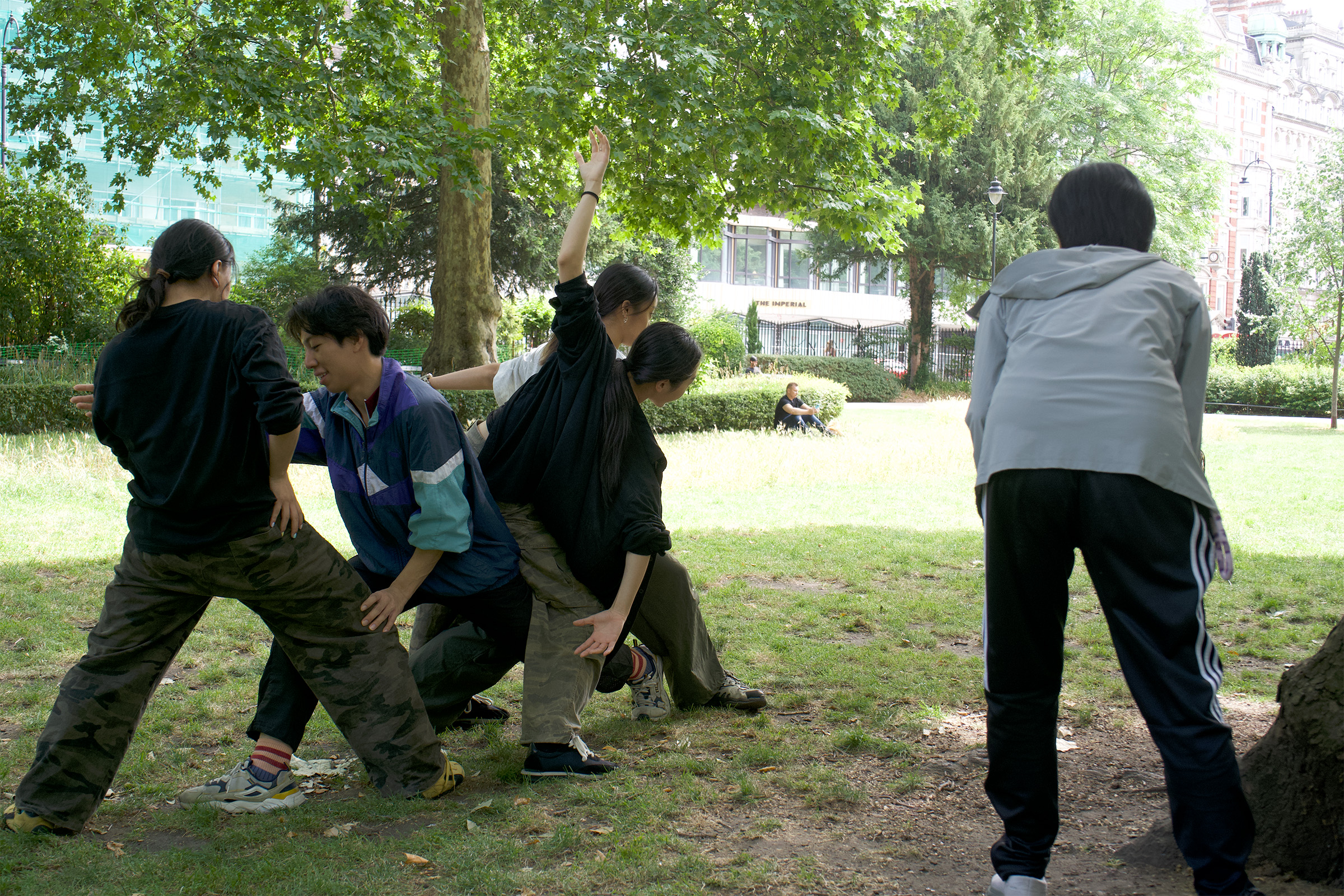
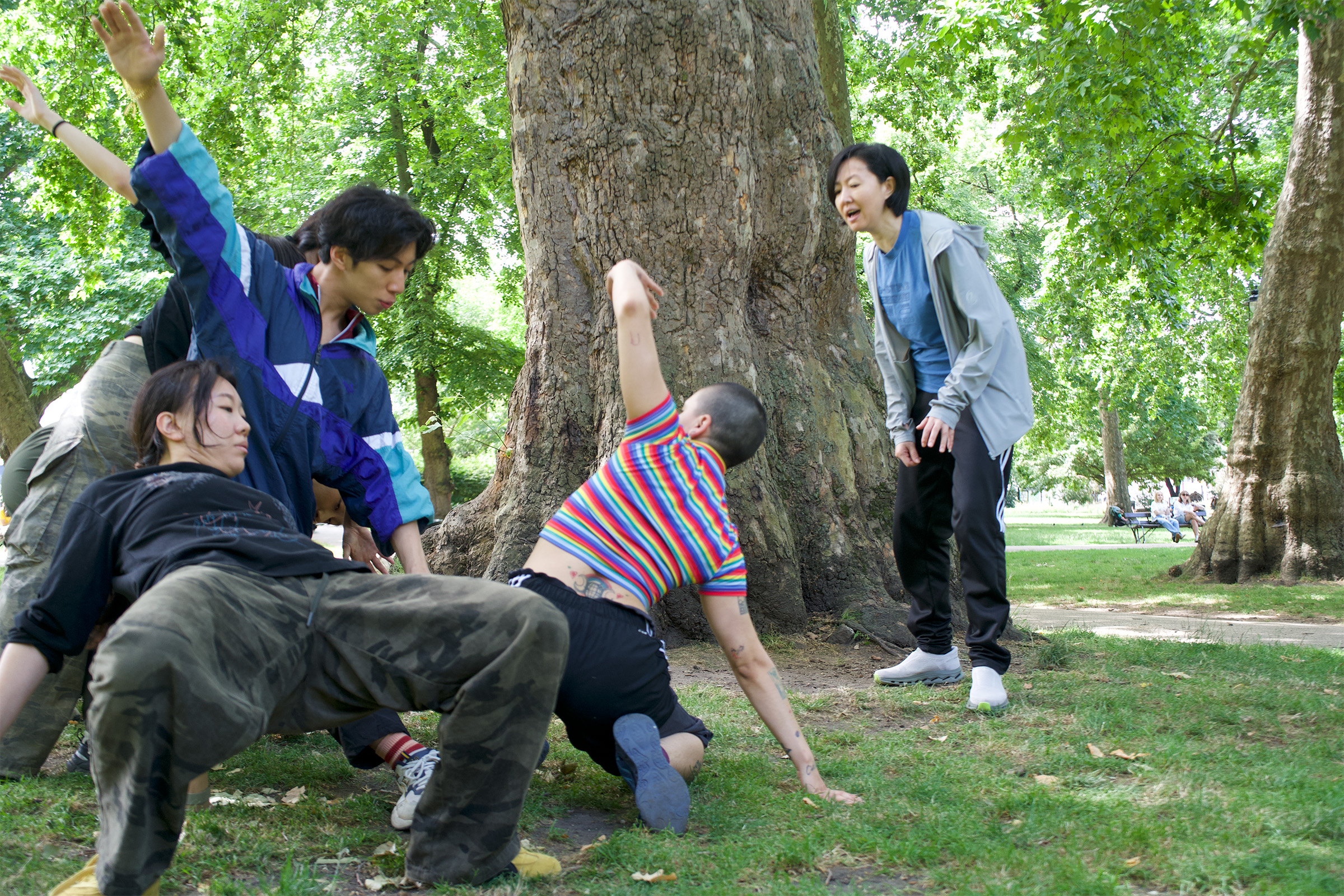
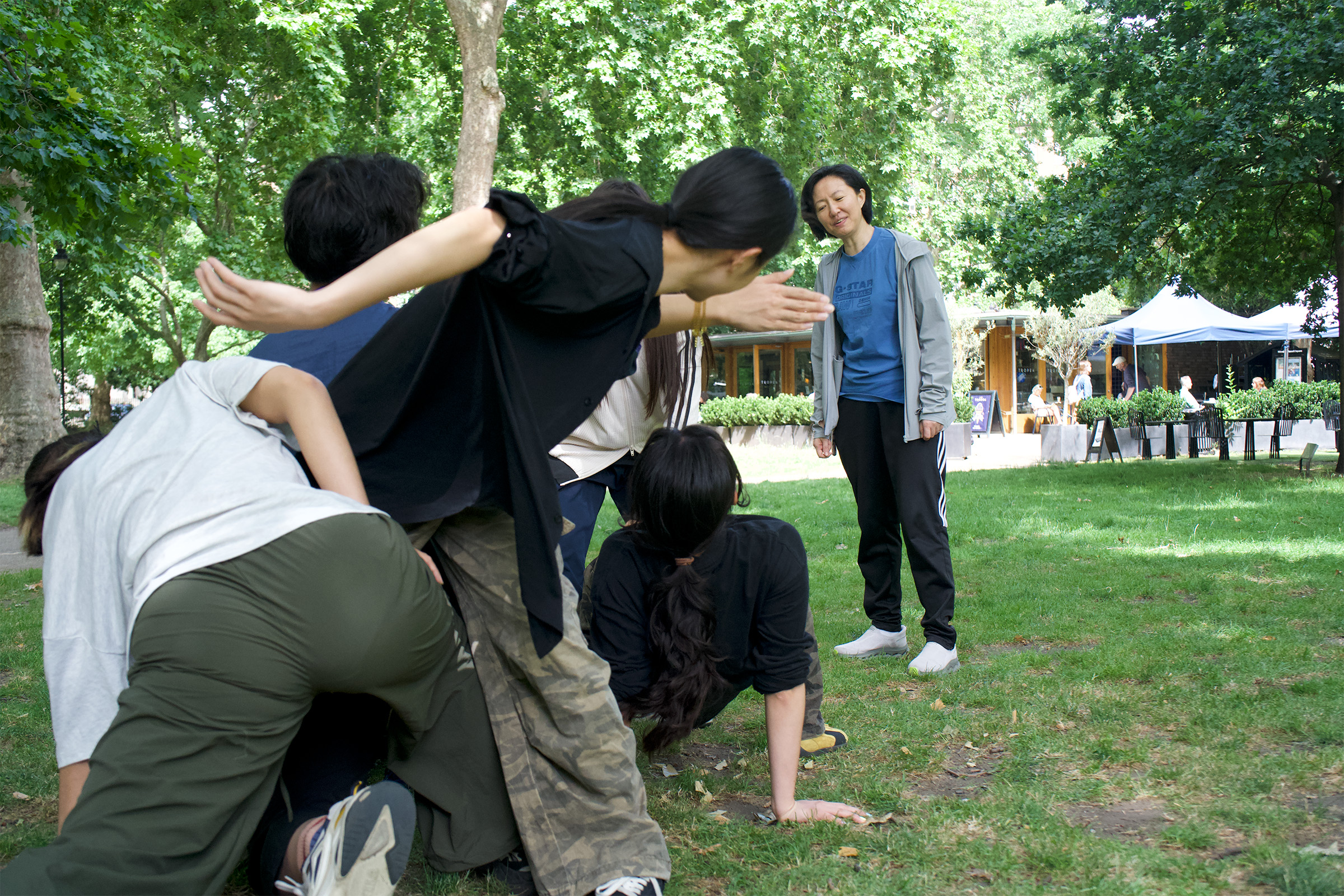
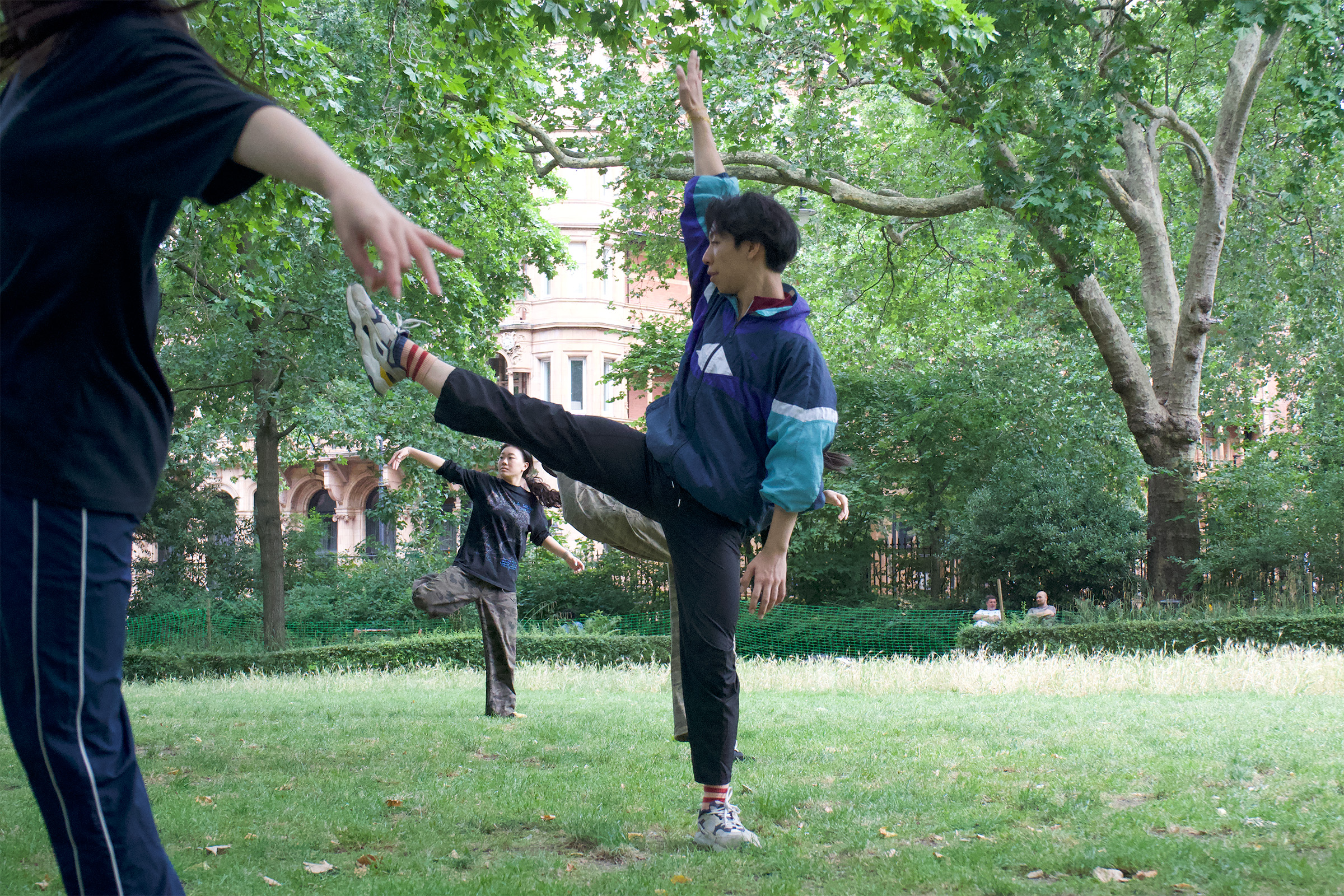




Week 1 – Recap video
Filmed by: @bjohnsoncreative & @jessieleethorne
Edited by: @jessieleethorne
Day 2: First day of rehearsals
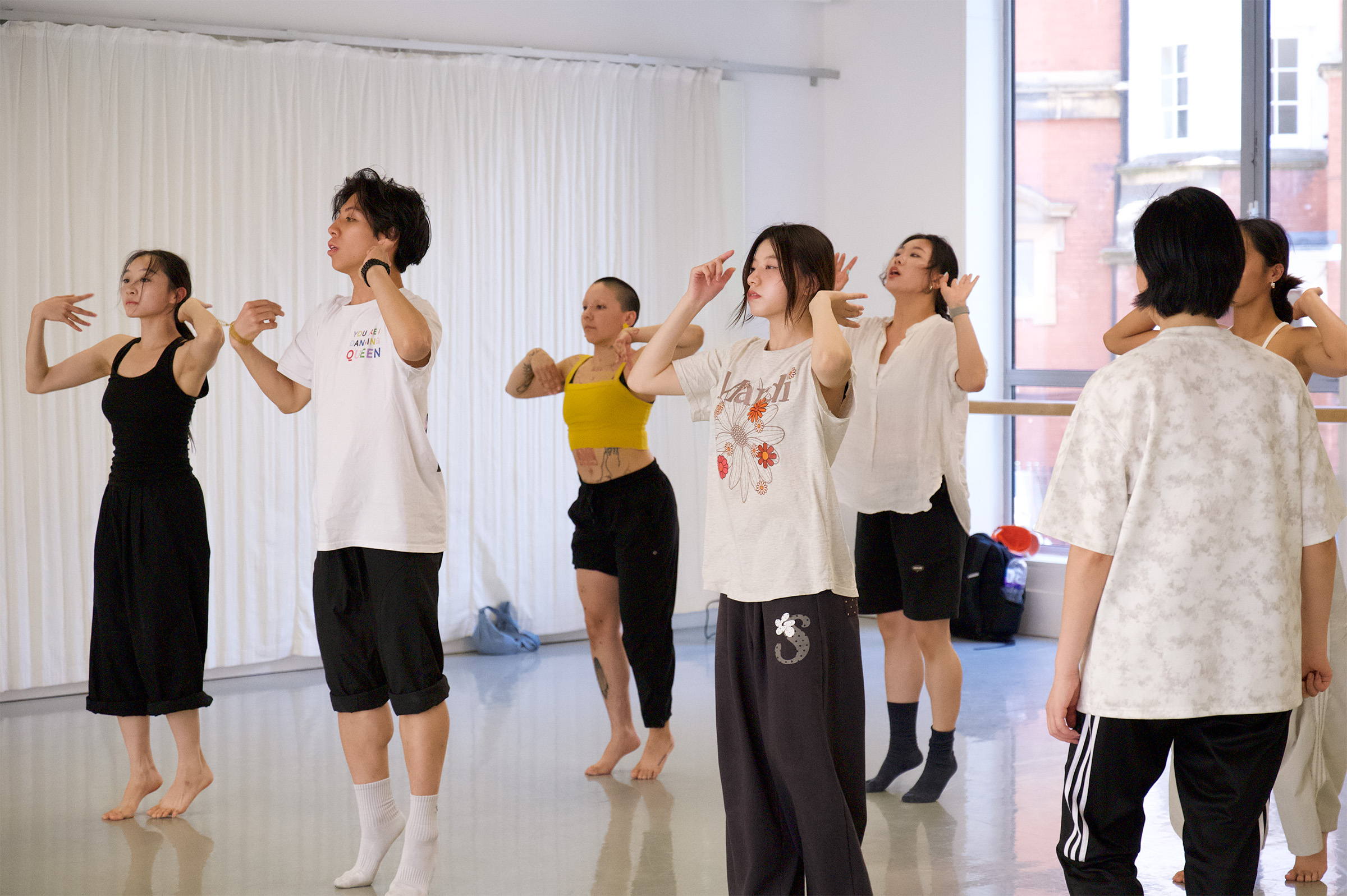
We embark on the first day of rehearsals, high on excitement, the dancers meet each other, meet the choreographers, and together, we embark on eight processes.
Each process vastly different from the
Choreographer Wang
As you enter each studio you find a different sound. The choreographers curate the yìjìng (意境) — mentioned in the introductory post — the dancers respond, with their background, their luggage, their soil. The yìjìng is amplified.
Electrifying energy is palpable in choreographer Cheng Yongping’s rehearsal as precision in movement and enthusiastic energy allow for an impressively efficient transmission. Despite the language barrier with one of the London dancers, he is not left behind — and is in fact enveloped by the group. Everyone in the group becomes native to this yìjìng. Their new language of communication.
Clapping and cheering is the atmosphere we walk into when entering Nayaw Fangas rehearsal hosted by Ifen. Dancers present improvised solos to music of their choice, using this as a form of introduction to each other, creating a supportive yìjìng from which to begin.
In Ma Nan’s rehearsal dancers quietly work in pairs towards perfecting material that is set. In this room yìjìng appears in bubbles, that surround and encompass the pairs. Each bubble with their sharp focus on a different movement, but all bubbles creating an
Léa Tirabasso’s laughing prompts create a vibrant yìjìng full of personality, where all dancers take ownership of their choices. The outsider becomes spellbound, becomes a part of this flowing vignette. As you see the dancers process to make choices the viewer plays
Another moment of vibrancy with a more chaotic tint washes over Wing Fai Tsang’s rehearsal. As the dancers speak in languages they don’t know, laughter emerges. A cacophony of unregistered sounds builds up in the room as dancers try to understand each other. Somehow, over time, and with the help of the echo in the room the chaos starts to sound like a choir.
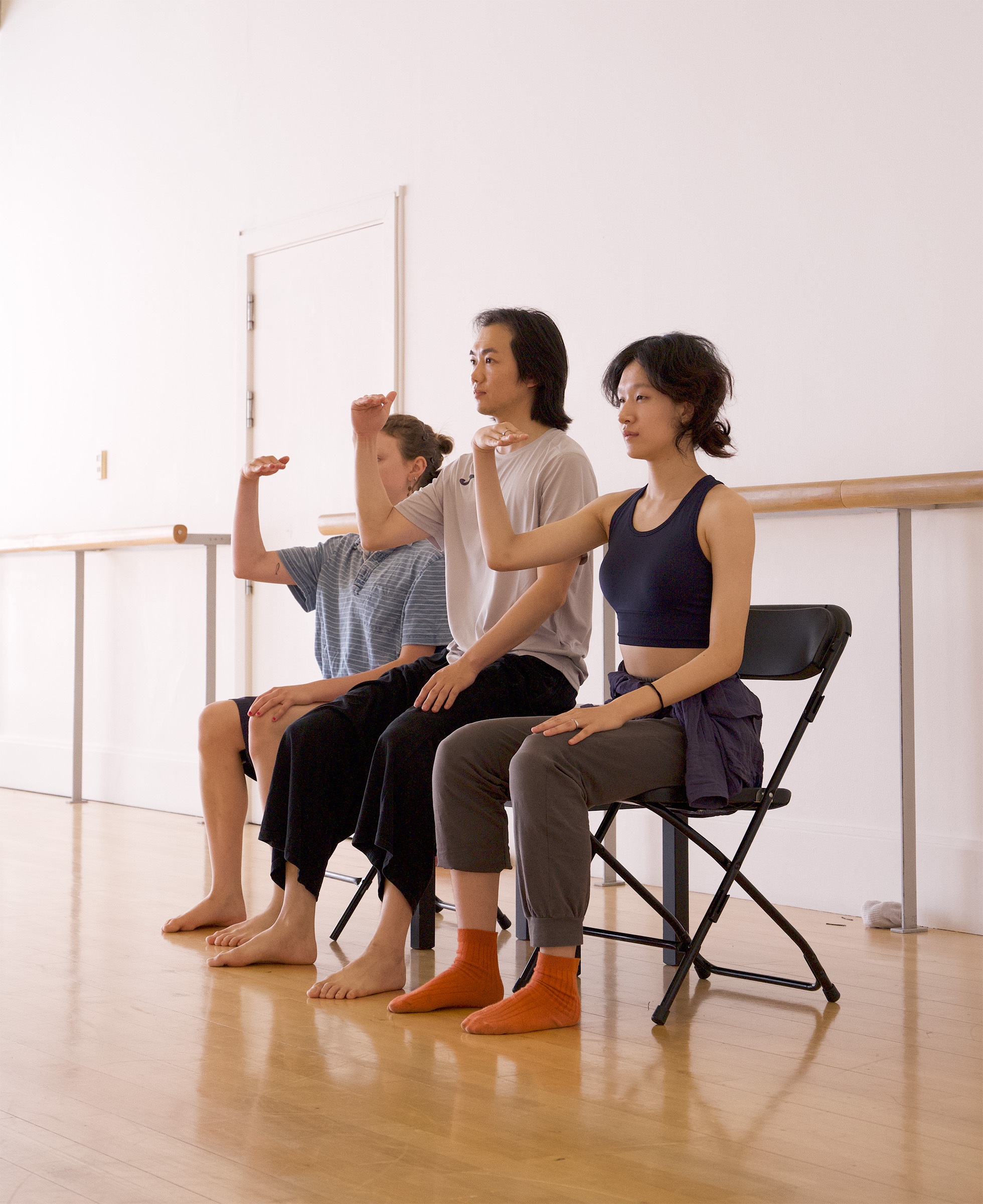
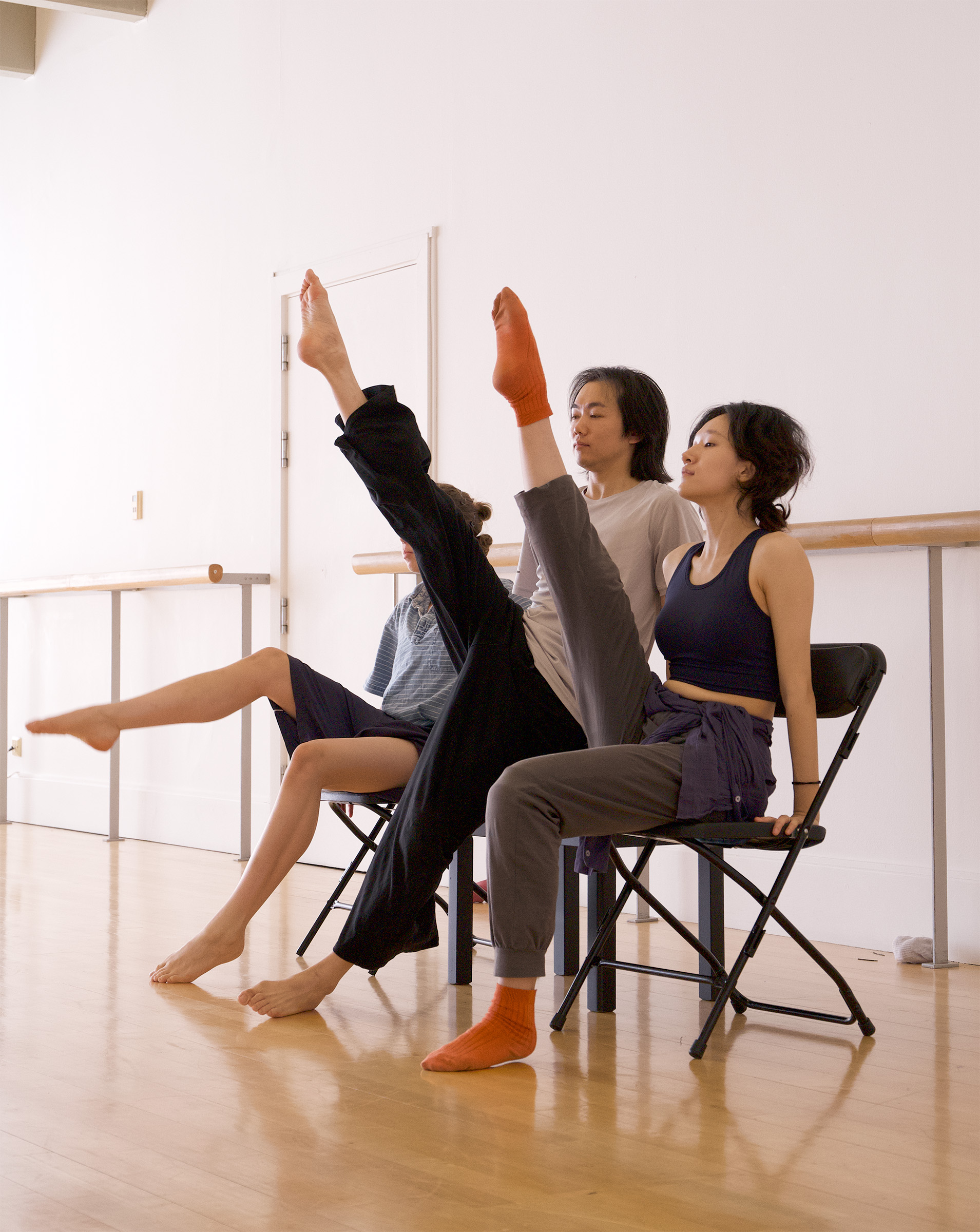
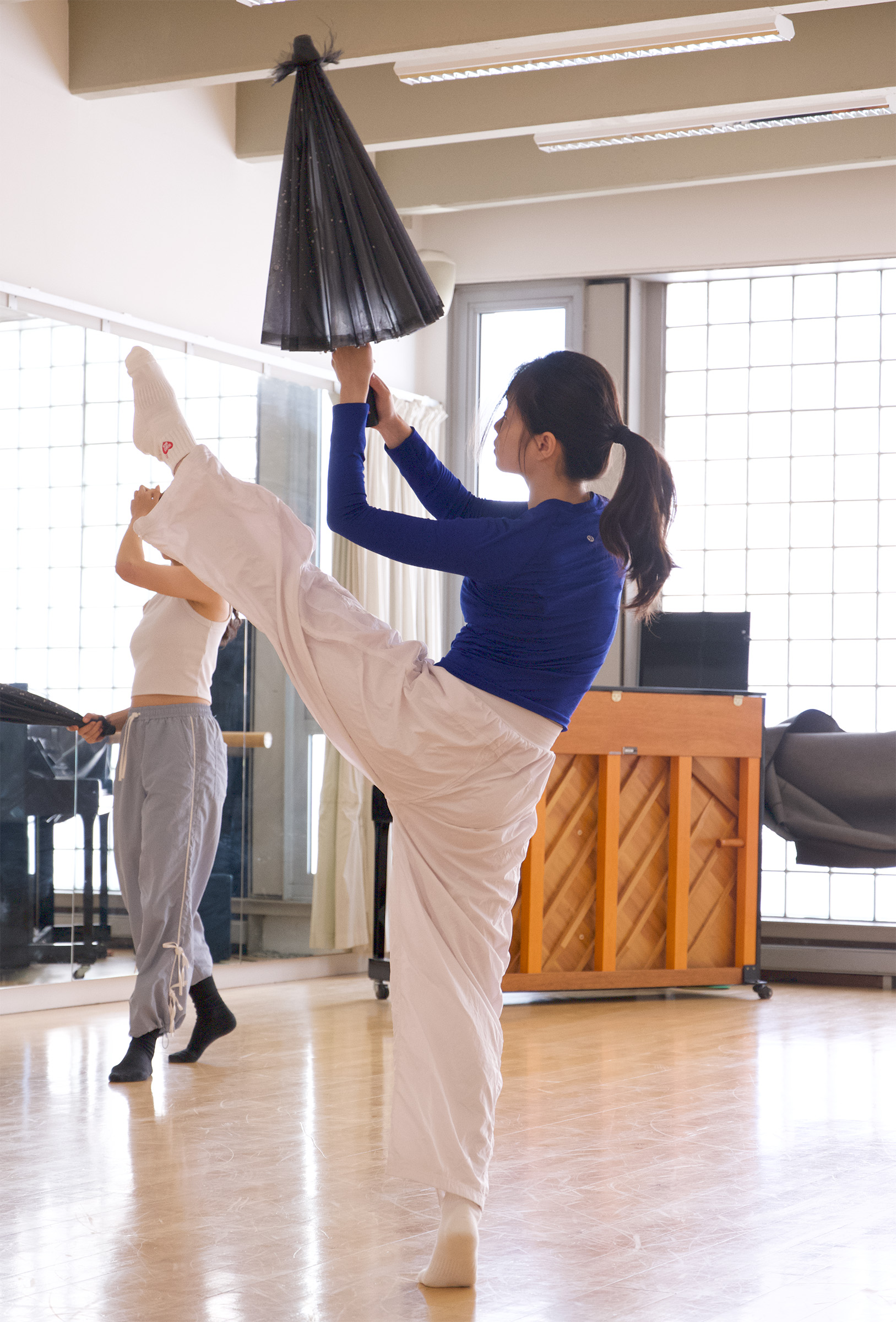
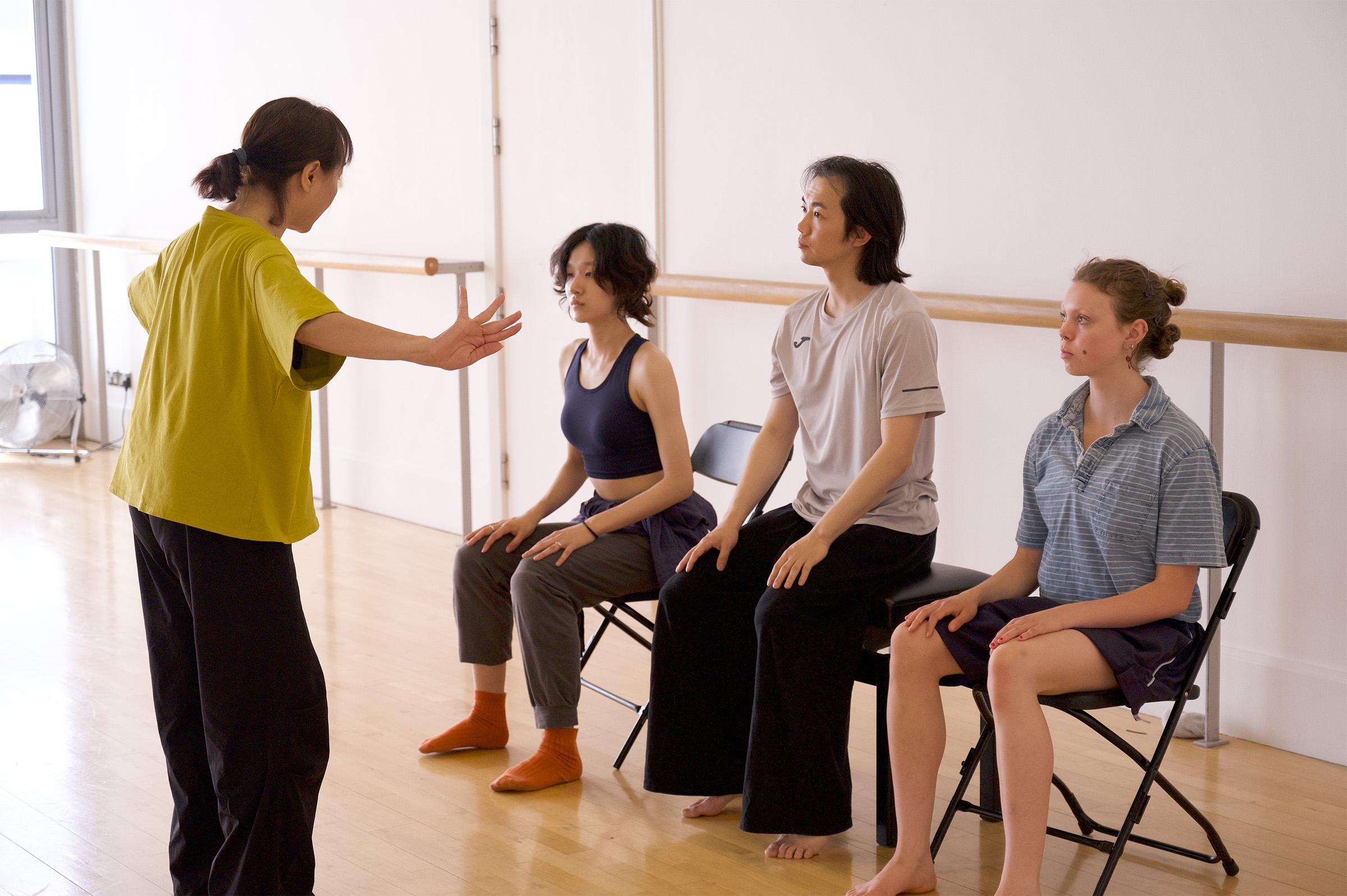
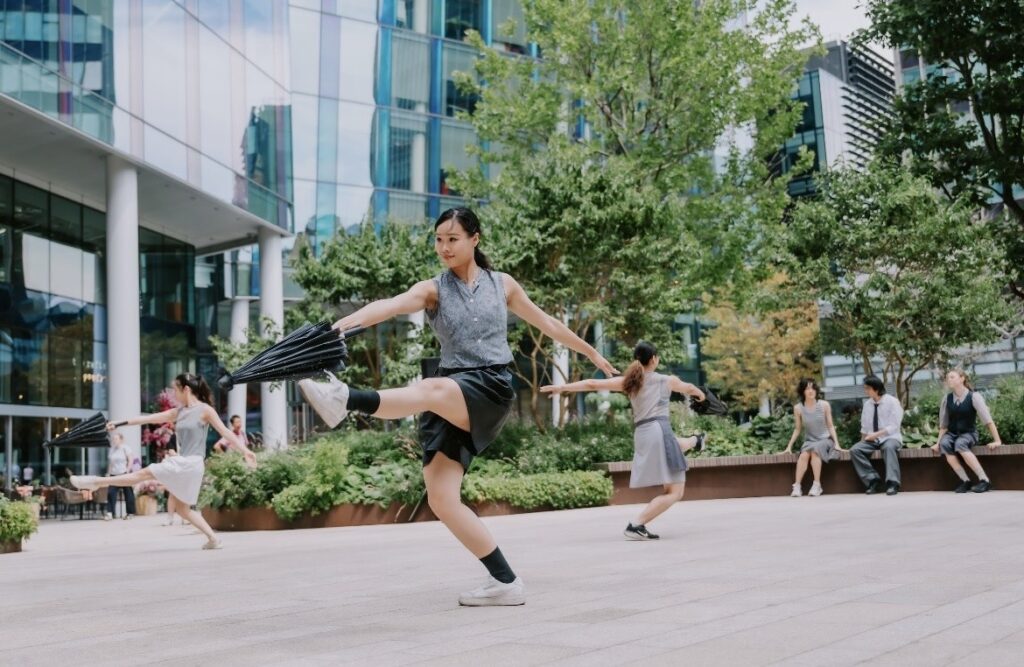
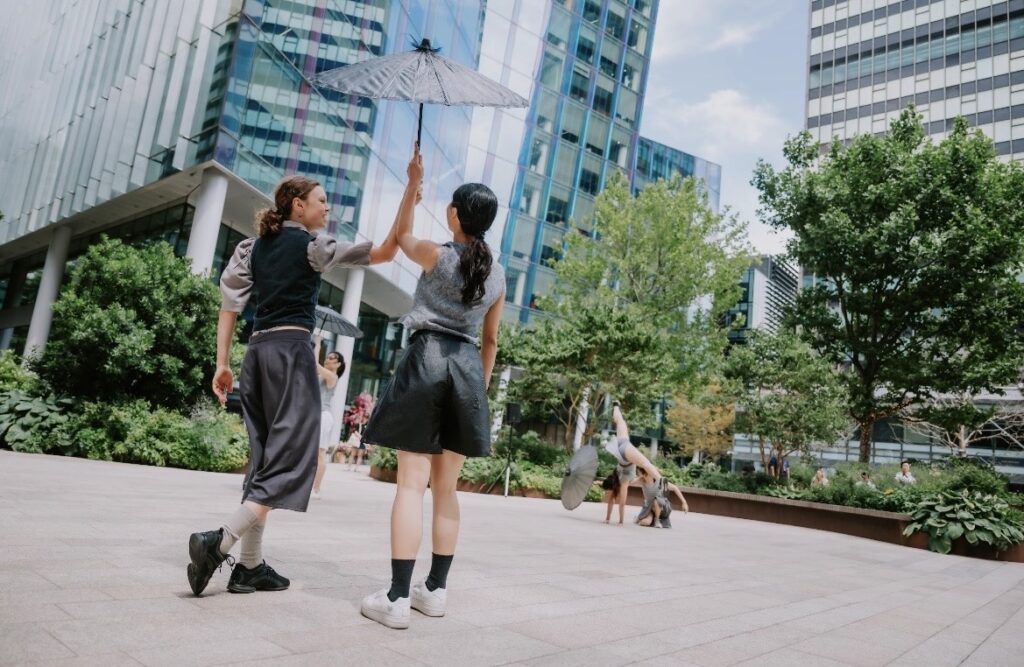
Pik Yim Yu brings umbrellas to her rehearsal, and as the dancers attempt to bring them to life, and incorporate their rhythm, cadence and space to their bodies the focus becomes precision. The yìjìng that overtakes the room exudes concentration and careful consideration of both the dancer’s kinesphere and wider space where it becomes almost addictive to observe repetition grazing obsession.
The yìjìng in Wang
FUBUNATION rehearsals are silent, as the dancers work individually in small movement tasks. The yìjìng of this room can only be described as dipping the toes in water, as both Waddah Sinada, and the dancers try to understand each other, find a common ground, and collect in a yìjìng that speaks as a group.
Written by Adriana Garcia Pinilla — Documenter
Week1: Appropriation or respect?
Pik Yim Yu’s rehearsals with umbrellas have a heavy base in Chinese traditional dance forms. The dancers, have knowledge, experience or are at least familiar with Chinese traditional dance, with the exception of Western heritage London Contemporary Dance School dancer whose dance background is moons apart. It is important to acknowledge the gap in cultures, and the white dancer partaking in this project raises the question for her: Appropriation? or Respect? Encountering a form so foreign to them poses the reflection of how much knowledge of the culture do they need to have to perform loyally, to understand the movement and allow a respectful embodiment of culture. This reflection is countered by a number of questions, questions that with a desire to honour the culture become sensitive. The fear of repercussion, of wrongdoing, killing the curiosity, or perhaps it is more appropriate to say, the desire to ask. My question in this is, how do we lower the stakes so that the research goes beyond the execution and enters a world of understanding. Perhaps, allowing space for a conscious incompetence (a known lack of knowledge) to dive into a wider pool of unconscious incompetence (not knowing what we don’t know) and over time, grow in familiarity. How do we become more aware of what we know, as we explore that which we don’t?
Written by Adriana Garcia Pinilla — Documenter
Unprocessed studio notes from Tom Hastings
Tsang Wing Fai
When you dance with props or objects, how do you get to know the object?
One dancer responds, “I see whether it’s hard or soft, its qualities, whether it has cultural meanings, and what its uses are… I think about the relationships between body and prop…”
Another: I want to know the weight of it, and the texture…
And another: The sense of touch and shape
We were talking about the cow and not being able to touch the cow (cloud!)… Each of you take some and just explore… cloud is just a metaphor, it’s out of place so it can be anything… Don’t eat it… (gestures of eating)… one dancer makes a Santa Claus beard. Just explore the material, you can completely destroy it, just play… texture, weight, colour, what can it become, what can you imagine from it, enjoy it (task)
Dancers flatten the cloud material on the floor and pound it in a loose circle as if they are threshing in the field, labouring, or doing a craft circle. Dancers begin to fan out with the materials, to partner with the cloud. Fei puts the cloud up her
“The longer you mess with it the more dense it gets. I found it hard to
In Chinese, “It’s meditative to tease the material apart”
“We don’t investigate what is inside a cushion, we hold it on the outside. Testing how long the material will hold by a thread. Not that easy to change the shape unless you make it more dense.”
“The material rebounds…”
“Imagine this is our body, becoming very light. Keep this feeling of the body and lets try standing up and remembering this. Keep bouncing, find a space, keep it in the air.”
The energy in the studio shifts with the introduciton of the material. Glimpses of performance history, of Yvonne Rainer and her dancers lugging mattresses aroung the performance area. Of the displacement of qualities from body to object and vice versa. The material introduces a partner for dialogue and exploration, activating the dancers in their investigations. I am curious to see where this leads.
June 29 afternoon
Studio 3 FUBUNATION
Listening to Waddah is inspiring: “Check in with ourselves, our breath… just try to notice your breath… where do you feel it, in your belly, your back, how heavy do you eyelids feel, where do you feel the weight of the soles of your feet, are your shoulders relaxed, how soft are the joints in your body, thinking about all the space around your body, the space underneath your armpits, the space in between your fingers, in between your knees… what does an exhale feel like in your body, and if you magnify that a little into a movement… breathing out, a sense of yielding, of letting go, of releasing, and breathing in, refuelling, recharging, a cycle… When you move think about various parts of your body, do they feel heavy or light, changing the nature of the space… if you tilt your hip, how does that affect your spine… just move to feel, not to perform… observe the information your body gives itself in response to a decision… always check in with your breath, it has to be present with everything we do… I will offer some contact… think about the energy you give to the room, with your back as well as your front… just think about stretching the possibilities of how we move, the snake in our spine, the twist, and then think about timing as well… how much time do you give to something, how long to you allow a single moment to exist, don’t always feel the need to move on… start to explore that idea of taking up space when you’re moving or not moving… Are you falling into a place of habit? Sometimes it’s really good not to go with your first instinct but your second… choose to go against it and see what happens… always look for those places and pockets of less… where do you choose to take your eyes… and together as a room we’re just starting to decelerate… still making our own choices but now coming together…”
How do we arrive at a process?
How to tackle the fear of not knowing?
Dancers are distributed across the whole studio; they move at different speeds; some twist, others on the floor, others work more with hand gestures.
“Making a choice in your body and then seeing what the remnants of that decision are… idea of consequence, I initiate movement, I bend my knee which tilts my spine and diverts my eye… when do we take over, when do we let lie… with someone I want to do a short exercise where you suggest something, make a decision for you and your job is only to follow that decision… If you don’t give me enough information, or not good information, I don’t know where to go with that… and then if you give me direct information, the ask feels clear, the sense of direction feels clear… if you’re the person doing, it’s about being clear… to feel the involuntariness of it…”
“If you think you’re being clear with your instruction, be even more clear… if you’re the person moving you shouldn’t have to second guess… what the puppeteer is deciding… As a mover, I’m going to make a decision that functionally works… sometimes I can give quite small instruction, or challenge her to stay with me… if you’re the person moving… the thing that will help is to try and be soft…”
30 June Tuesday morning
Studio 3 Wang
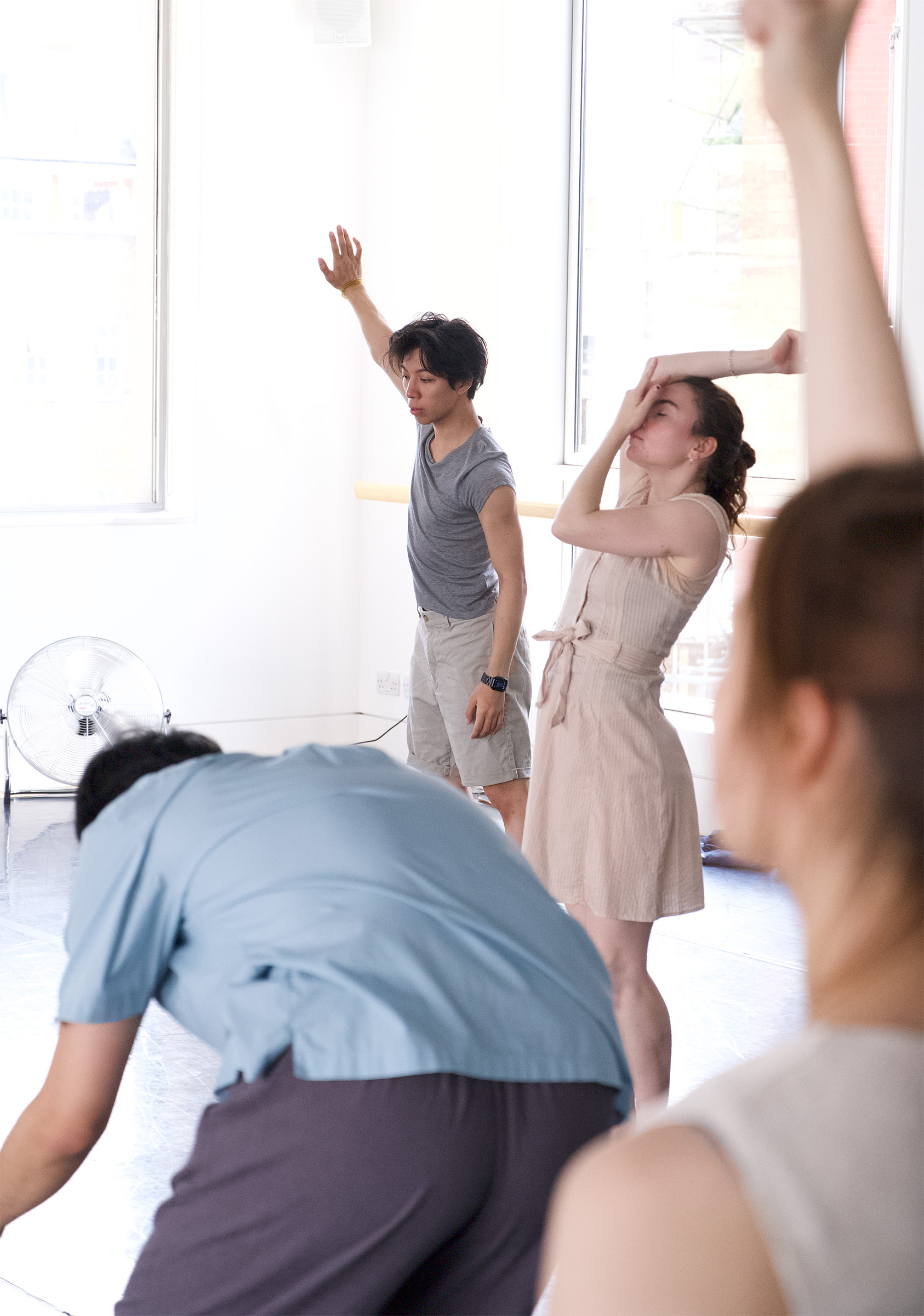
Dancers clapping and stamping rhythmically. Followers and leaders. There is a game of follow the leader happening but the rules are somewhat unclear. The dancers move as a pack. It seems that the person at the front of the group is the leader. Once the group turns, the position of leader shifts to a new person: the head of the group. And at some point, the group turns to rhythmic clapping and sashaying. I wonder whether the group is going to break or split. There is a commitment to the pack. “I think it’s still a little abstract. Leadership is more concrete. This time let’s try breaking through to take the leadership role.” They start from the beginning with spinning. This leader is a little more gestural: shushing sounds with index finger; clap. And then the groups shifts to the London dancer as leader. And quickly shifts back. A kind of battle. The duration of each leader speeds up. One dancer turns the fan on and stands right in front of it with his hands on his hips; he stares right at me from across the studio: disconcerting. The dancers work in pairs; on forms of conversation. “First of all, present yourself, then present the dialogue. So if the group has a lot of energy you go with the flow. The group will be doing its thing.”
Studio 3 Tuesday afternoon
FUBUNATION
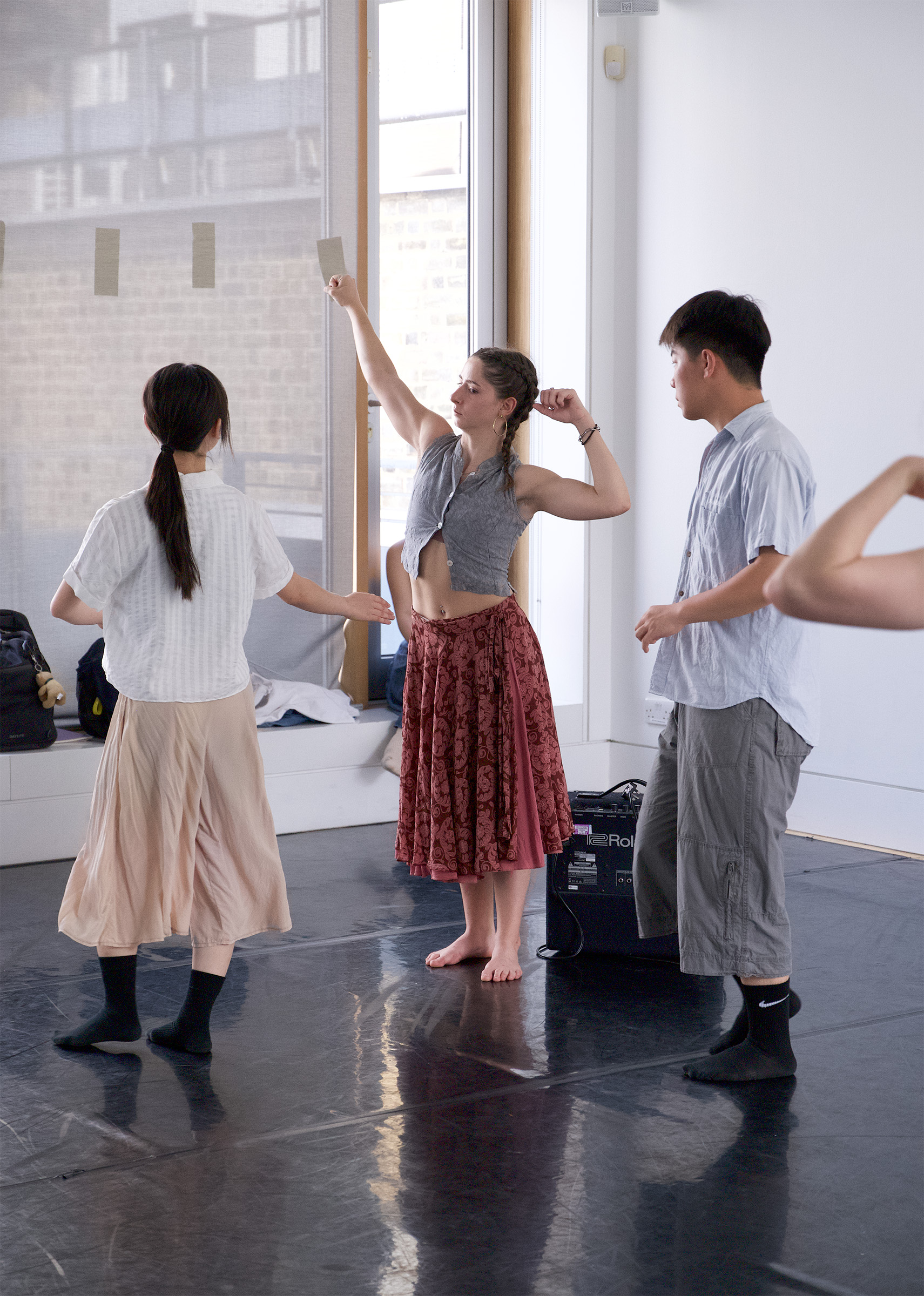
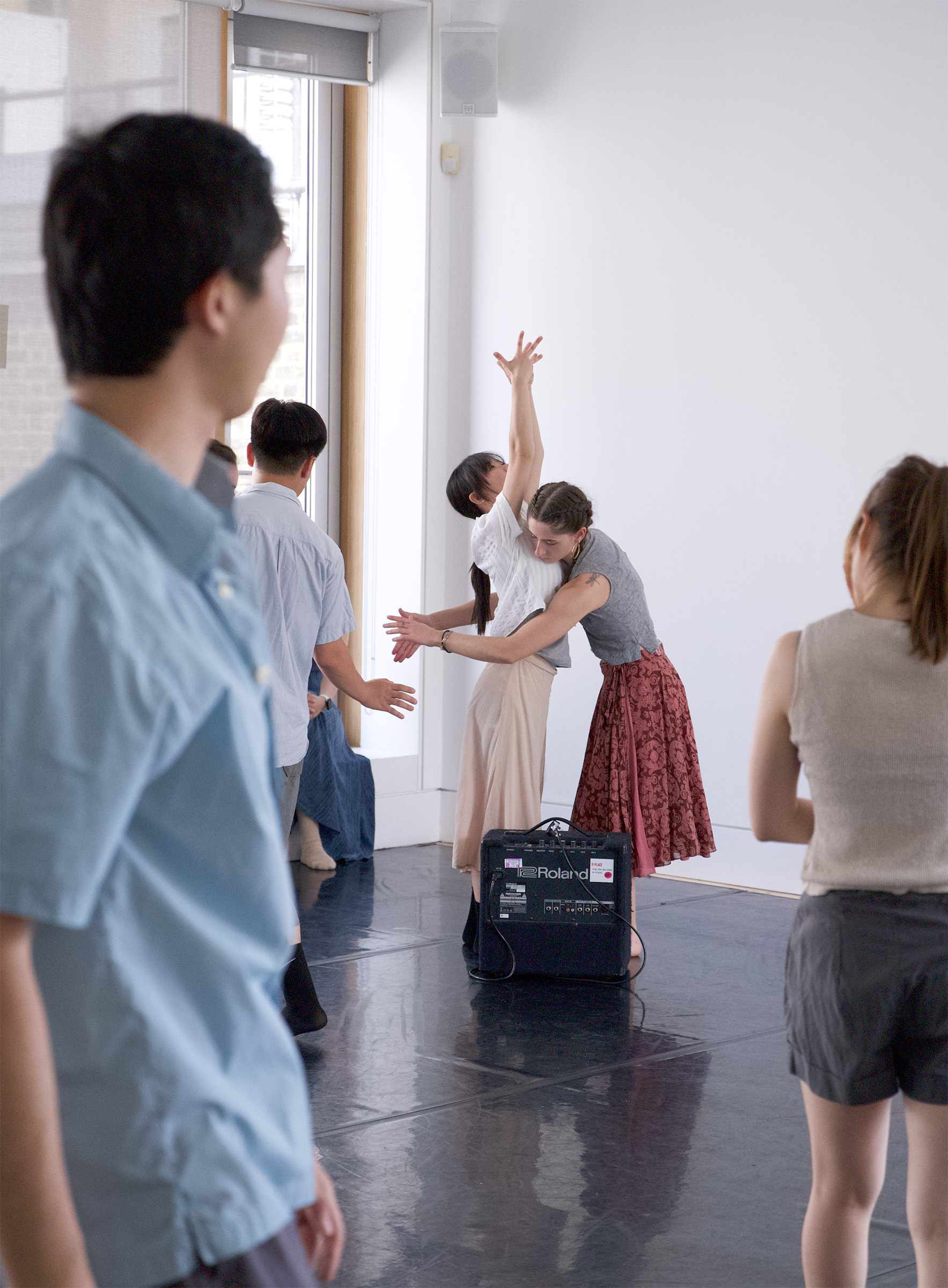
Dancers face each other in two lines. Walk slowly towards each other, maintaining eye contact. What does connection mean: reference points or differences in another body; how these points harmonize or collide. Don’t feel stuck on a train track; open up to your peripheral vision; work on your expression; “you’re going towards something; you’re giving a lot in this direction; but you’re leaving behind; there’s a trail of narrative; there’s a presence that remains as you leave it behind. Thinking about that might leave a bit more consideration of your backspace.”
“It felt like there was a really big story going on between us.” Changing who you’re conversing with… gives different context.
Studio 6 Yu Pik Yim
The back row of dancers move with umbrellas. The front row of dancers receive instruction from the choreographer. High kicks and twists. Not much is happening. Unclear whether some work has been set, if dancers are waiting for instruction, taking a rest, or working independently. I wonder why some of the dancers dance with umbrellas and some do not.
Monday morning 6 July
Studio 10 FUBUNATION
Waddah is giving directions to two dancers, suggesting how they move between states of tension and softness. Soften, soften, soften, strong. Aiming for contrast. Don’t let go of one pose to find the next one; you have to take it with you. Wait for the breath. Better. Does it feel different?
Written by: Tom Hastings (Scholar)





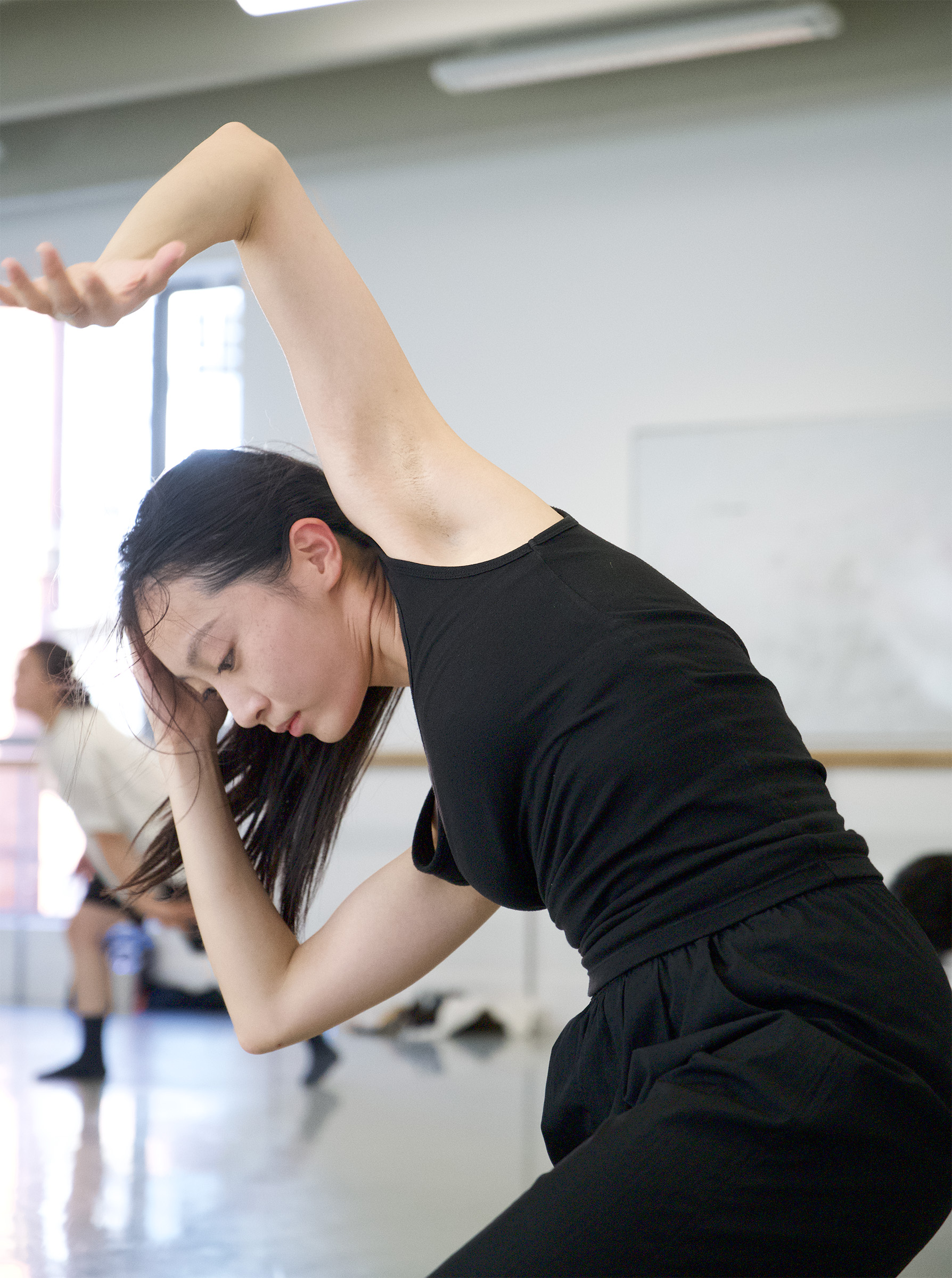
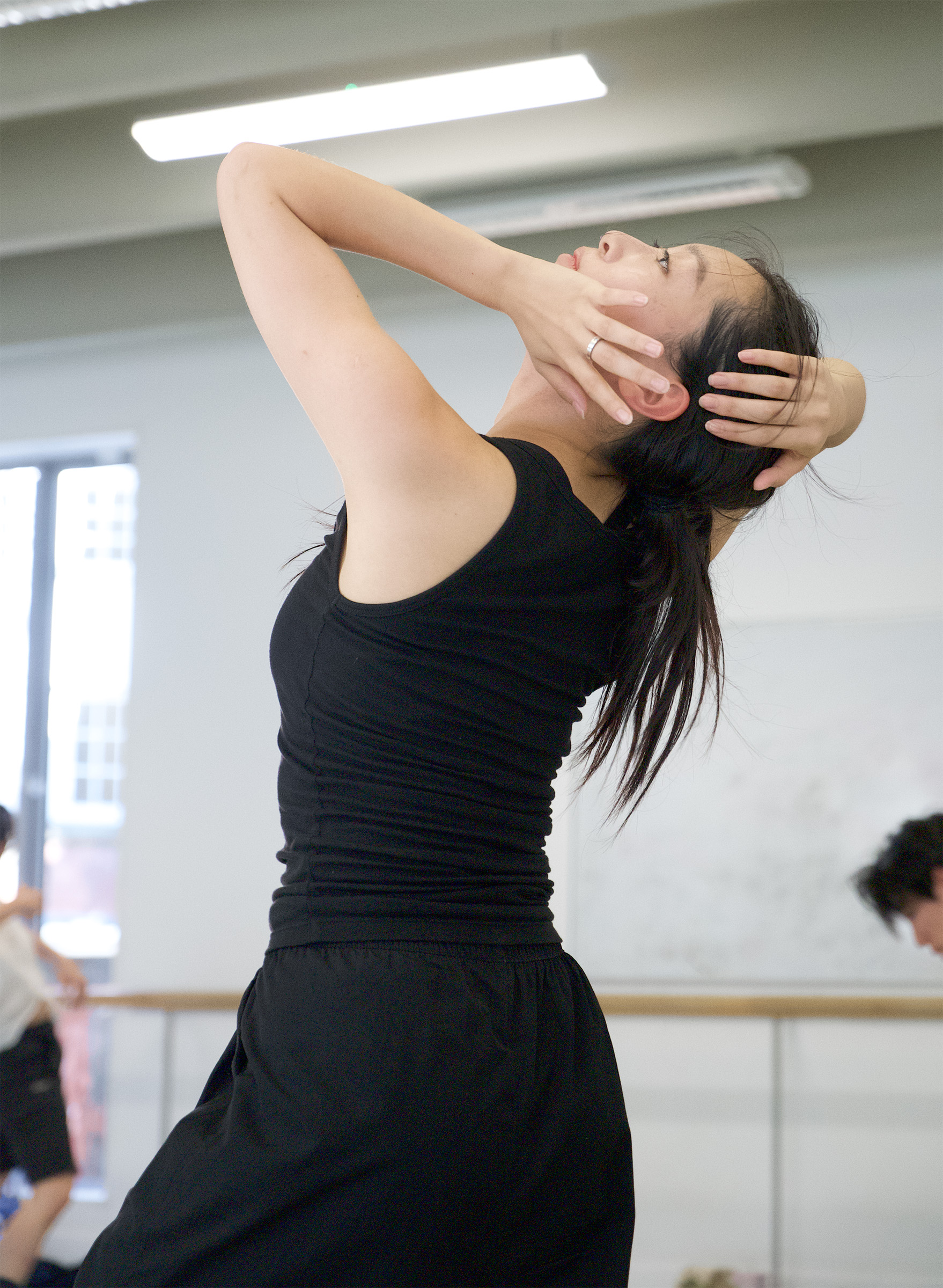

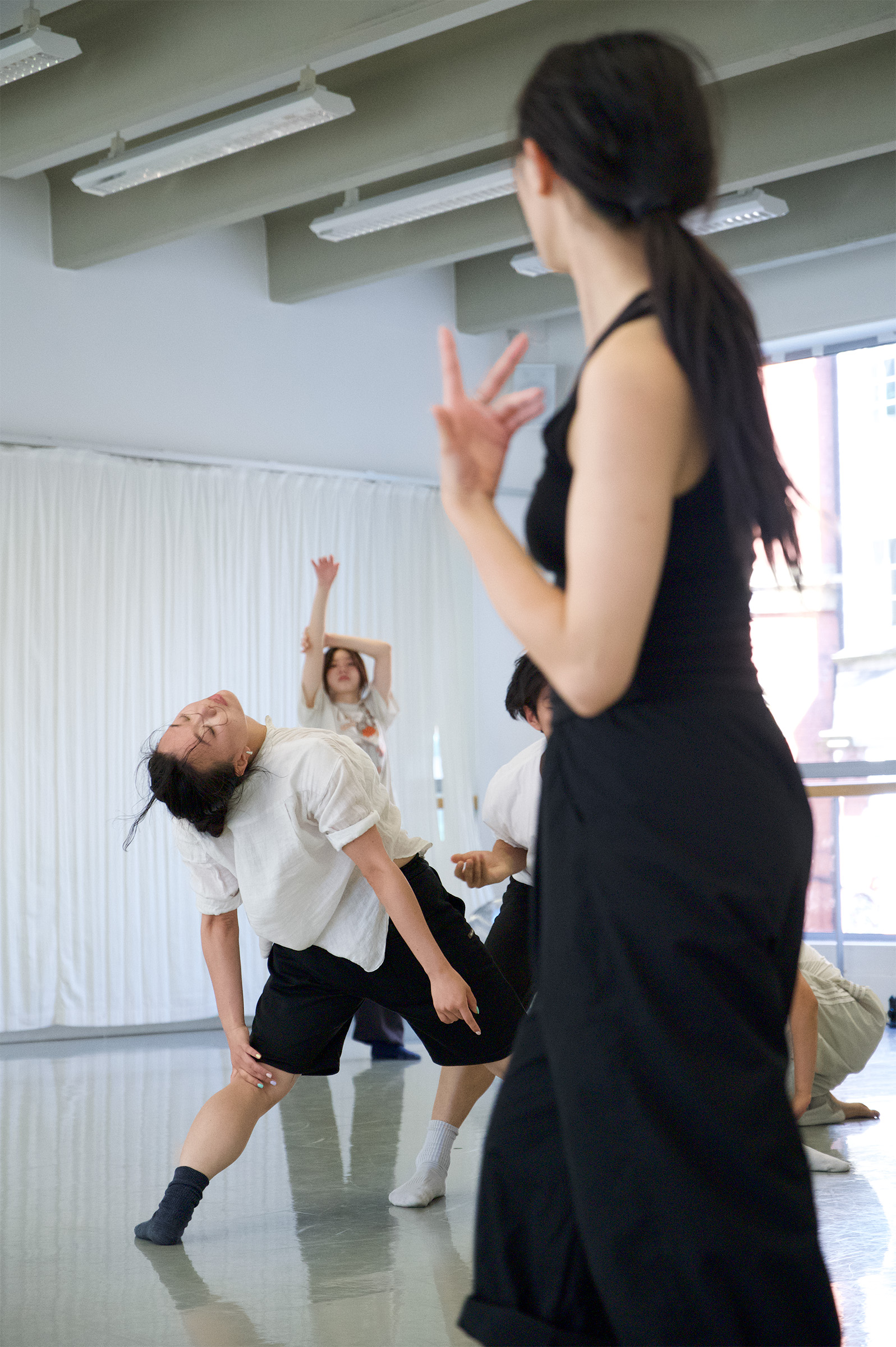
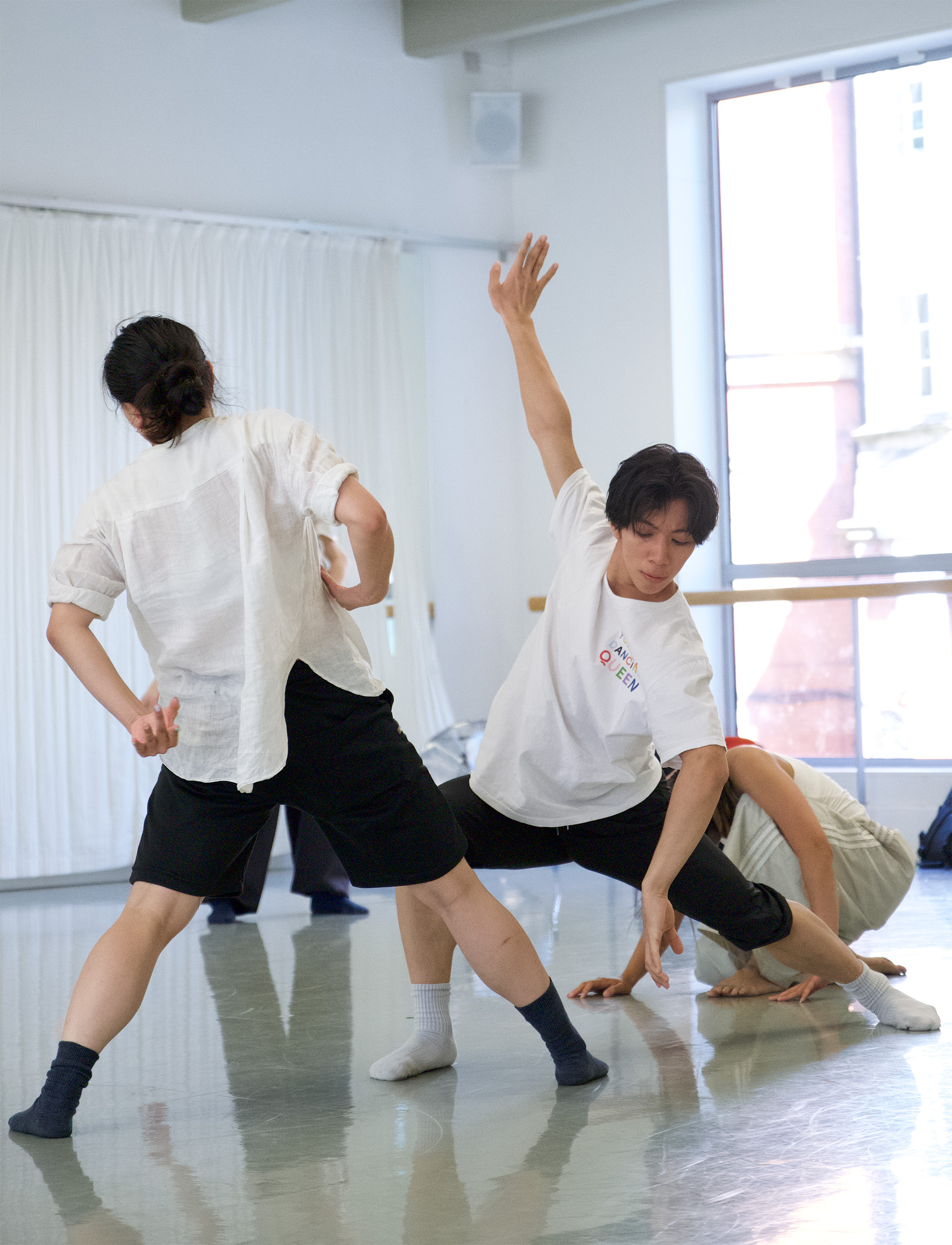
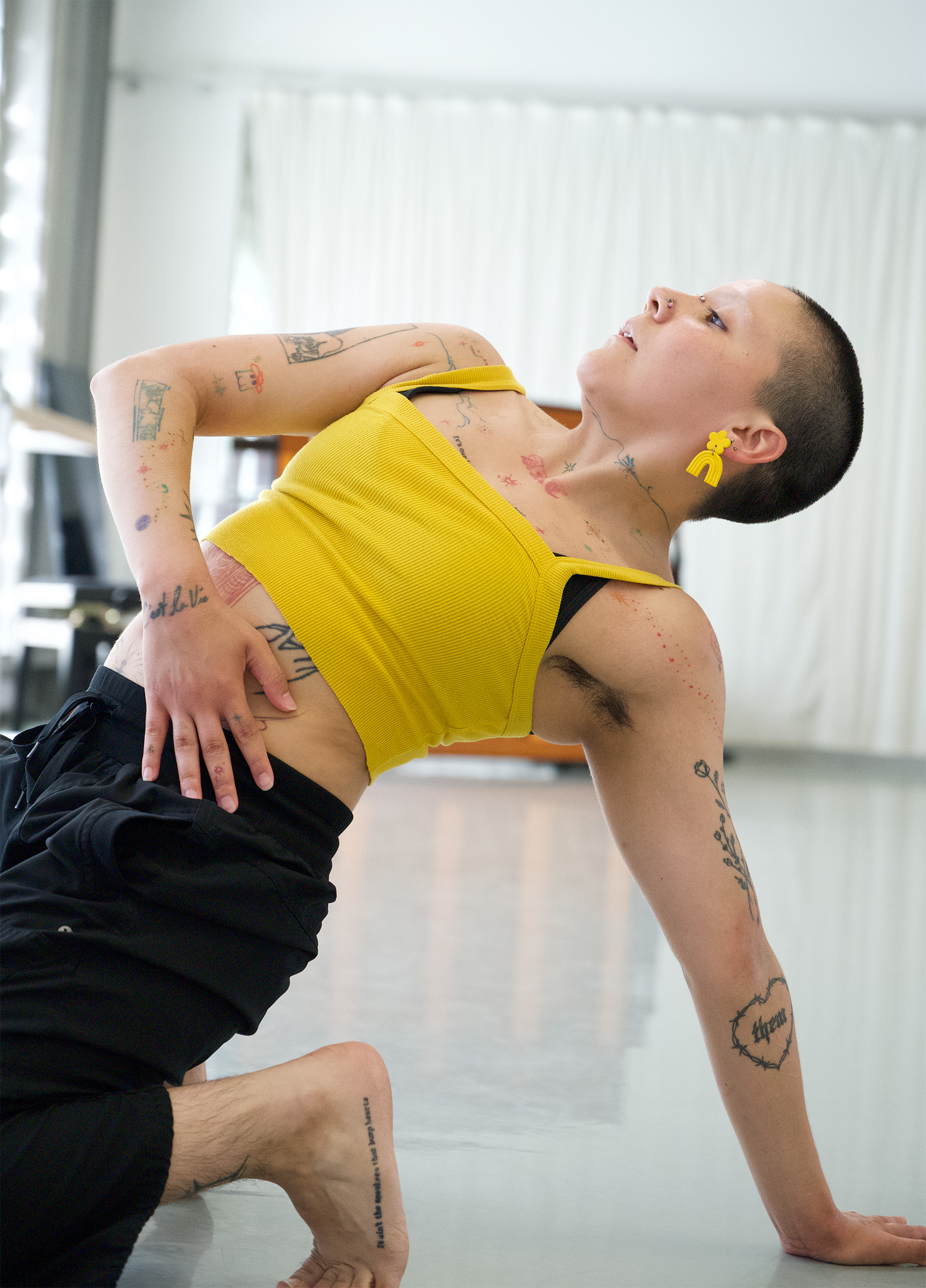
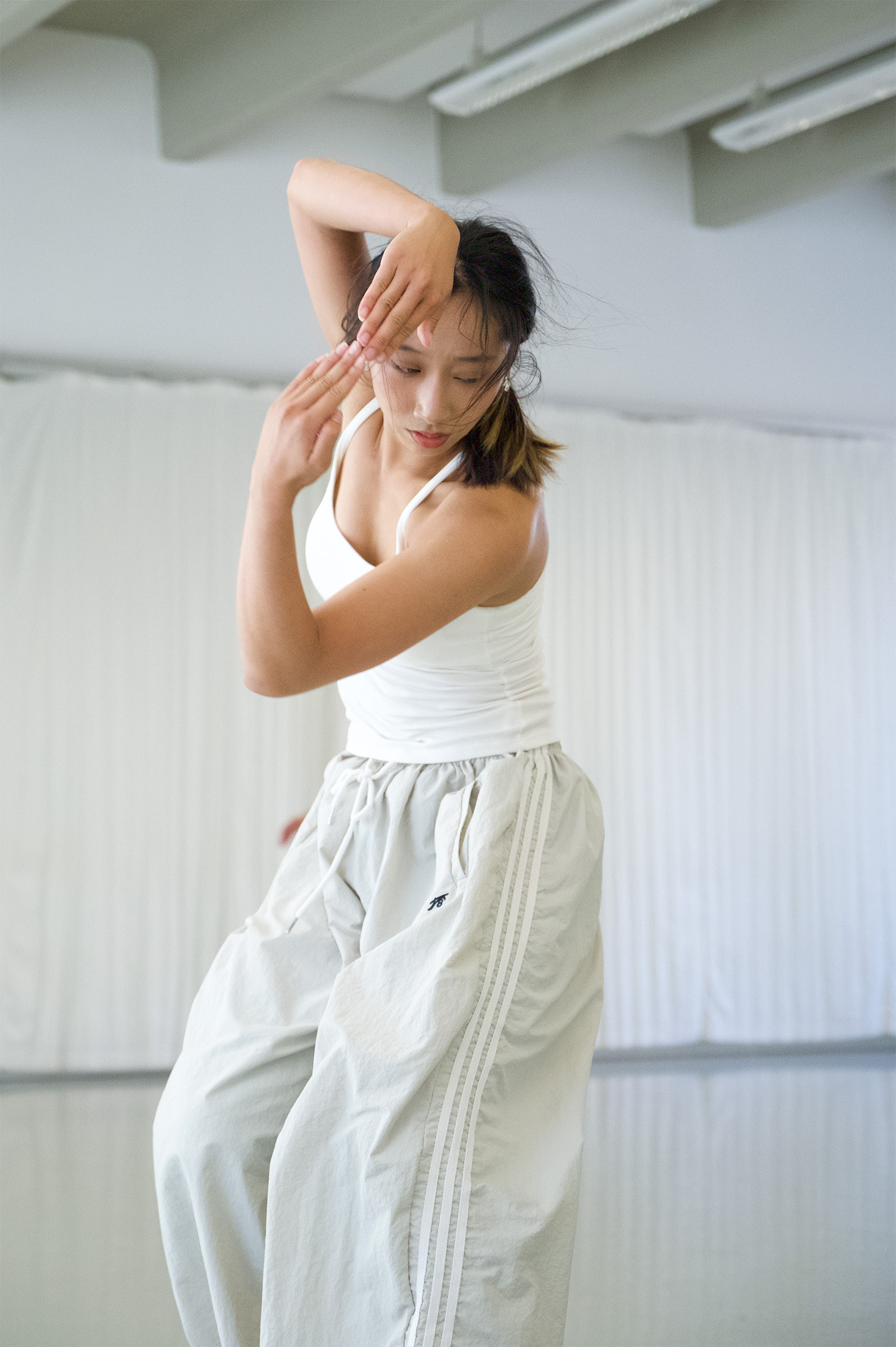

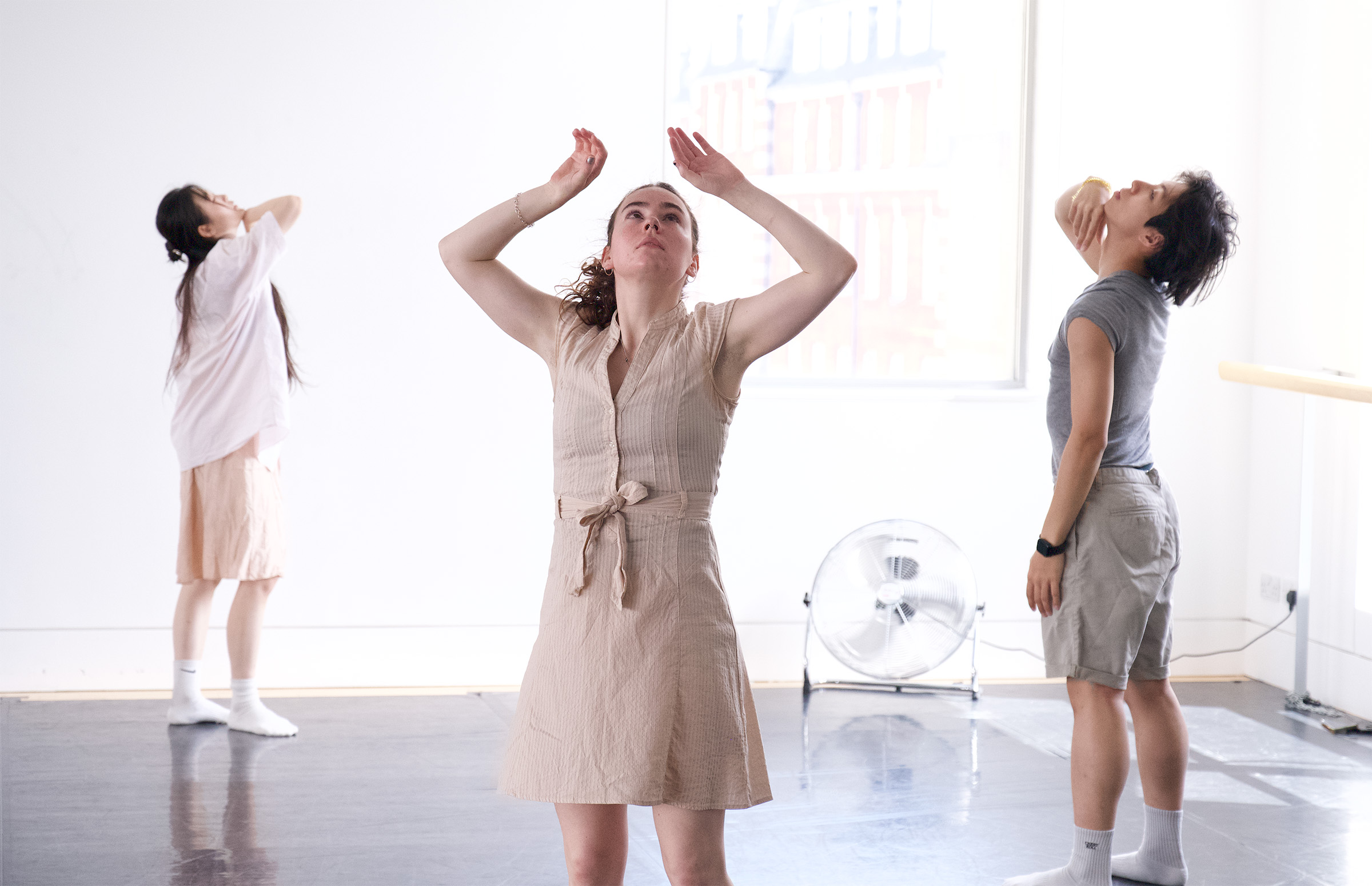
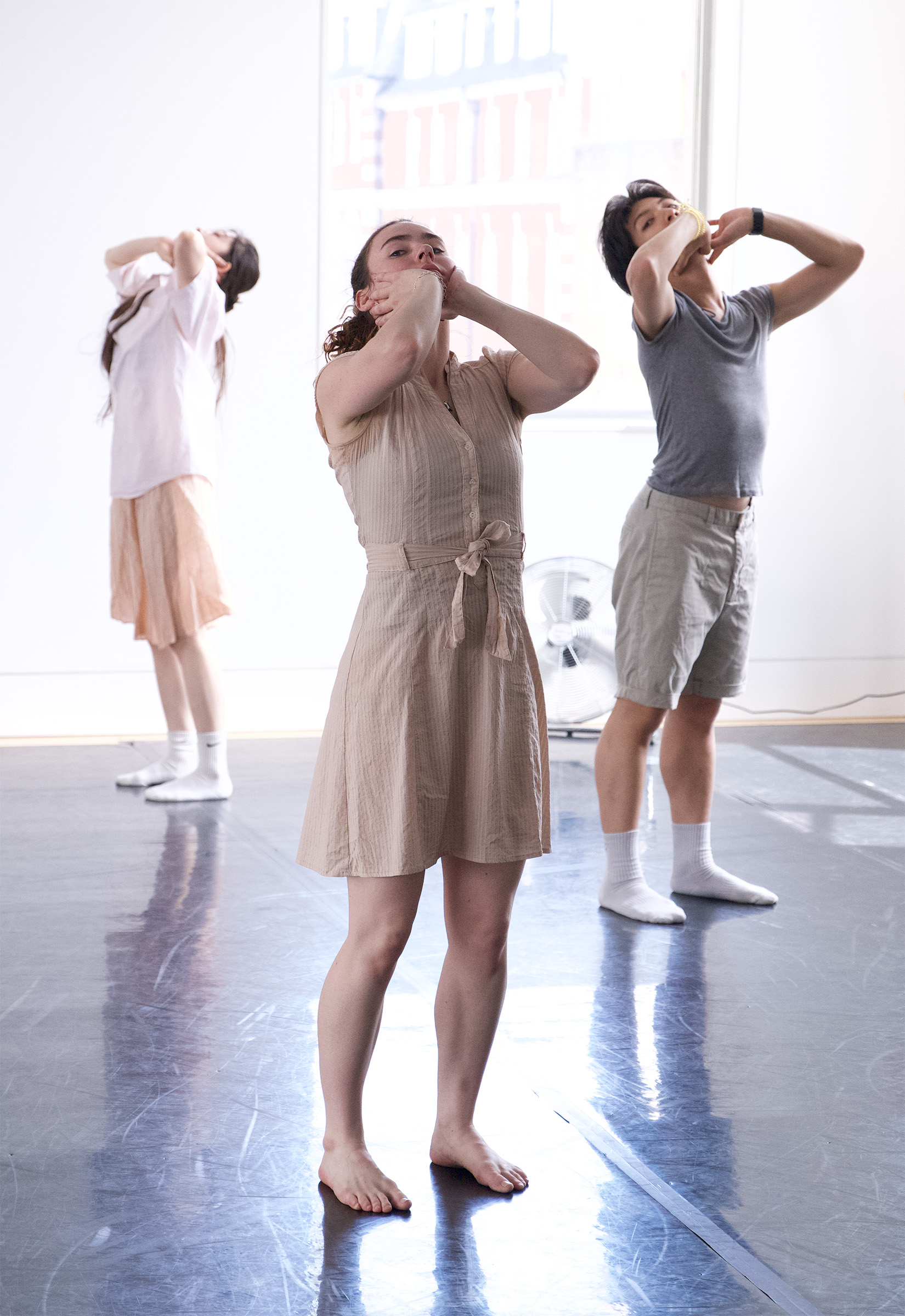
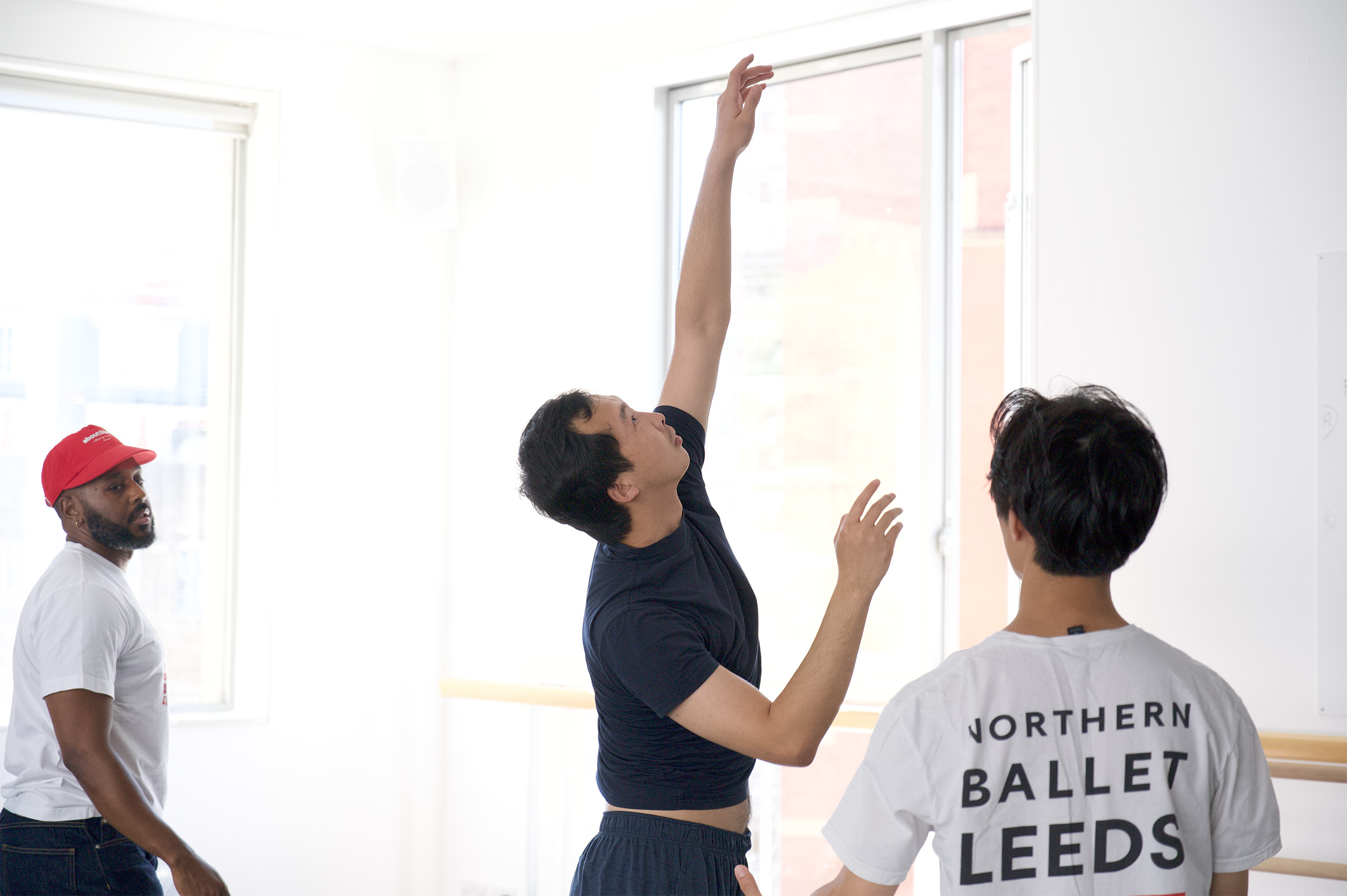
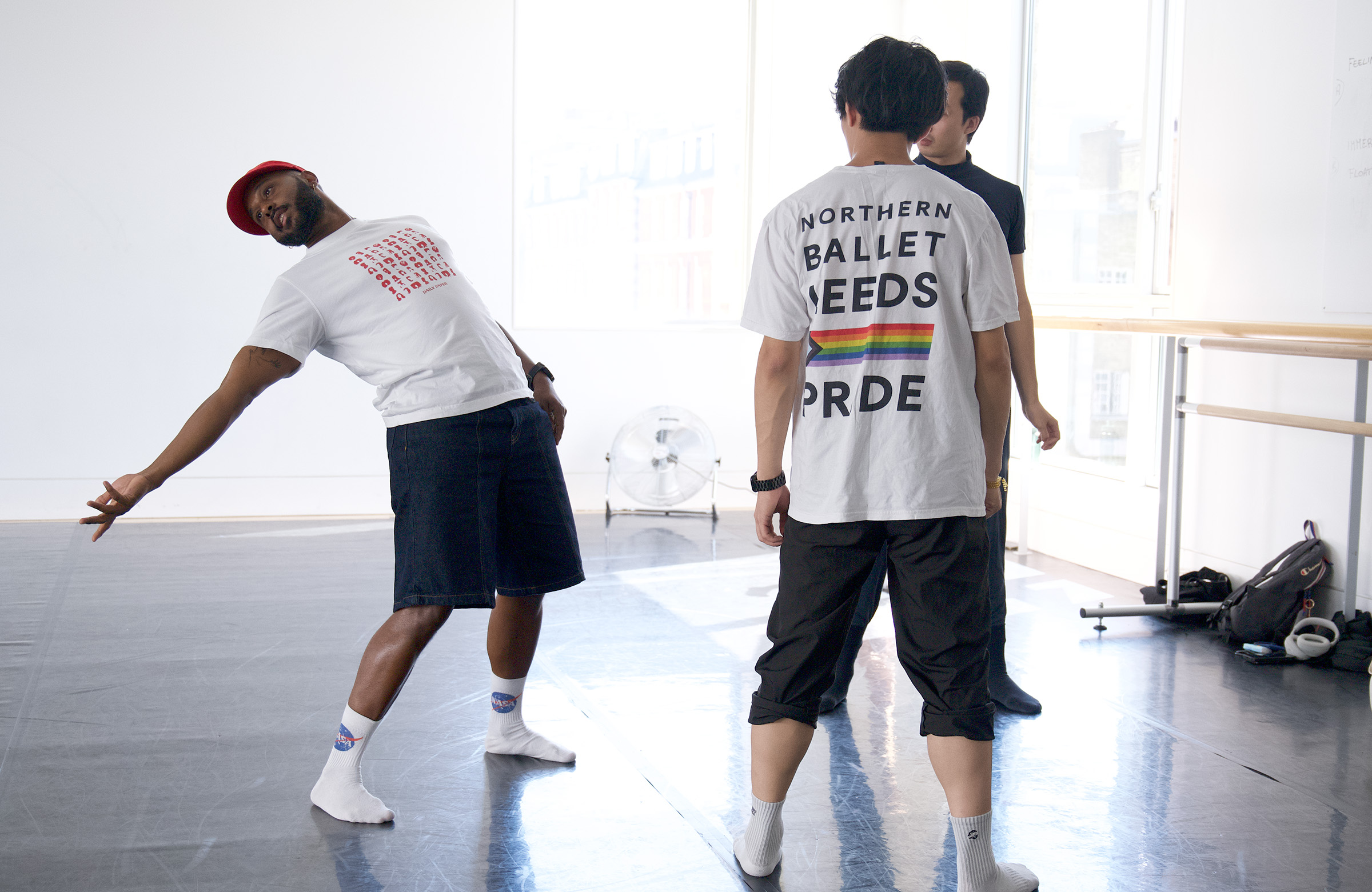
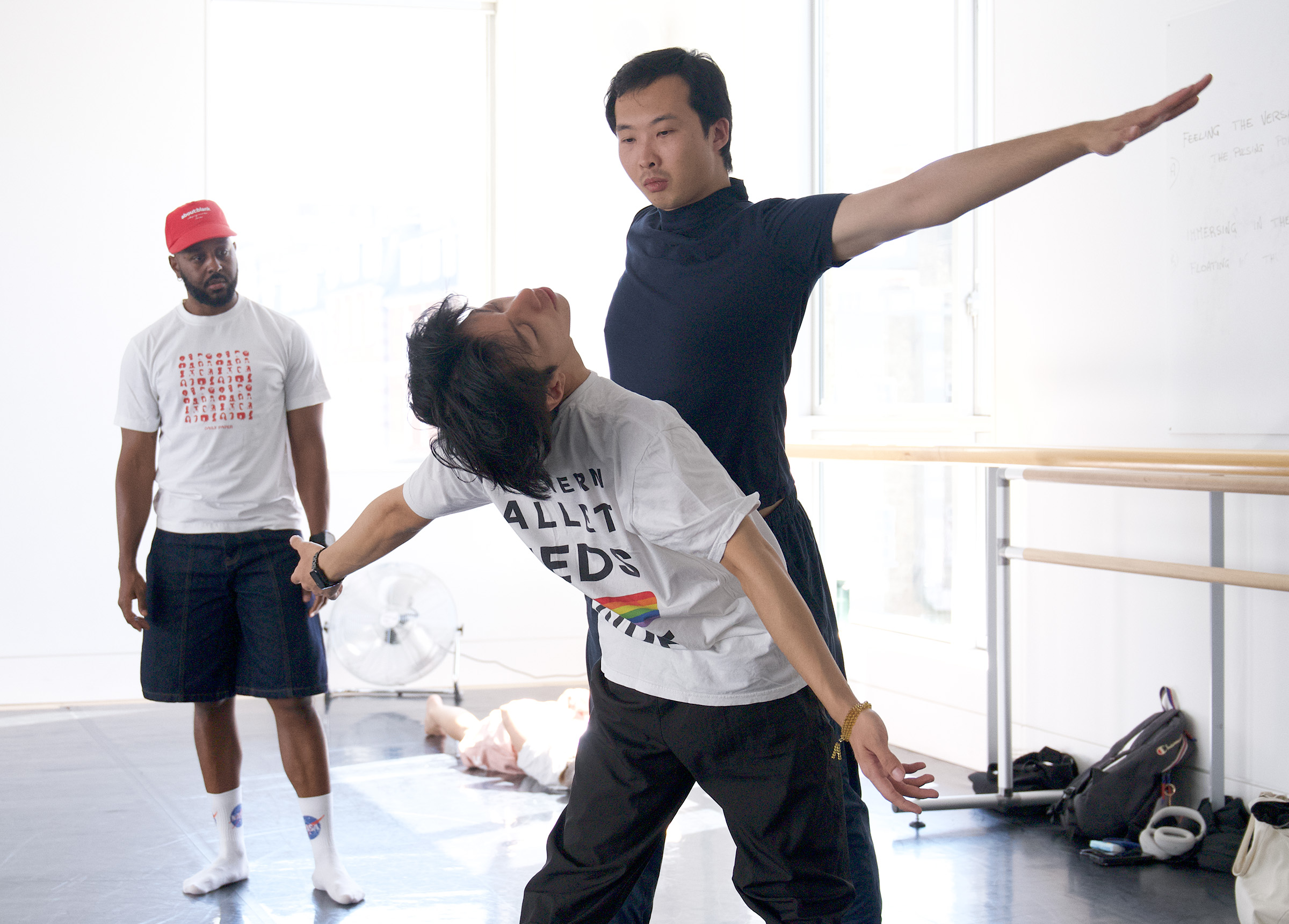
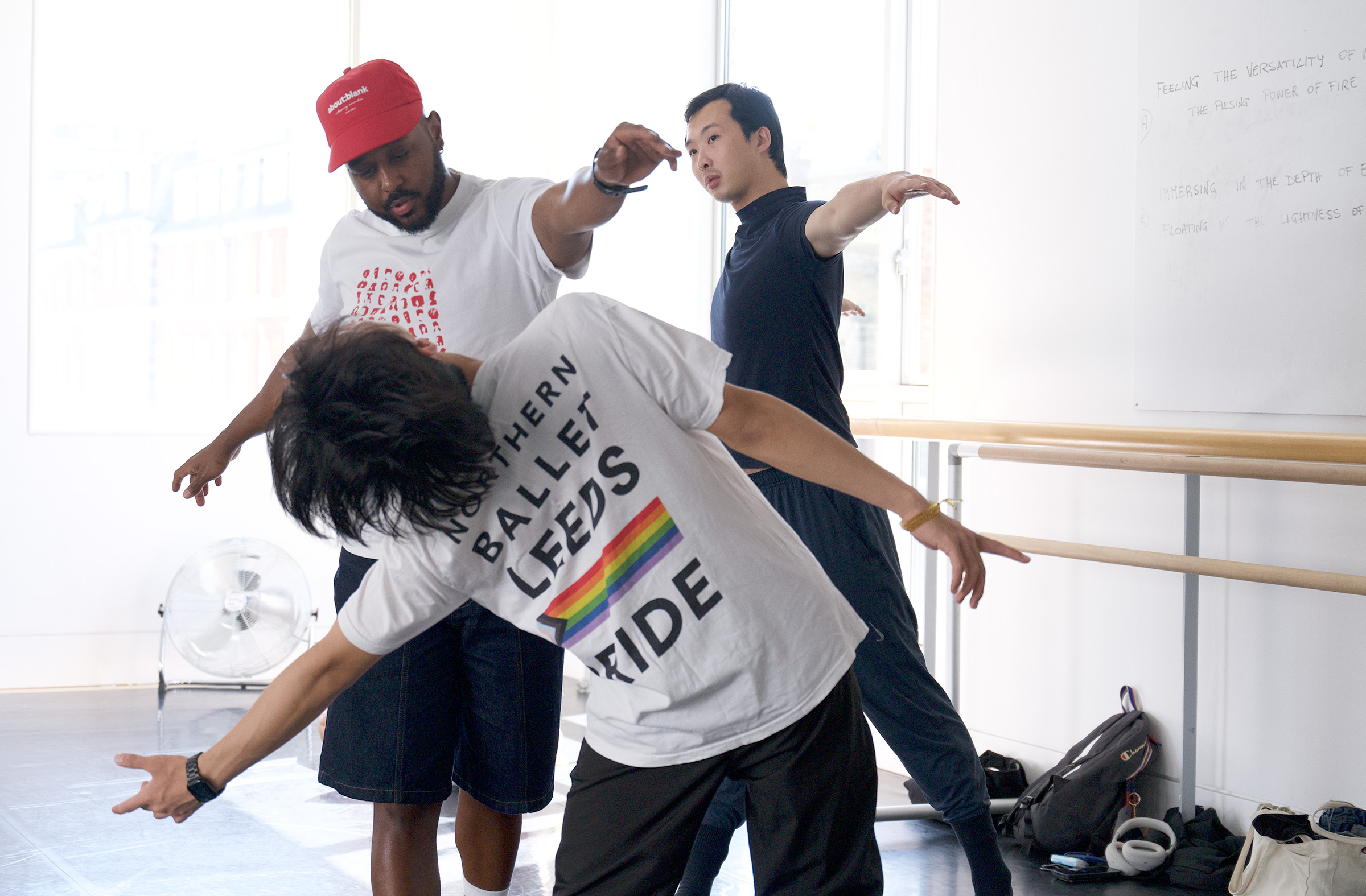
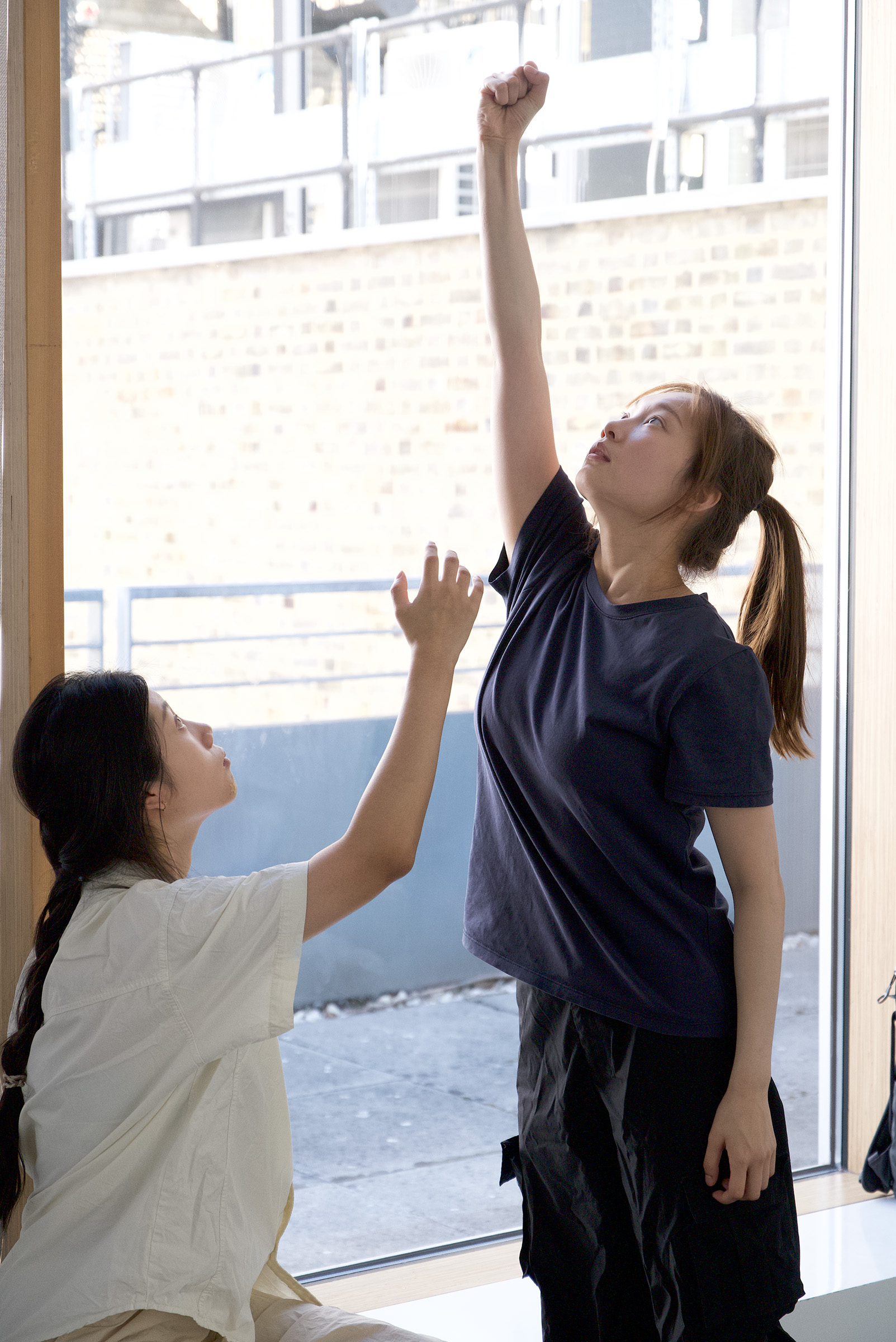
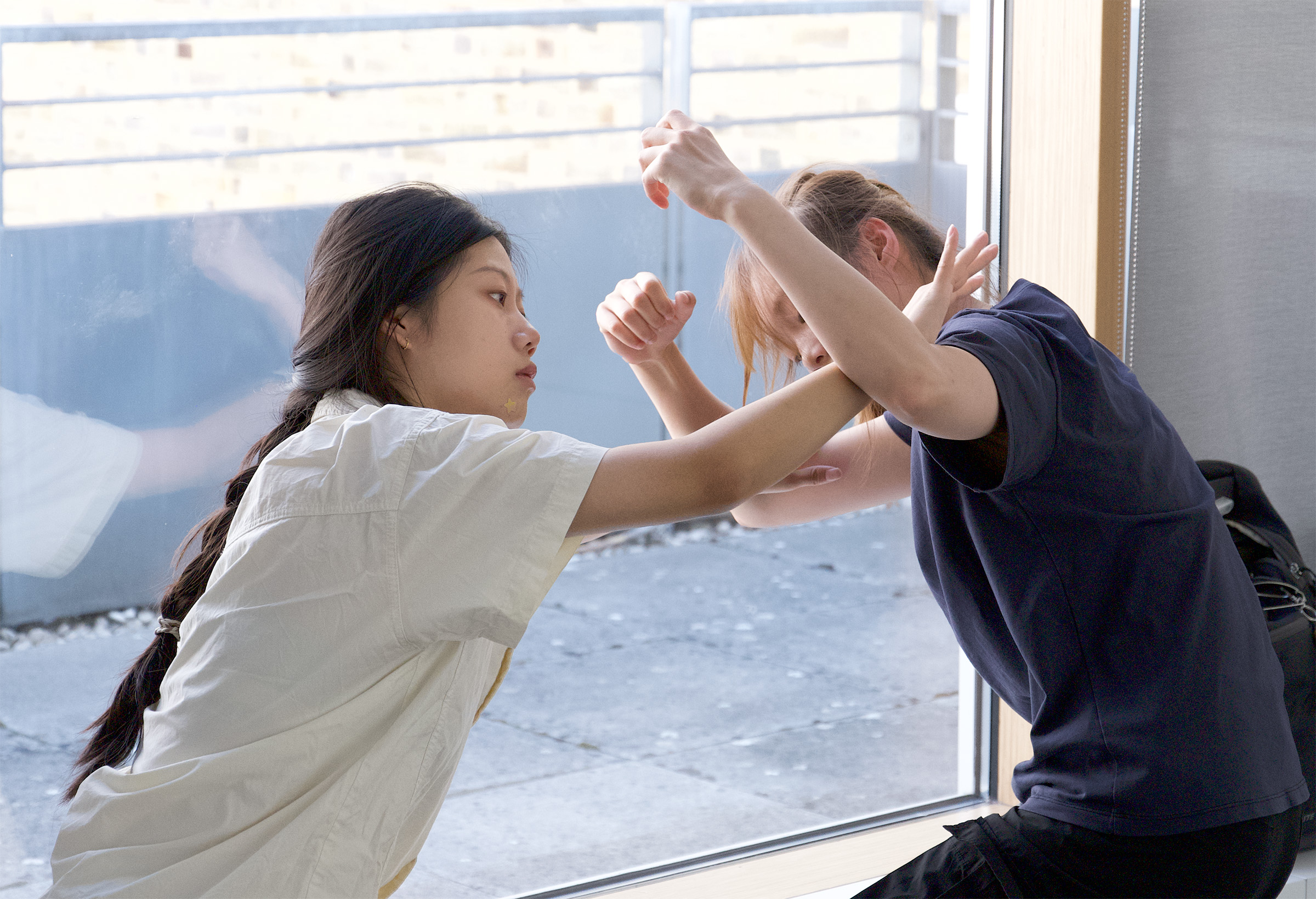
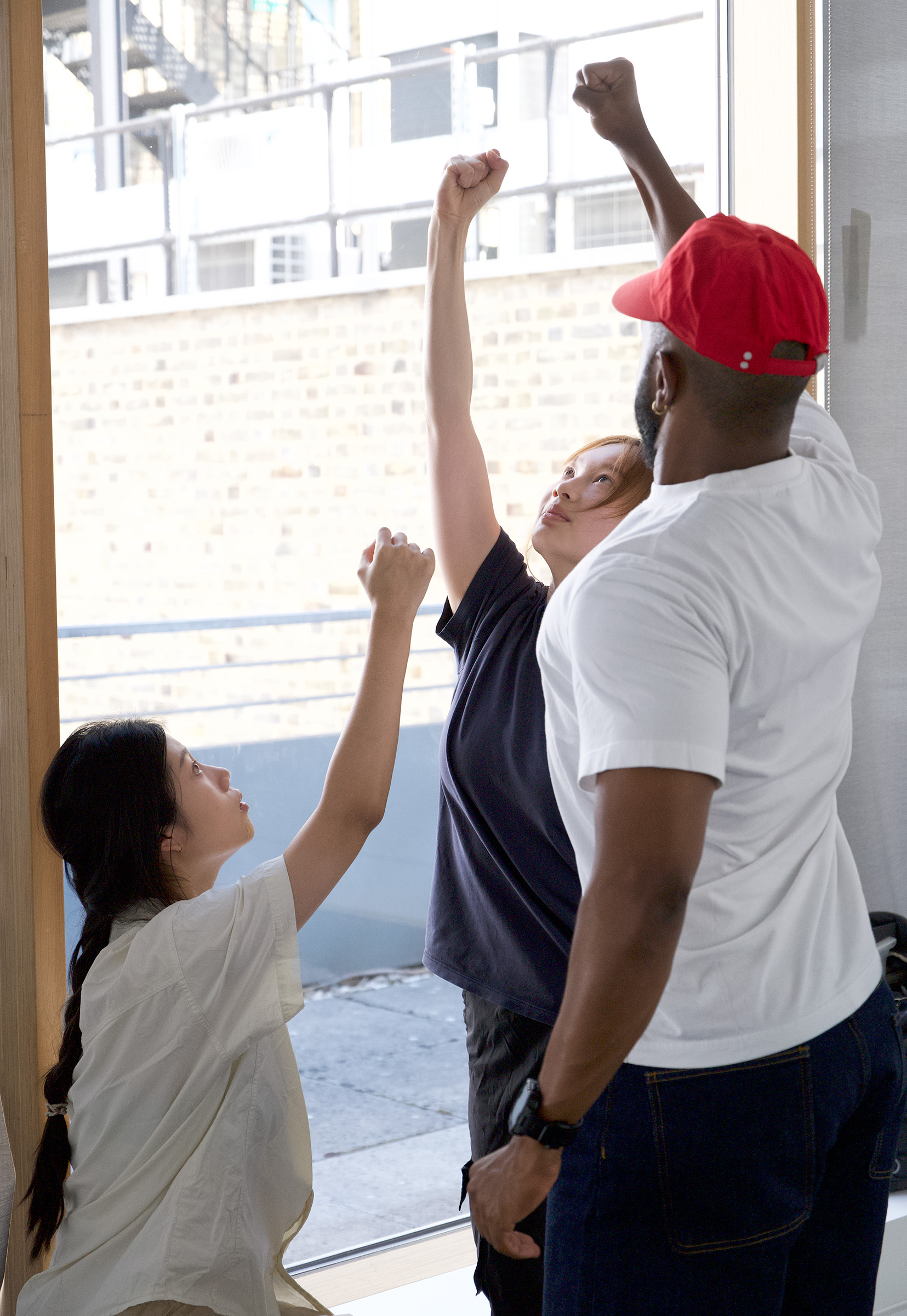
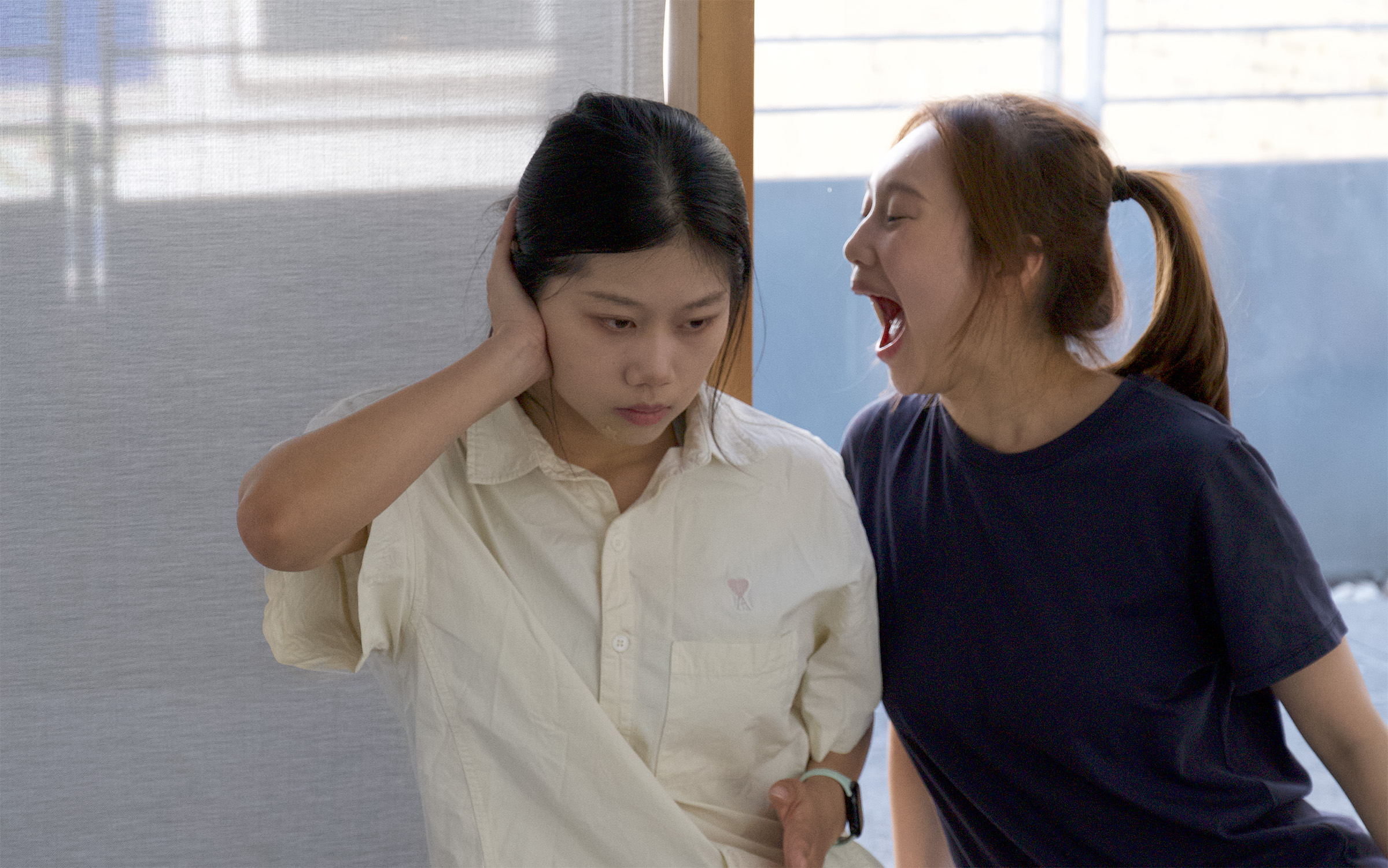




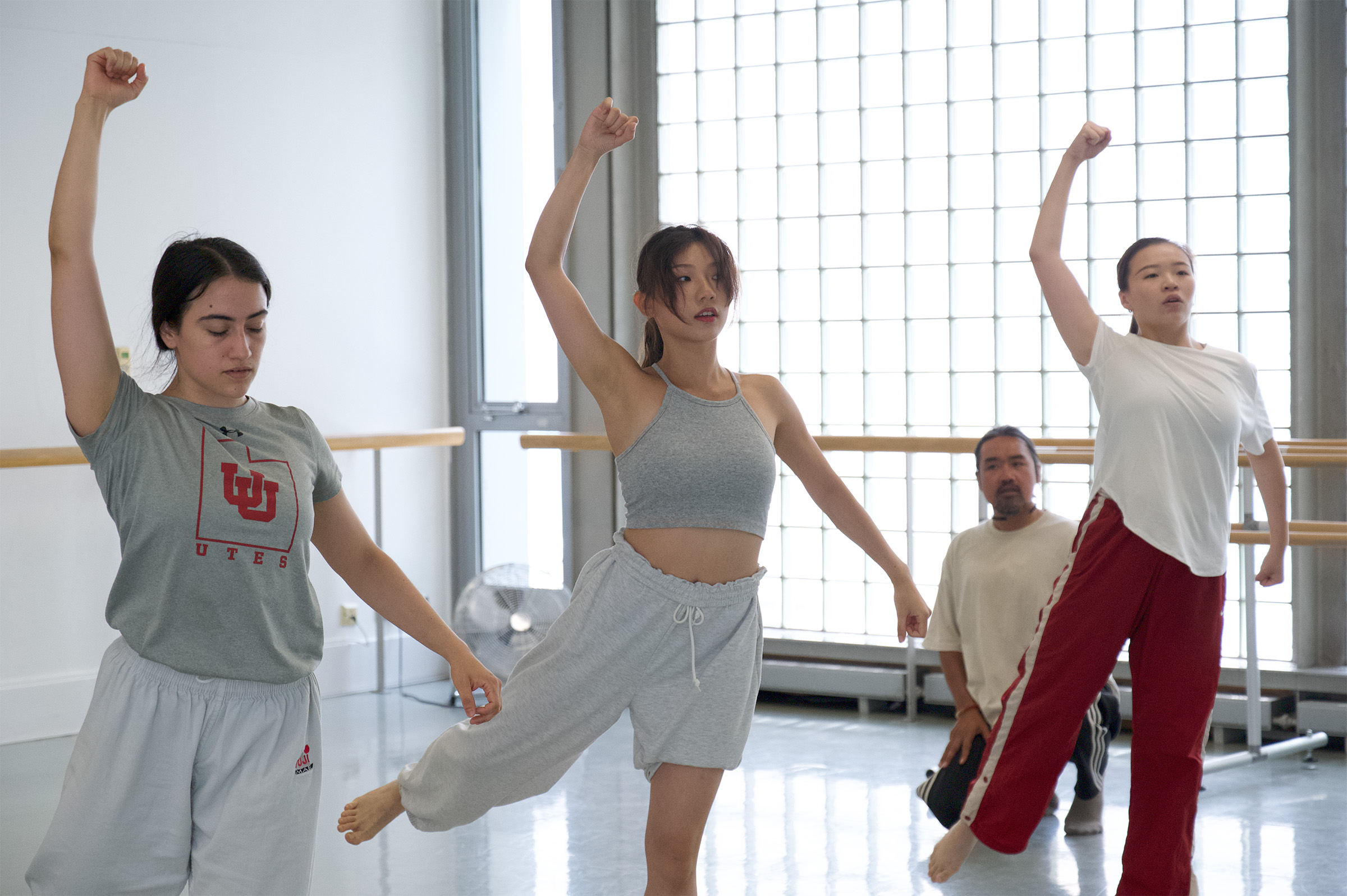

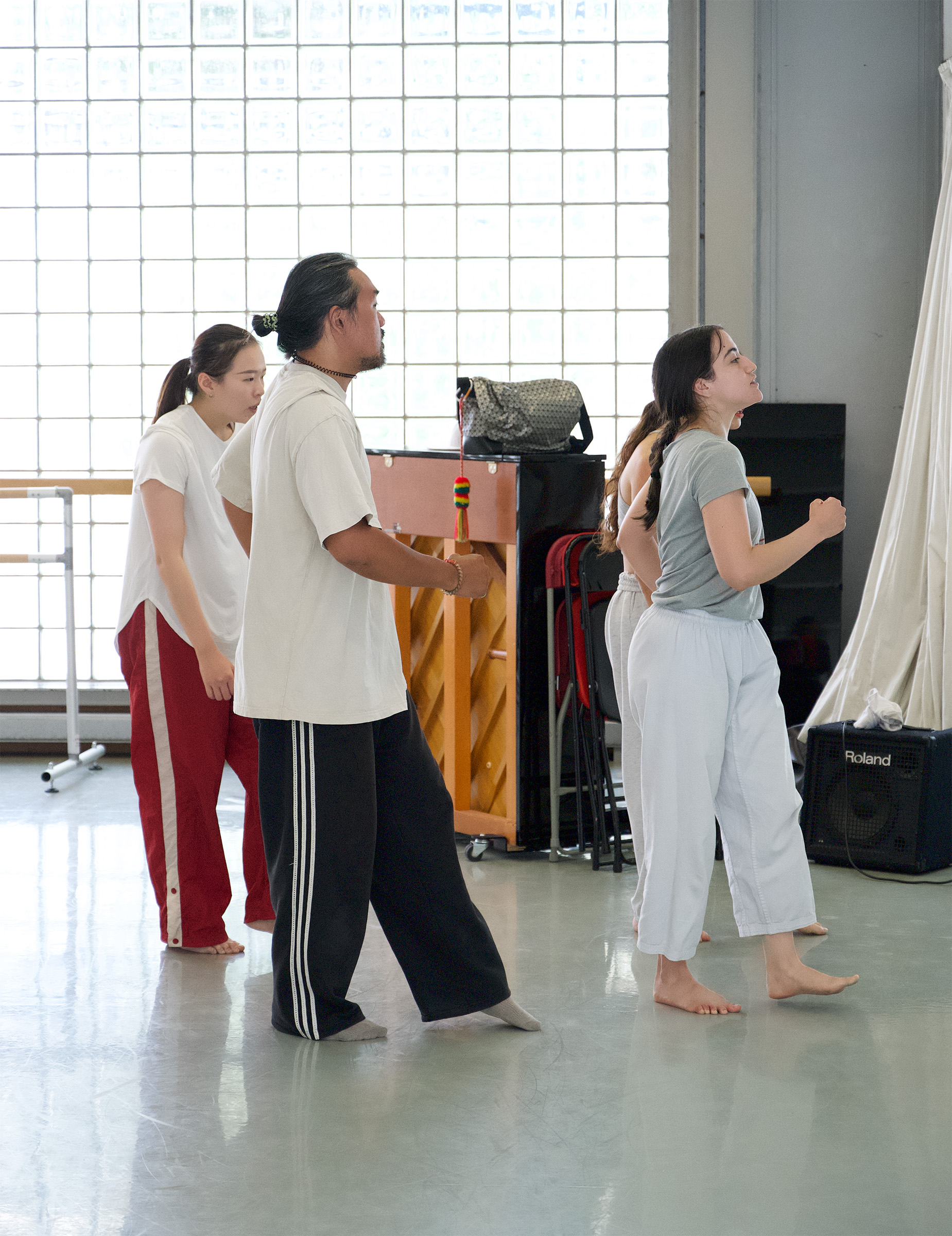
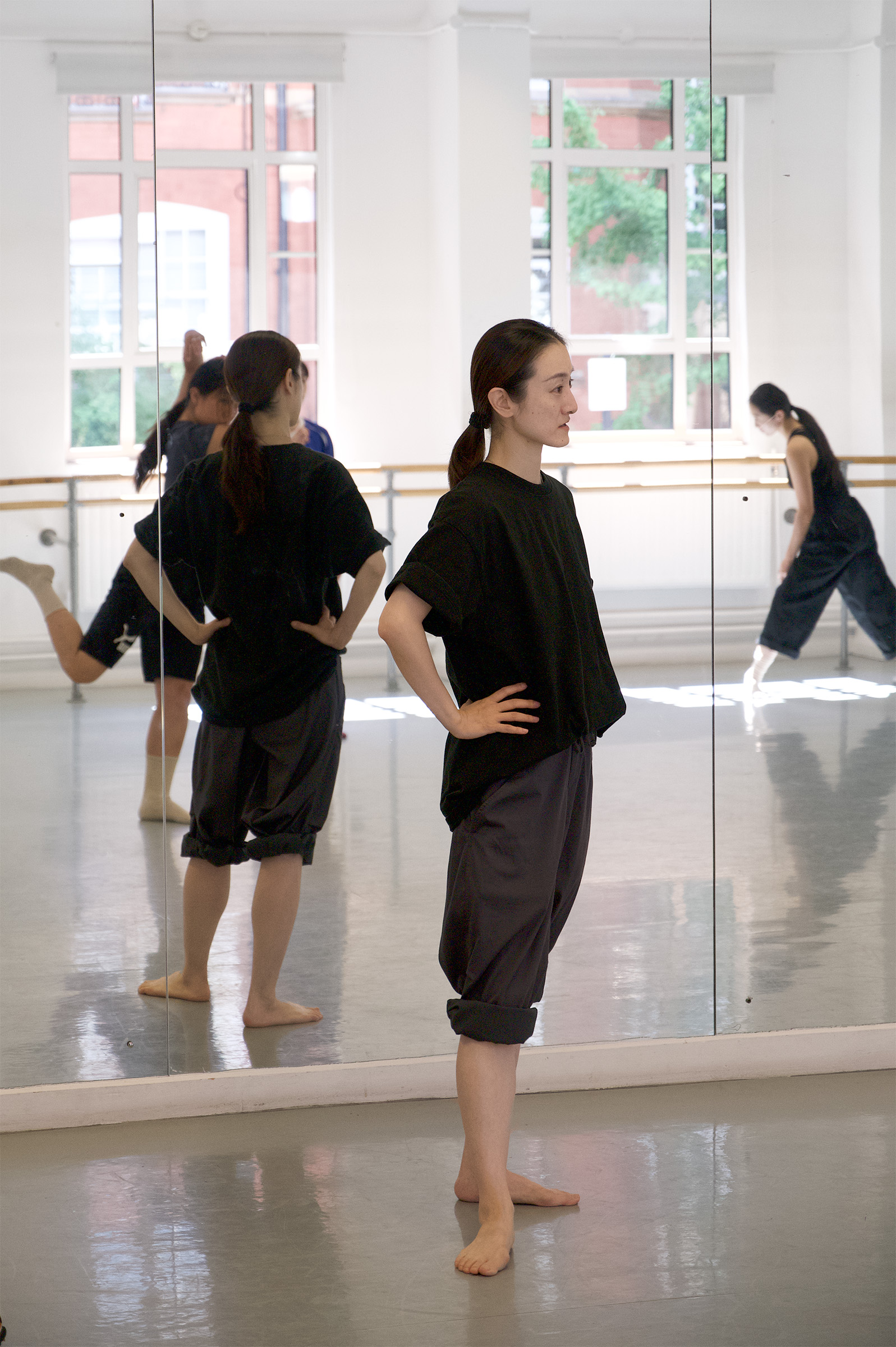
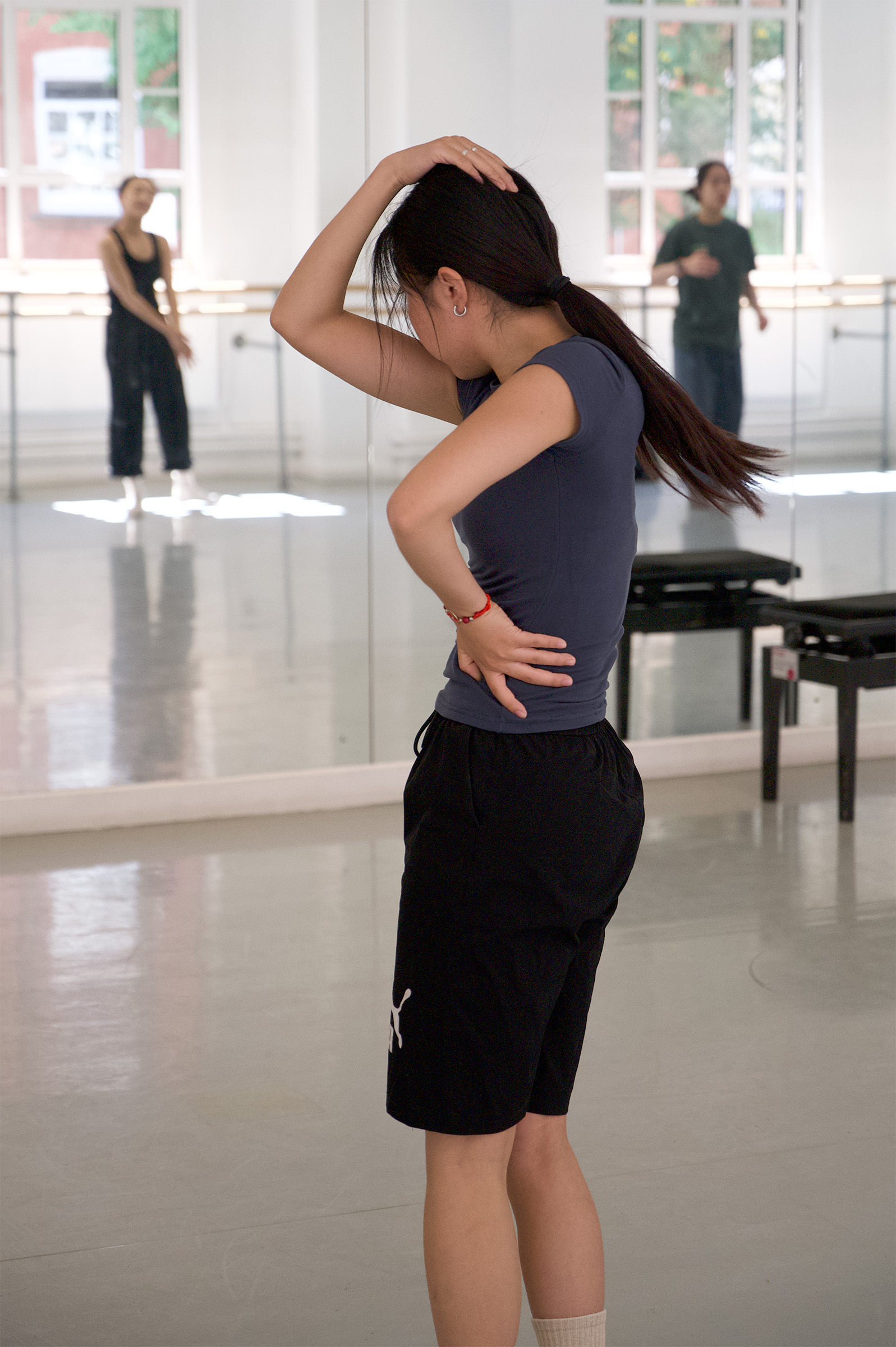
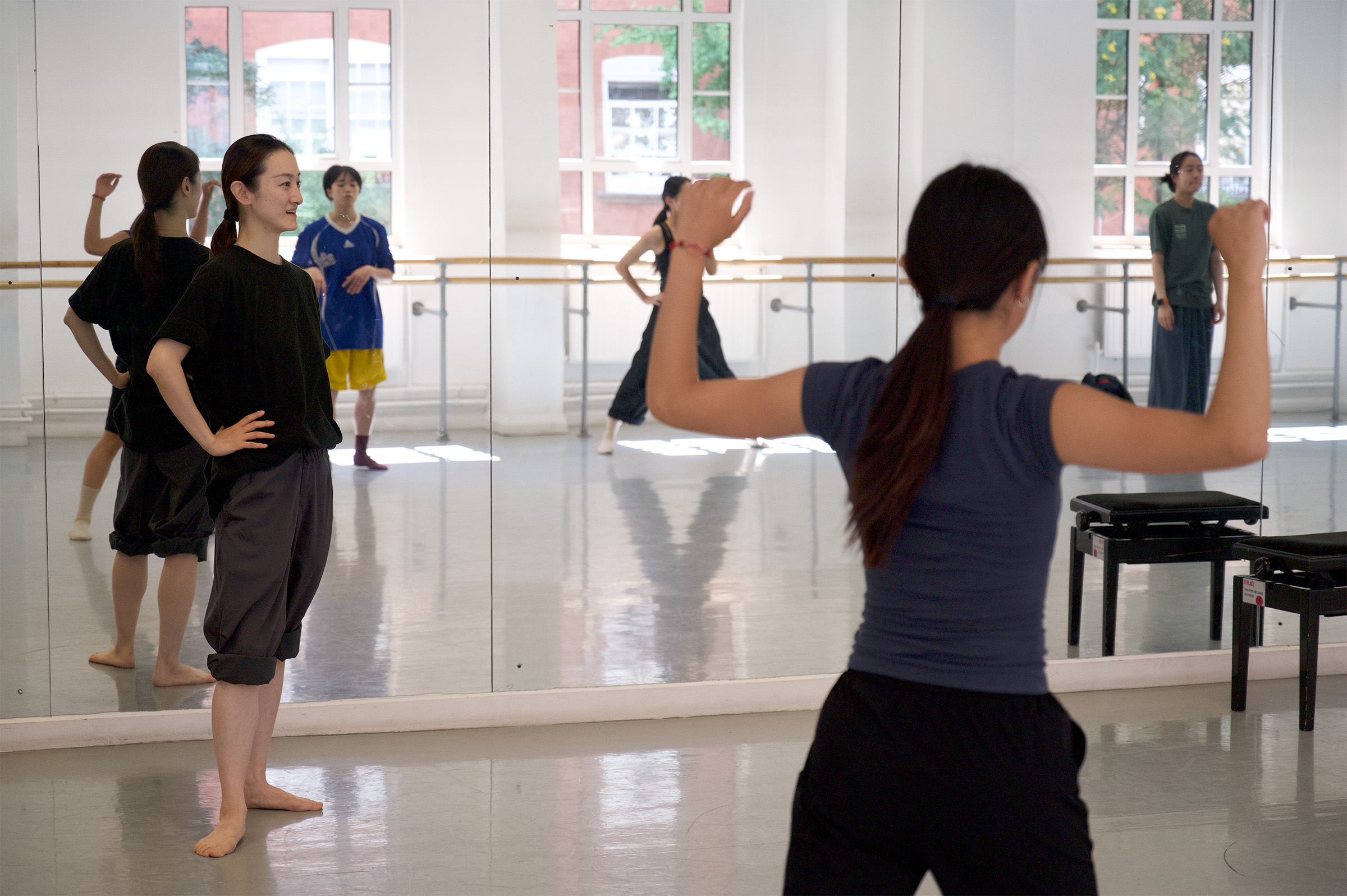
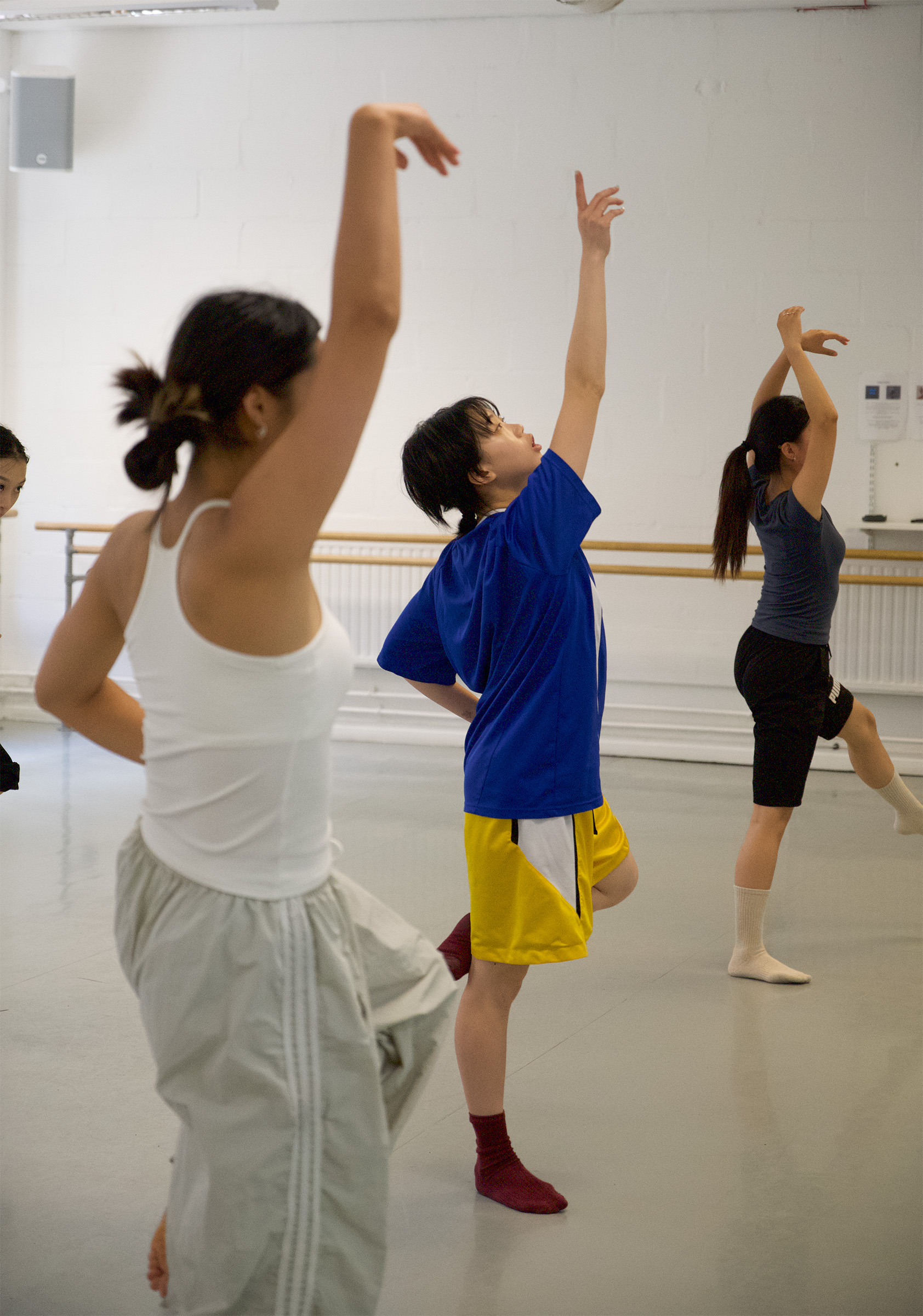

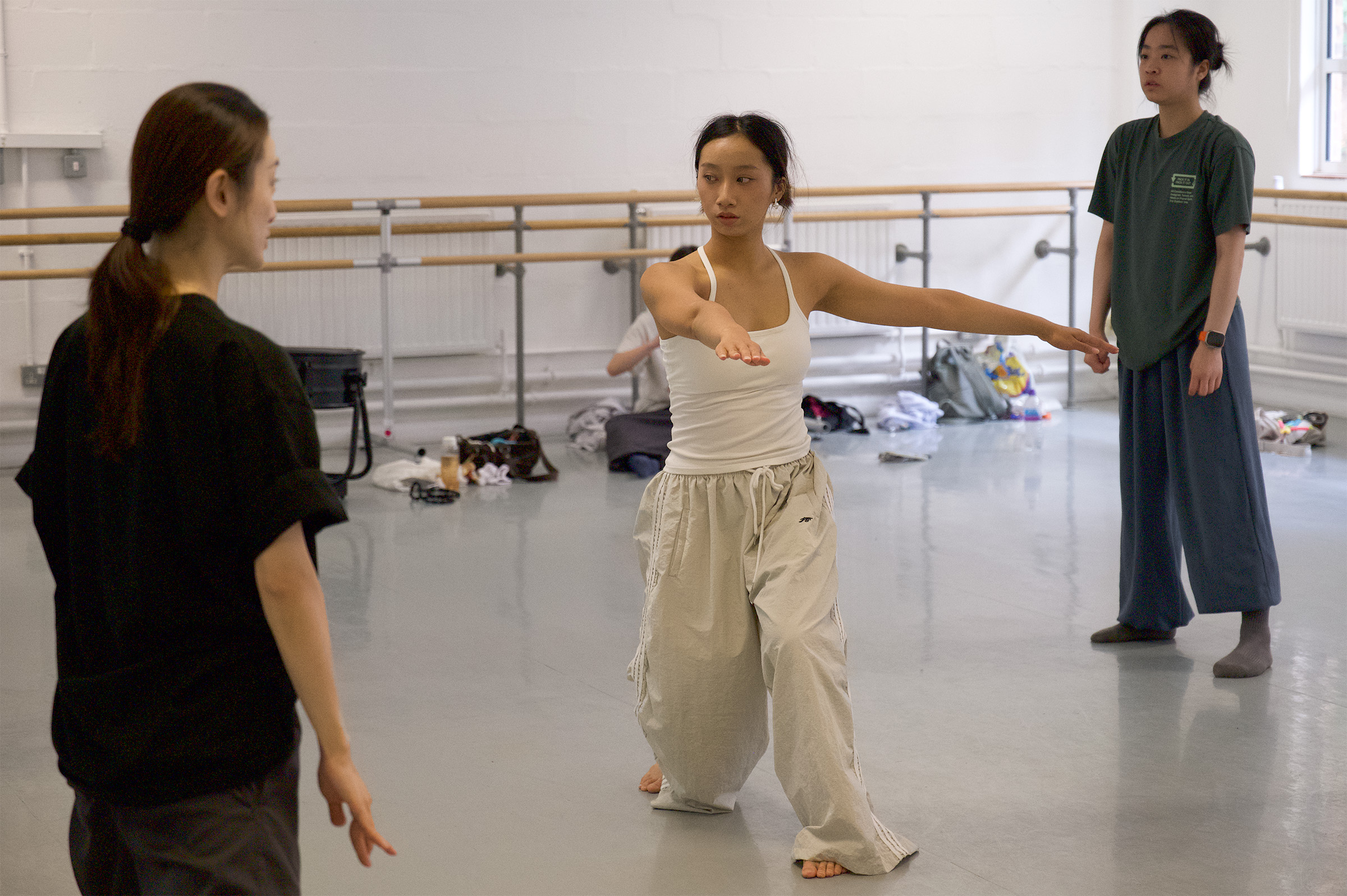
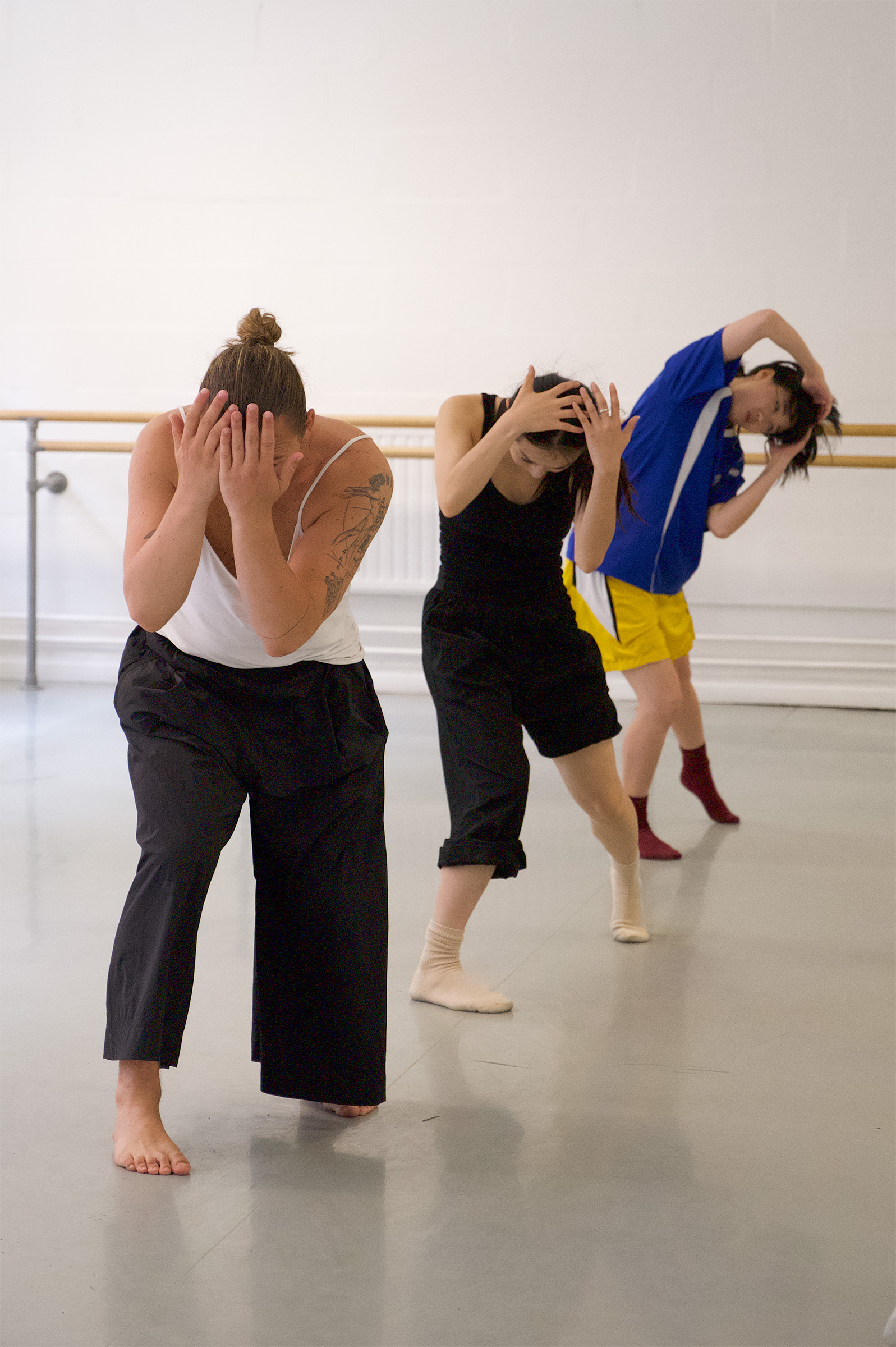
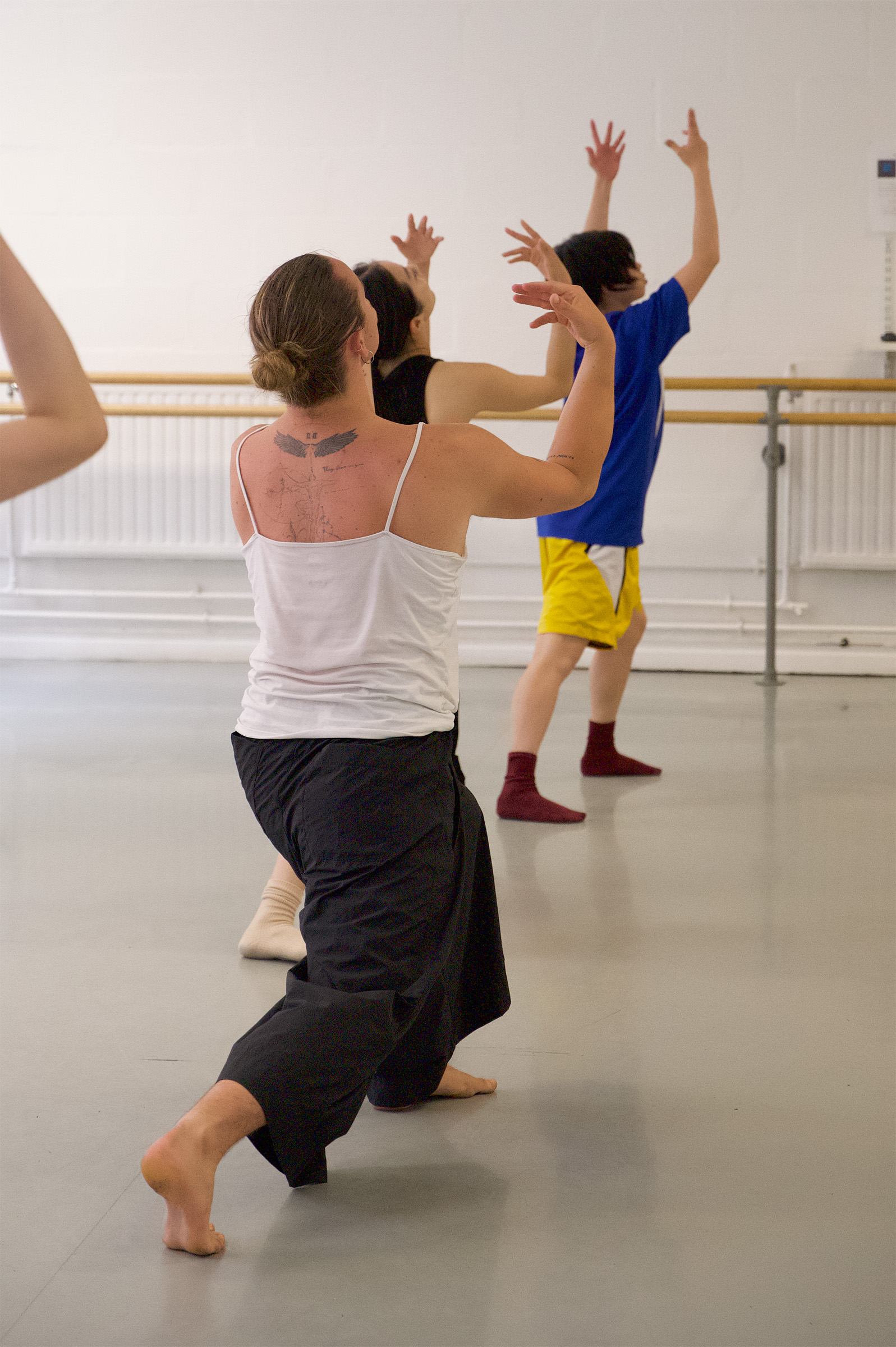
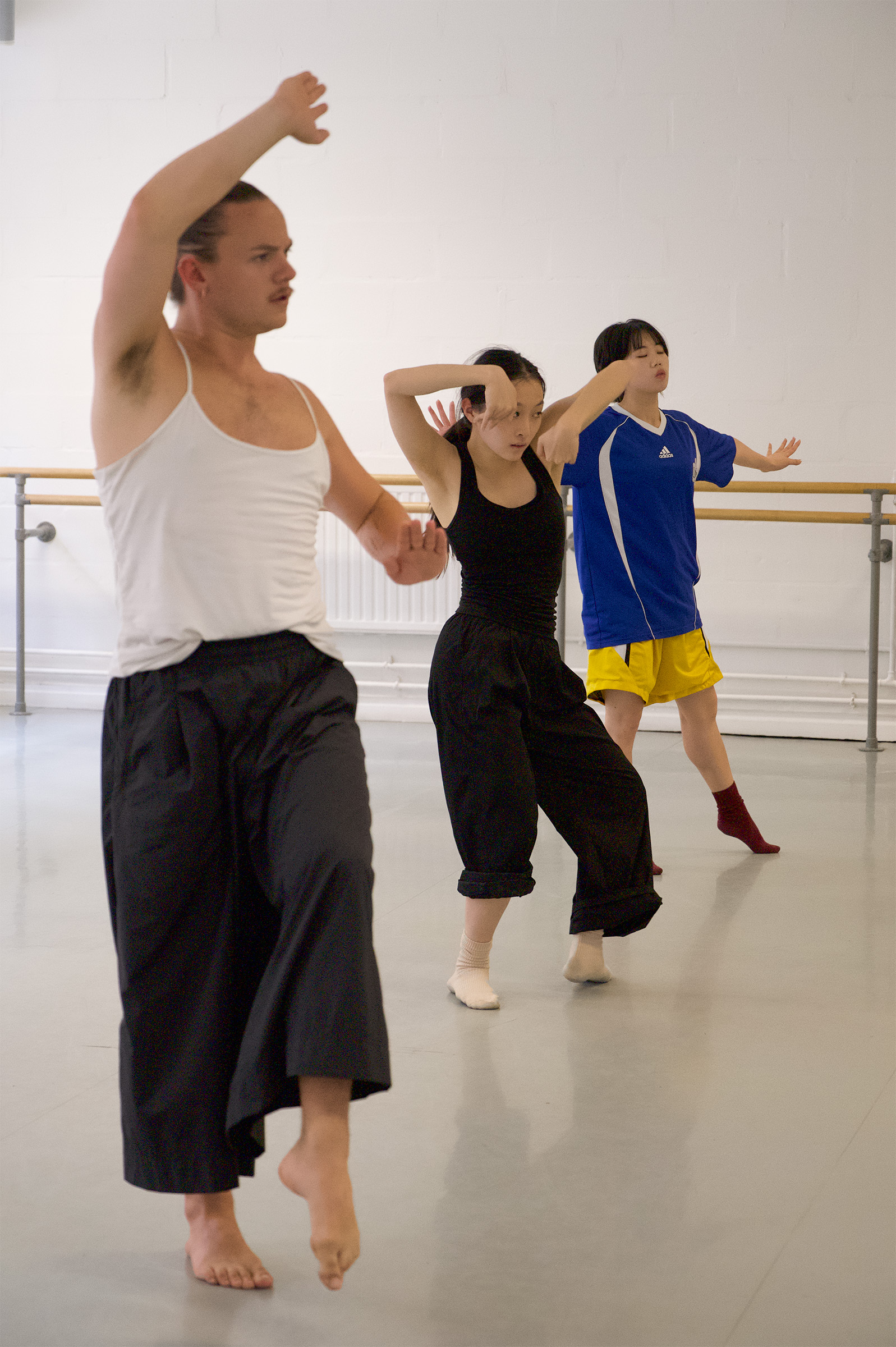

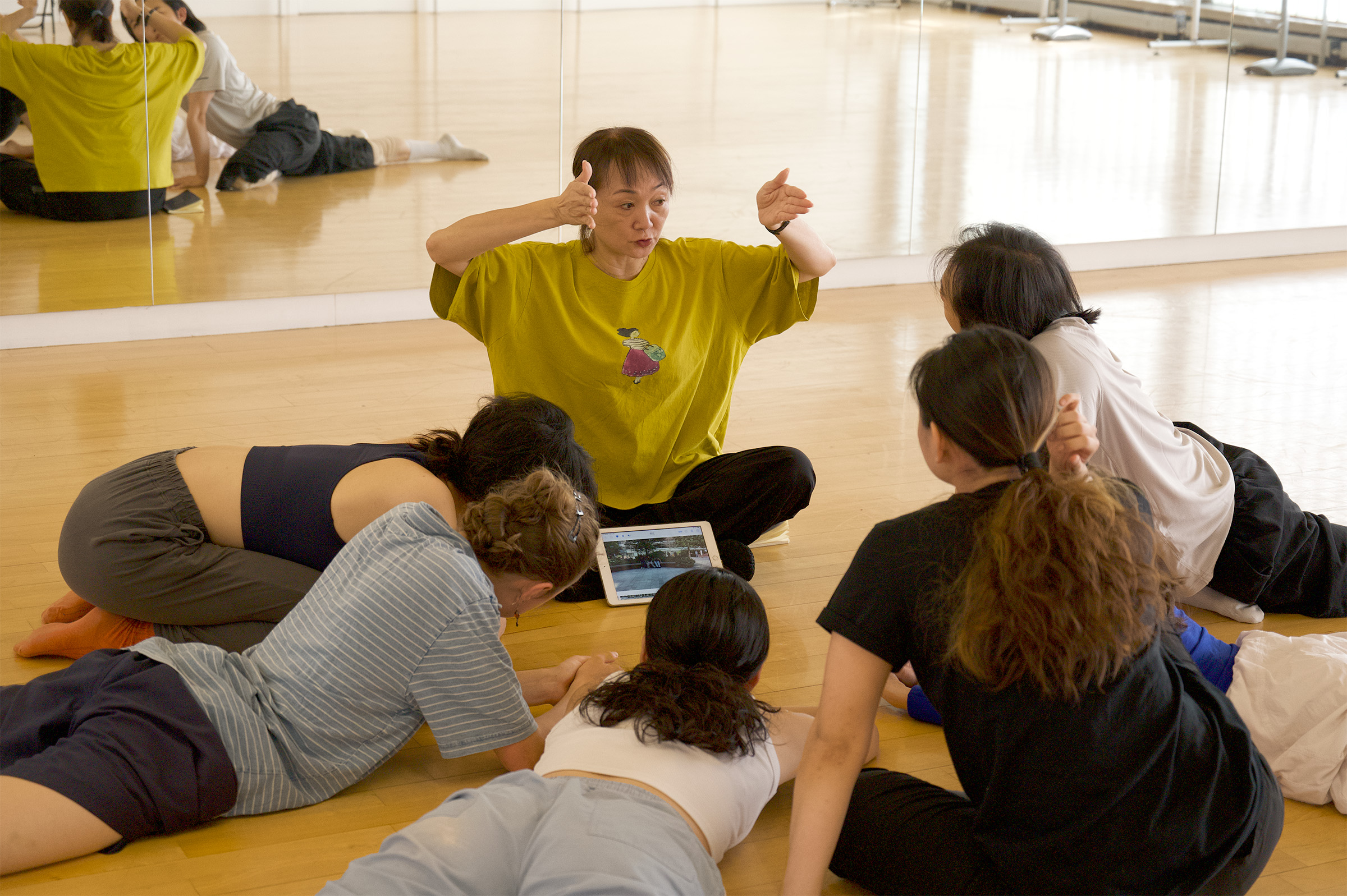

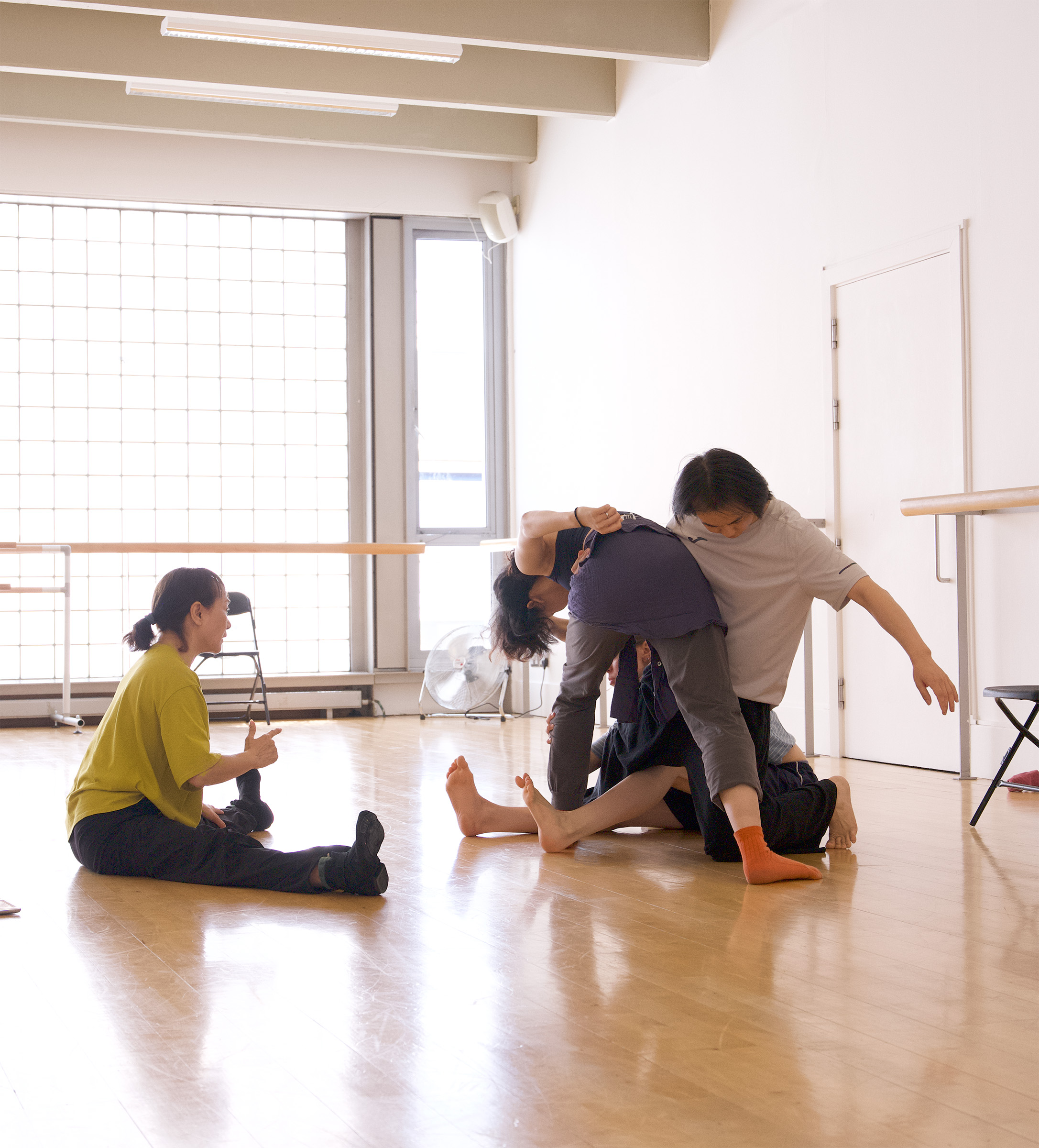


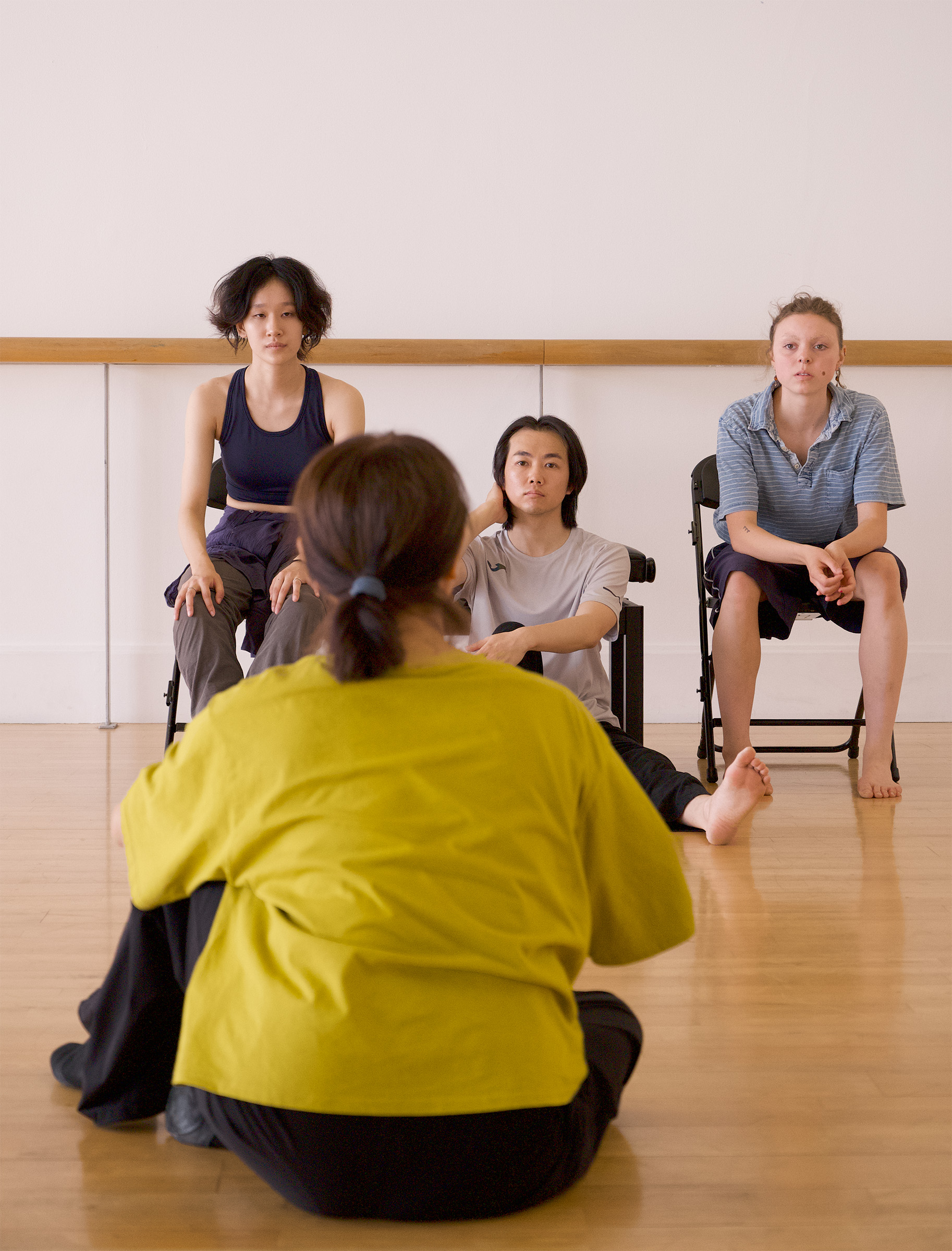
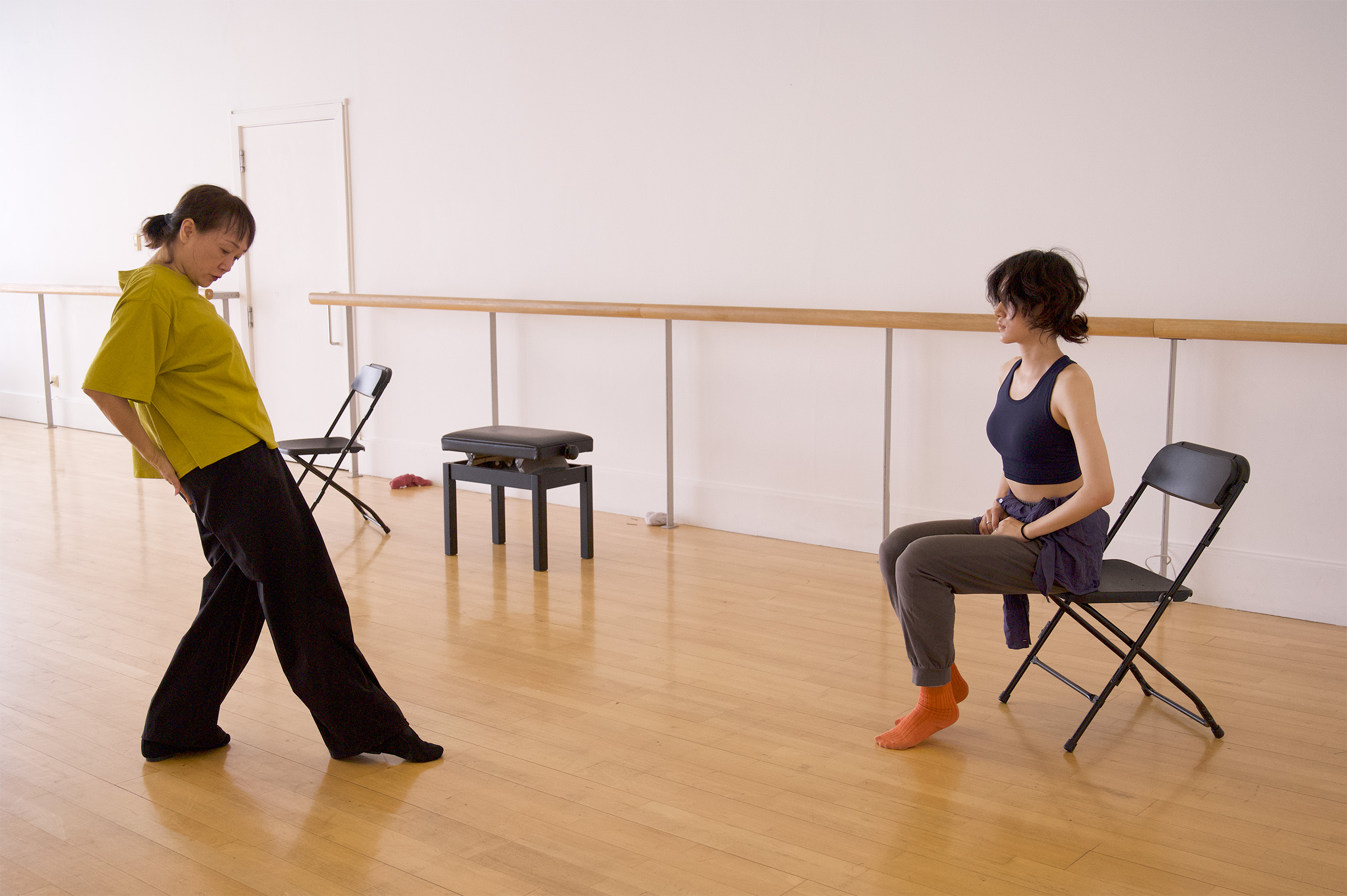
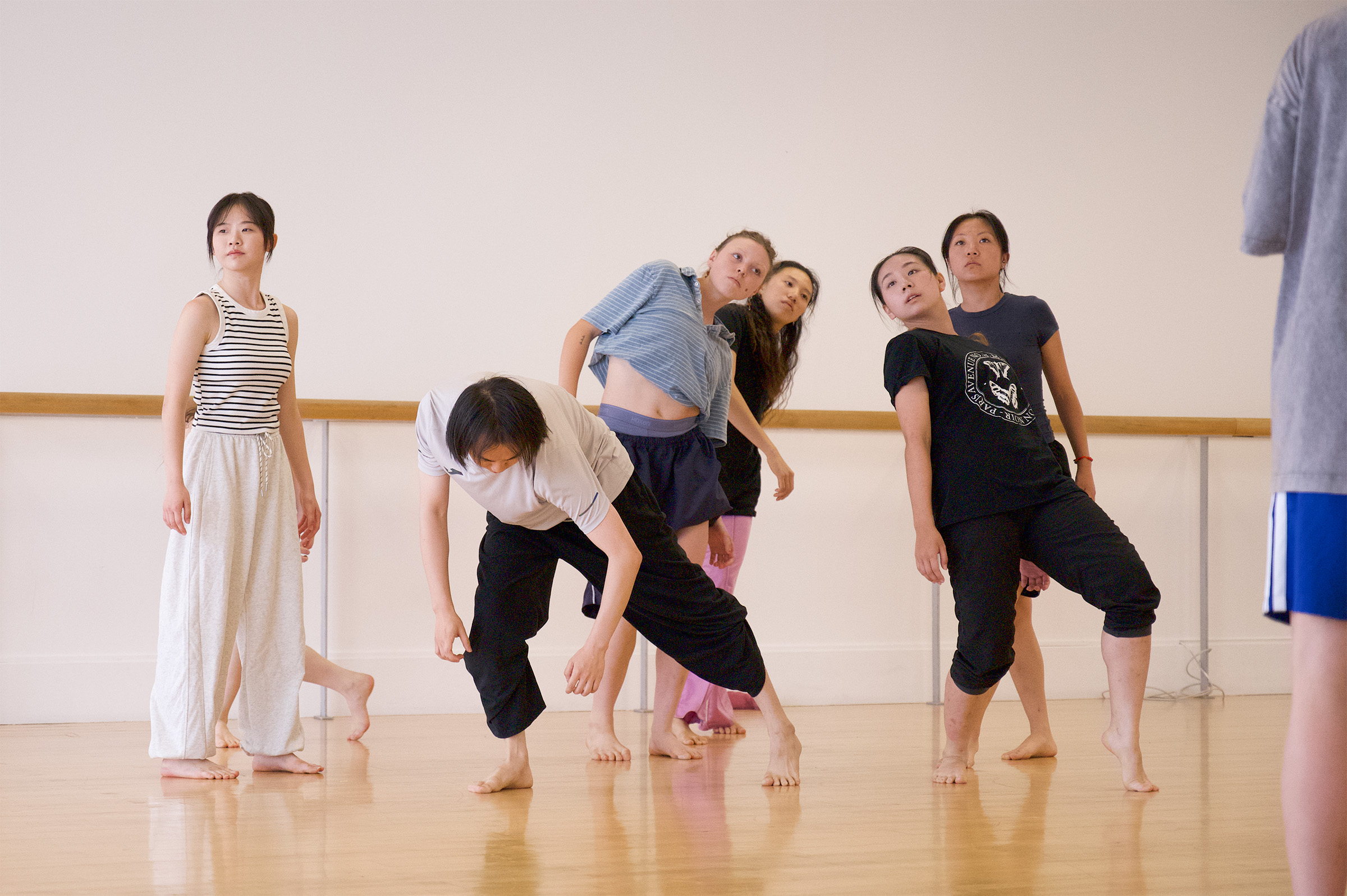
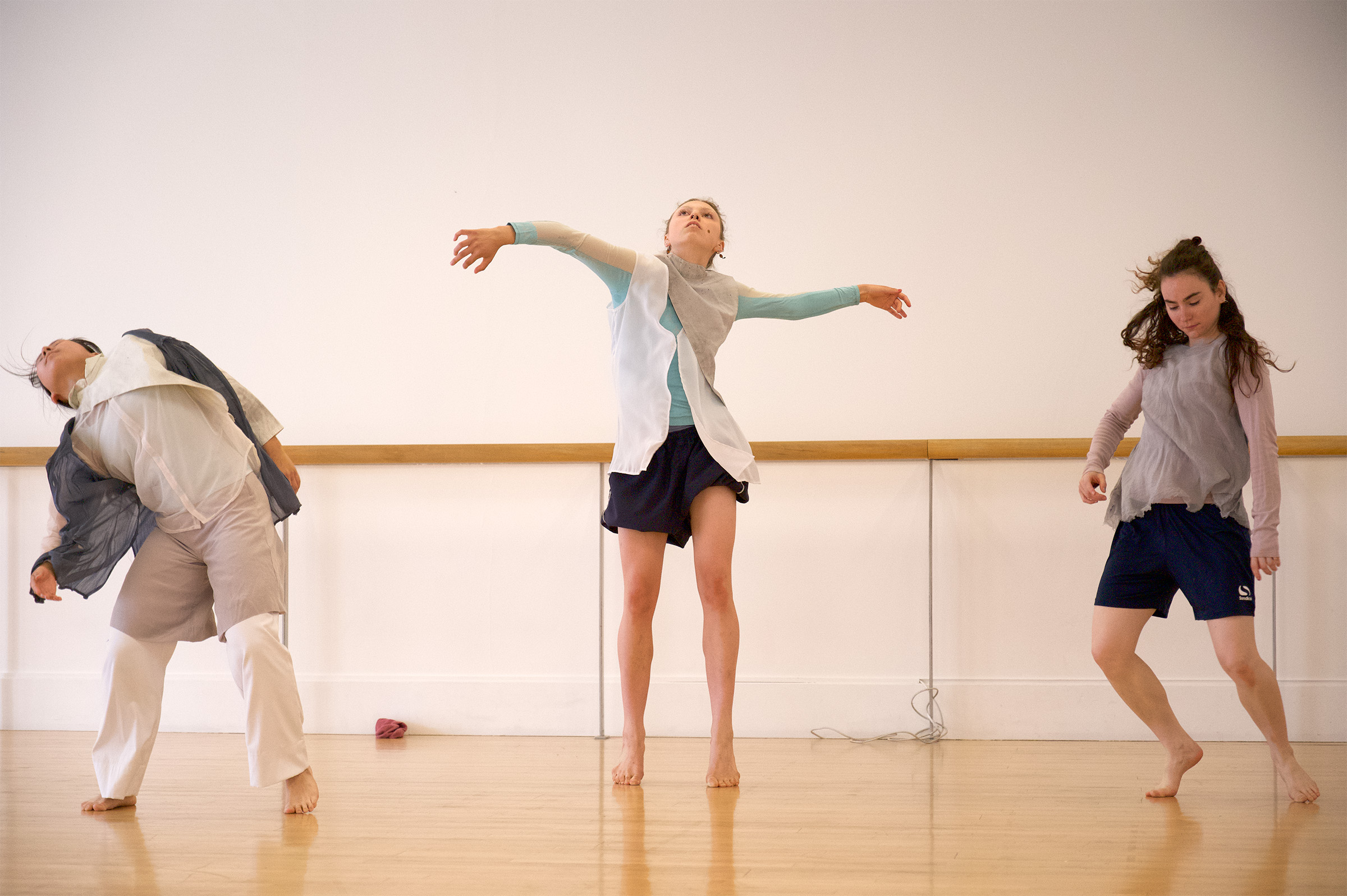
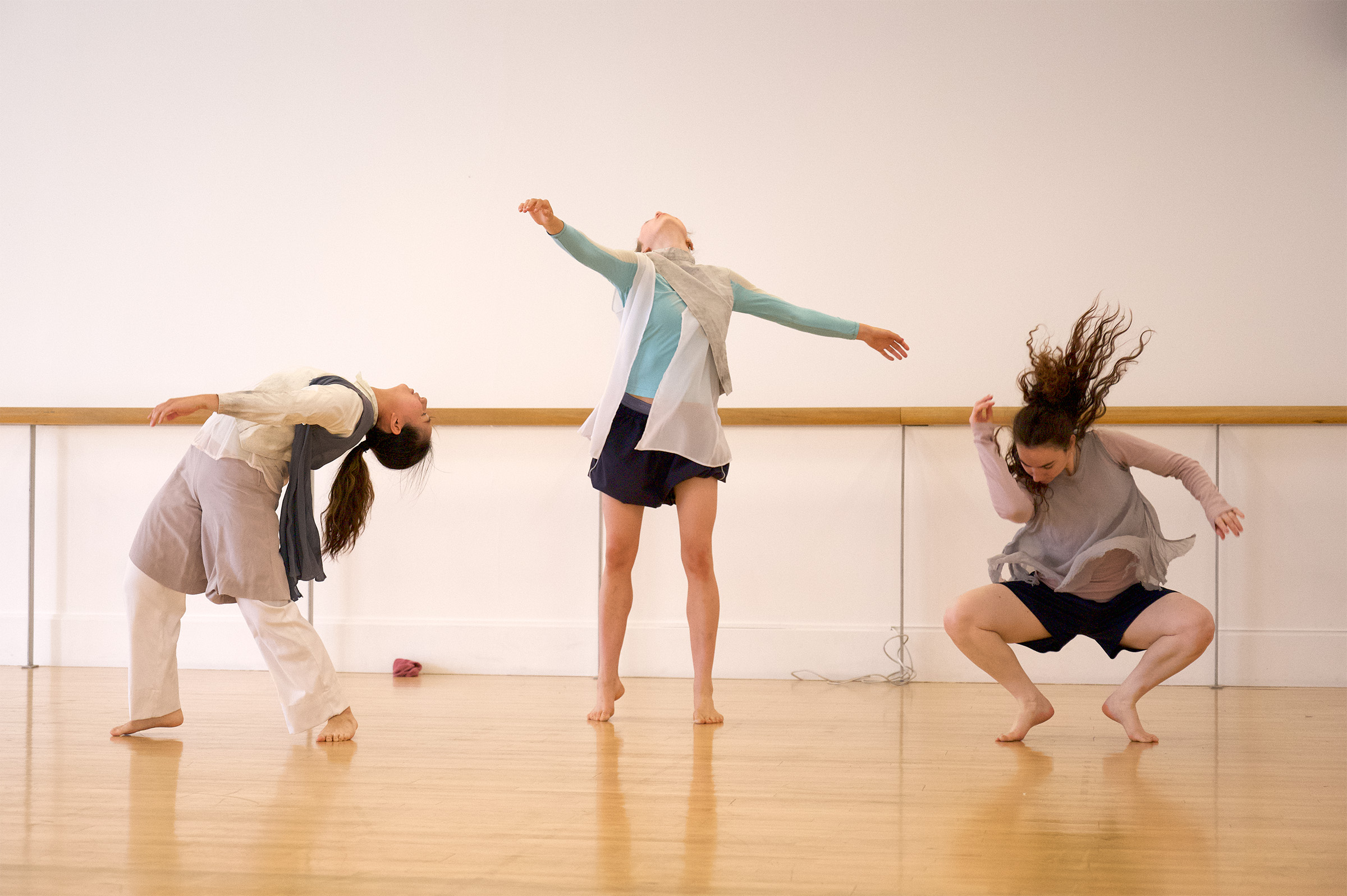
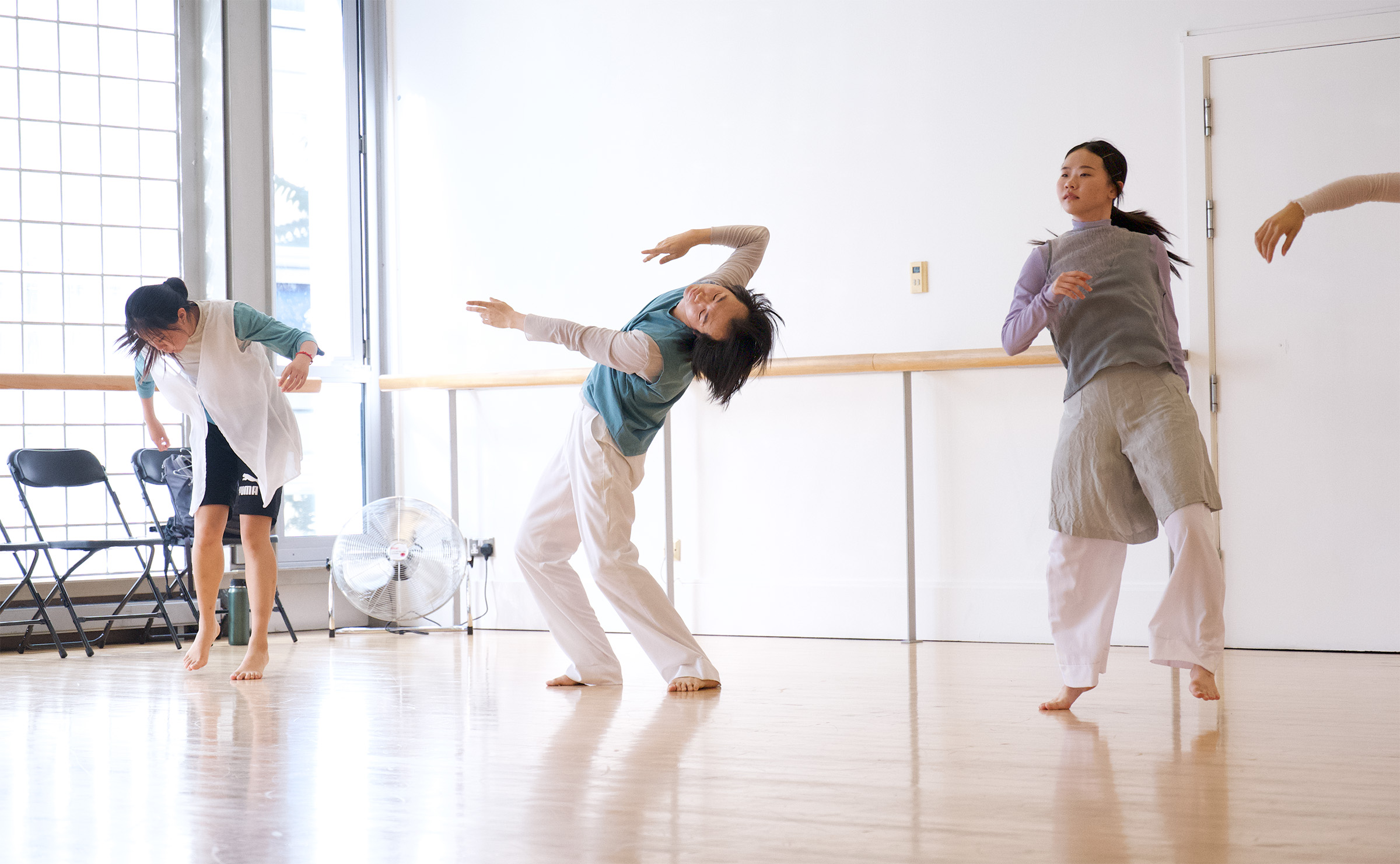
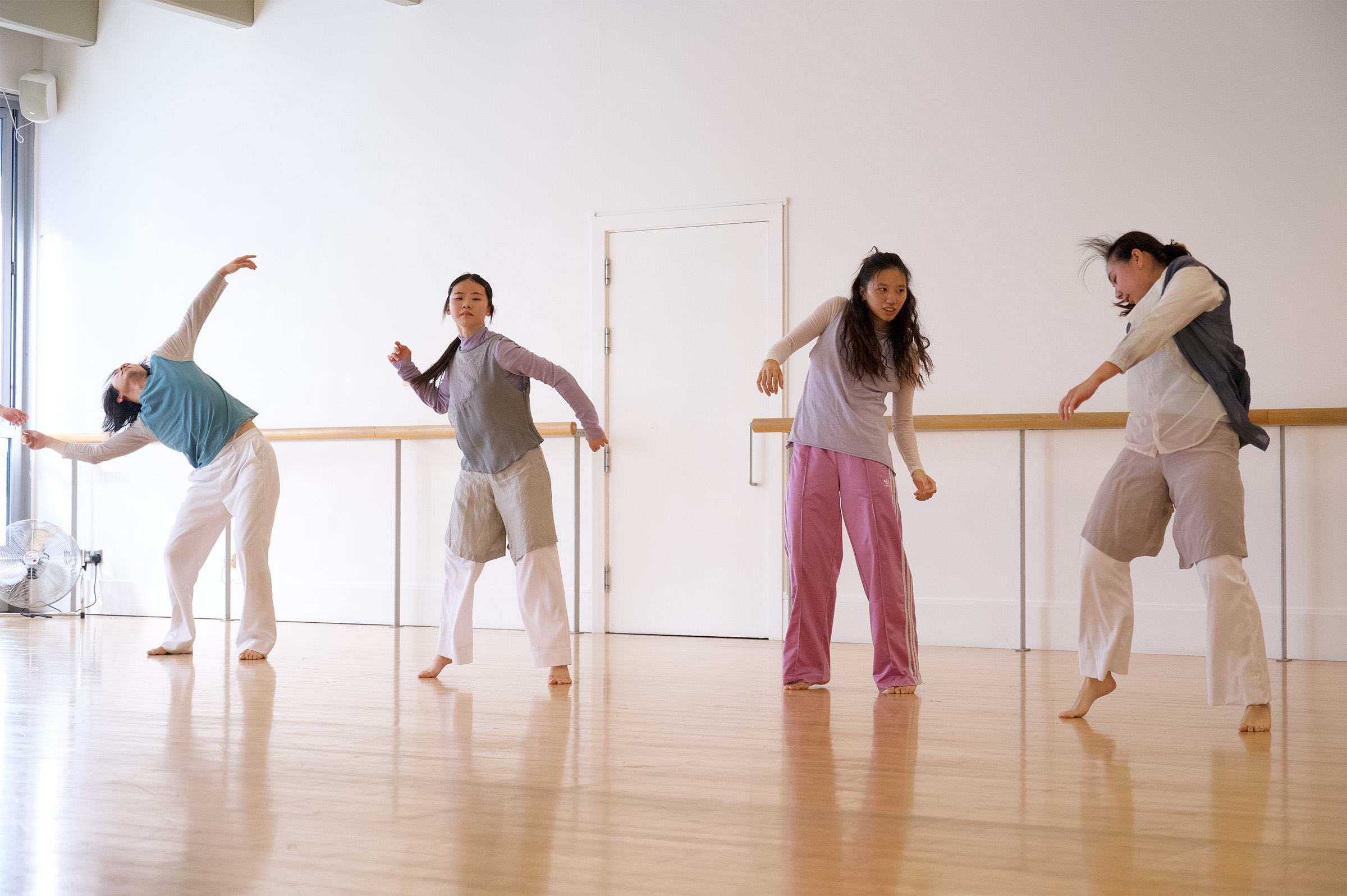


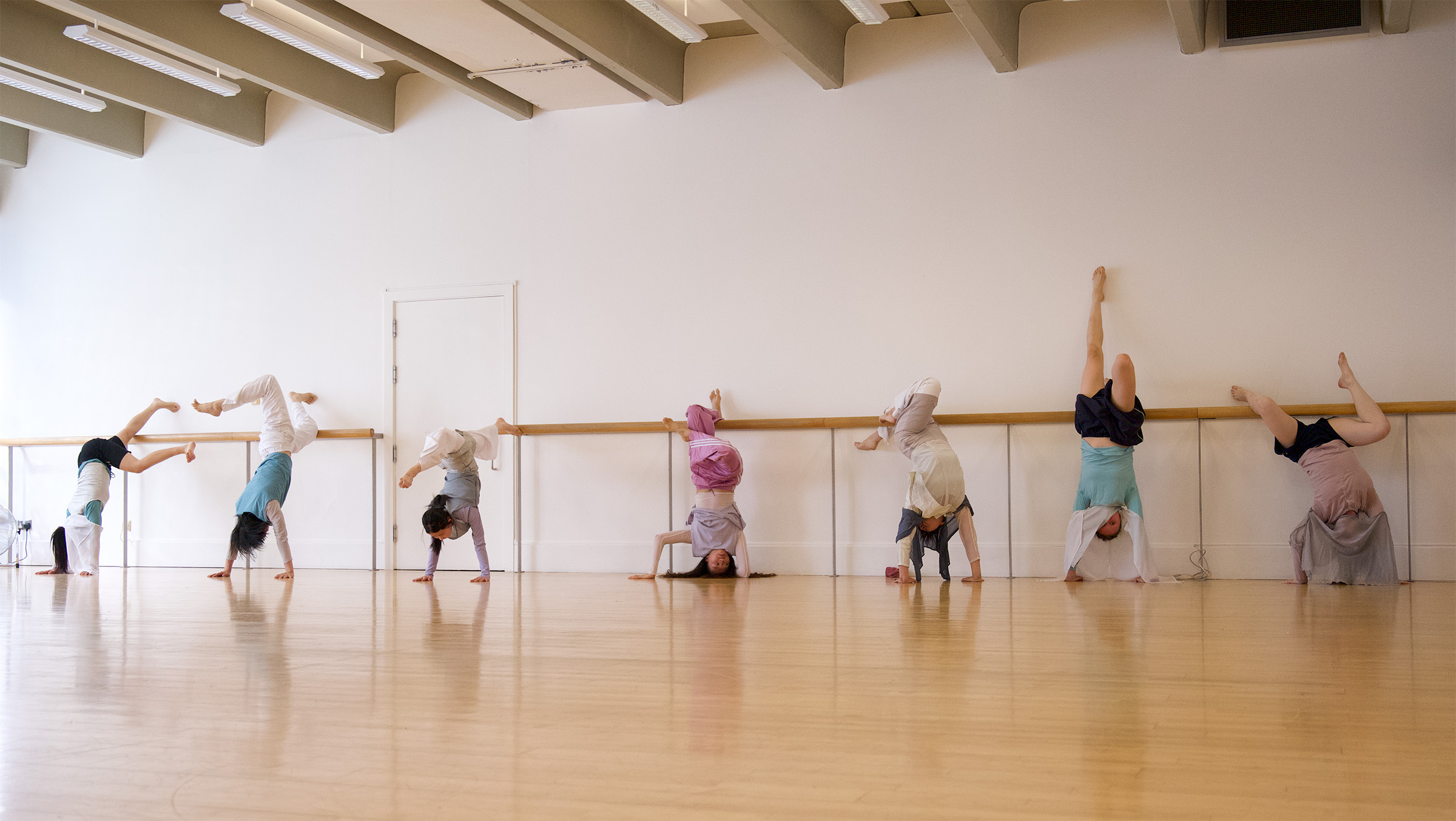
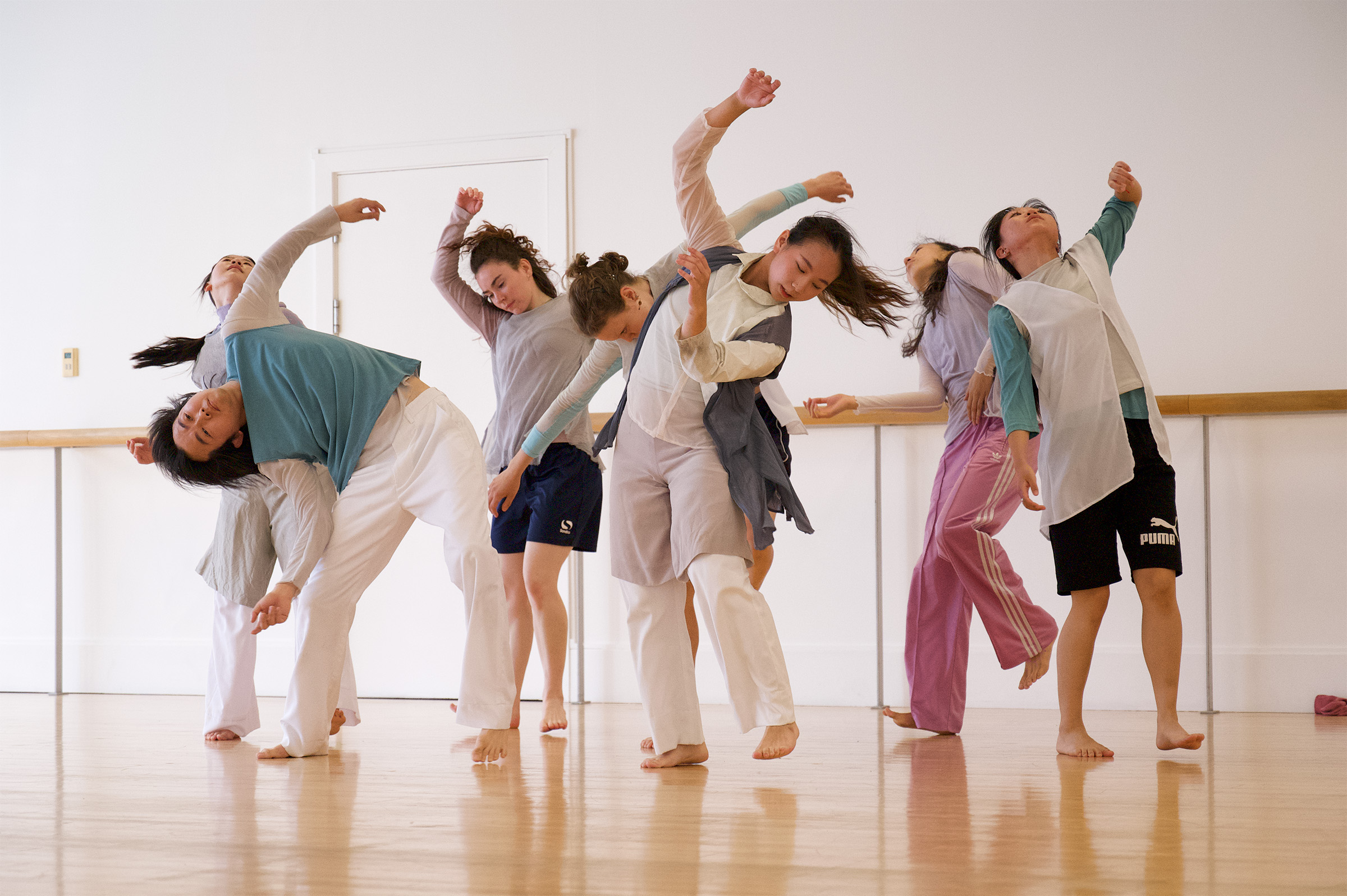

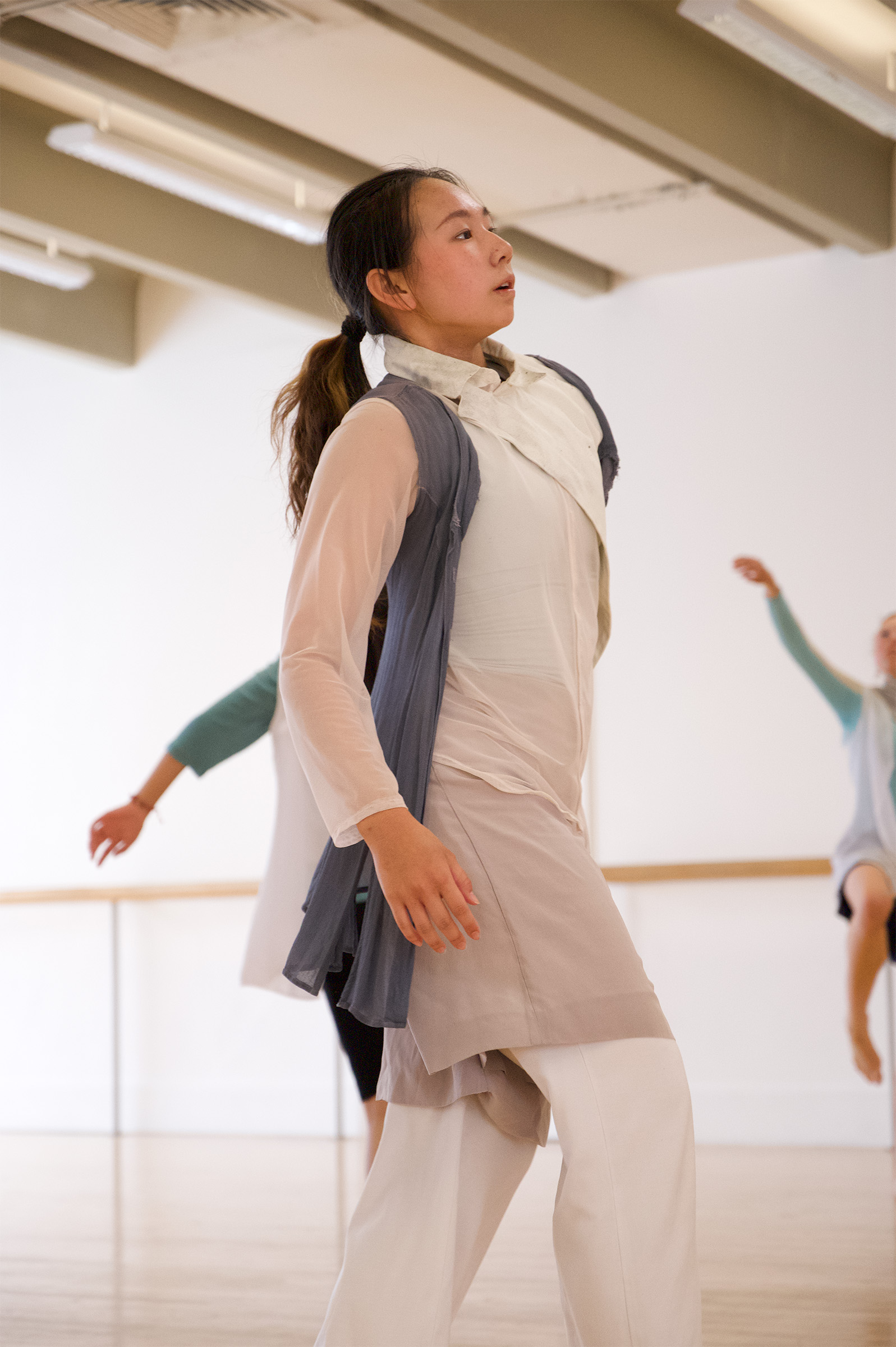
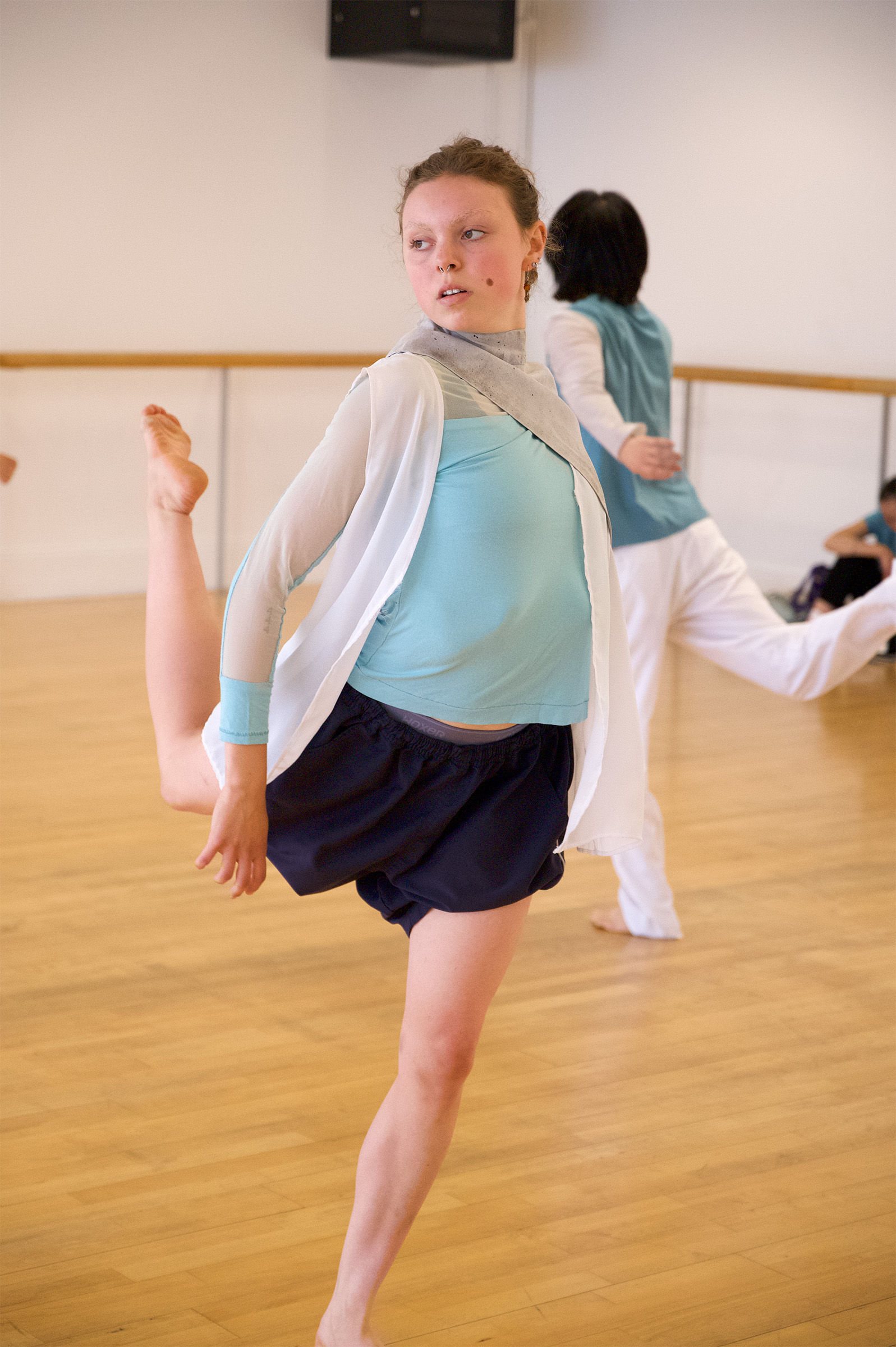
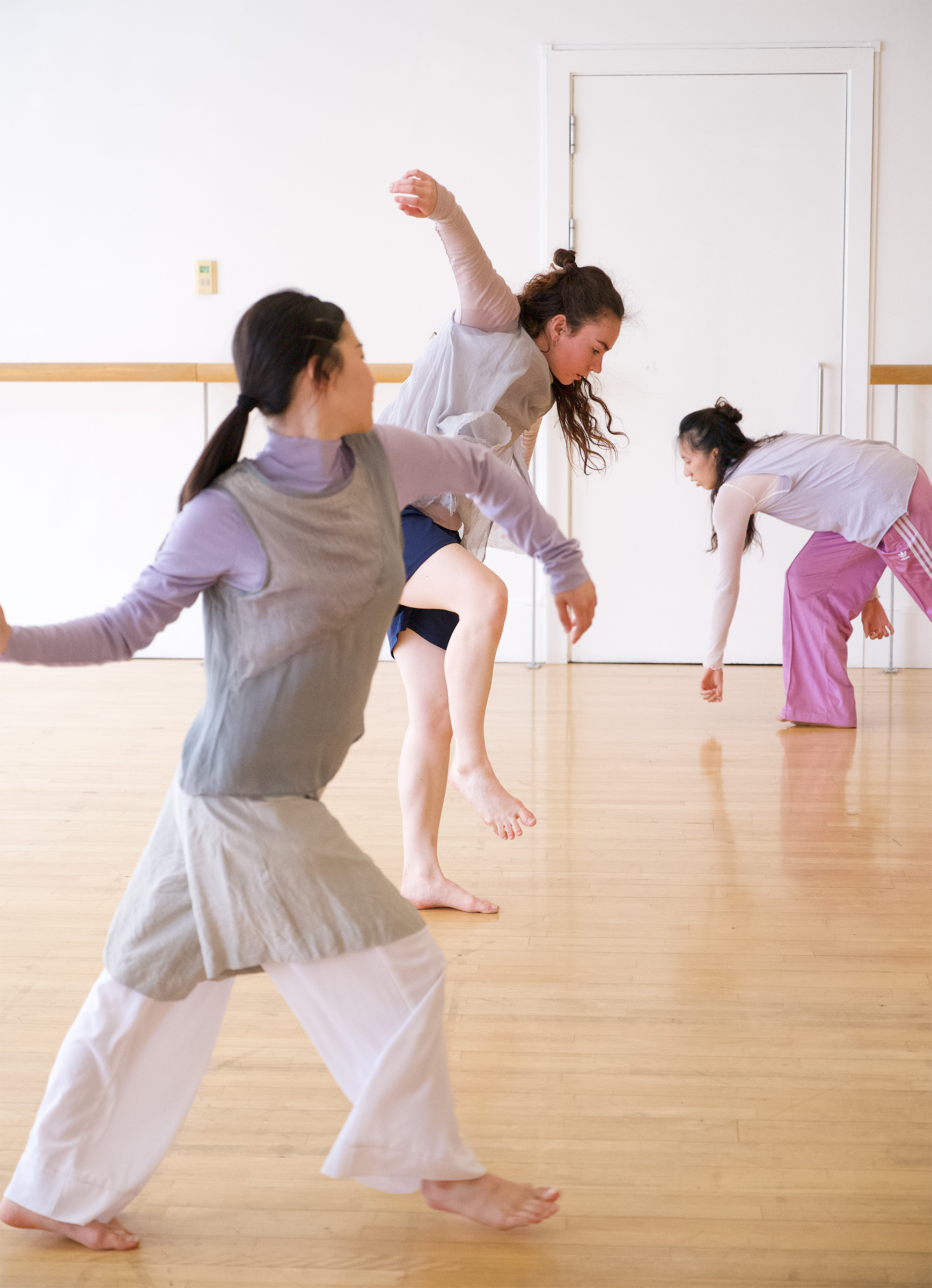
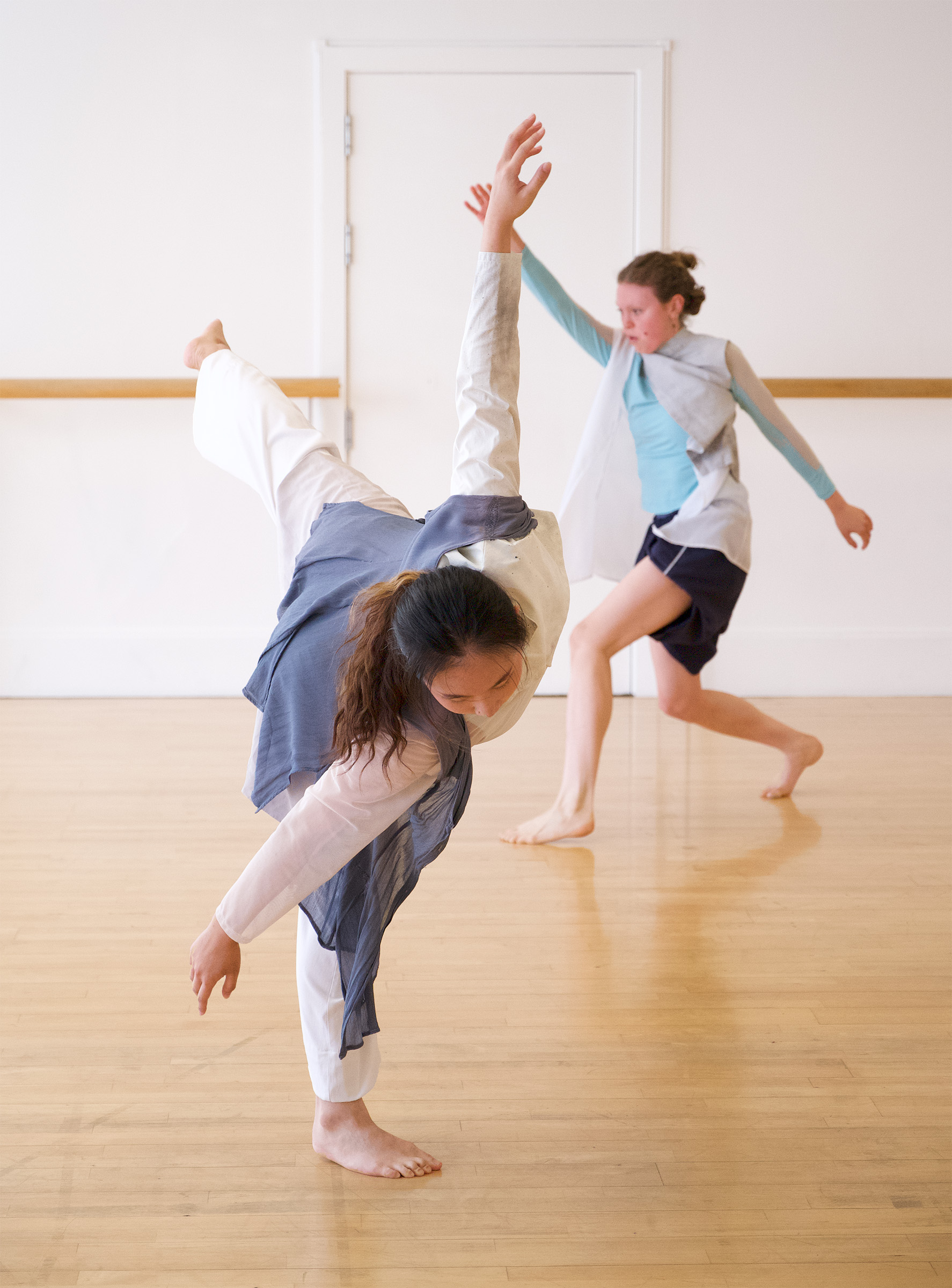

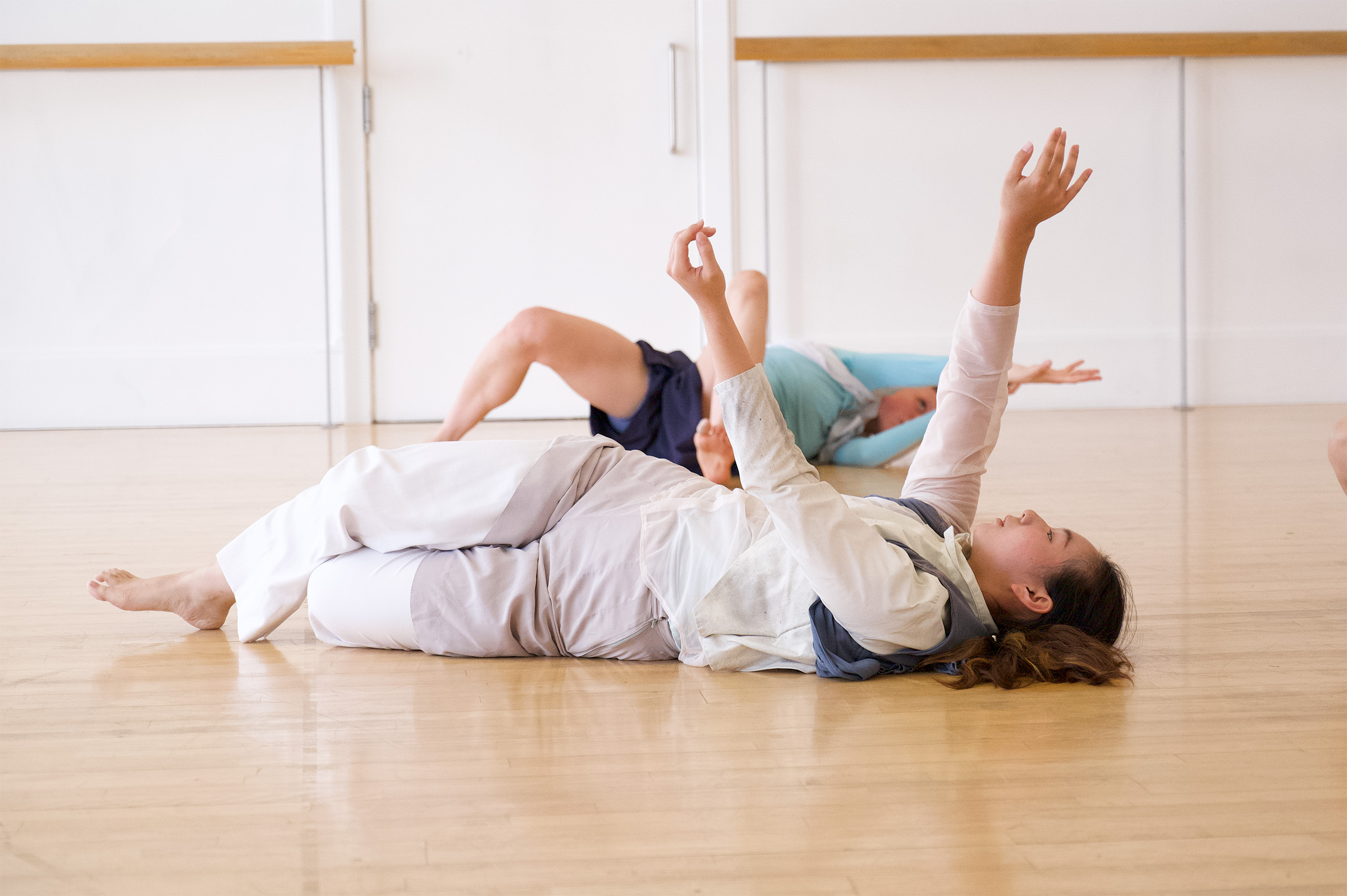

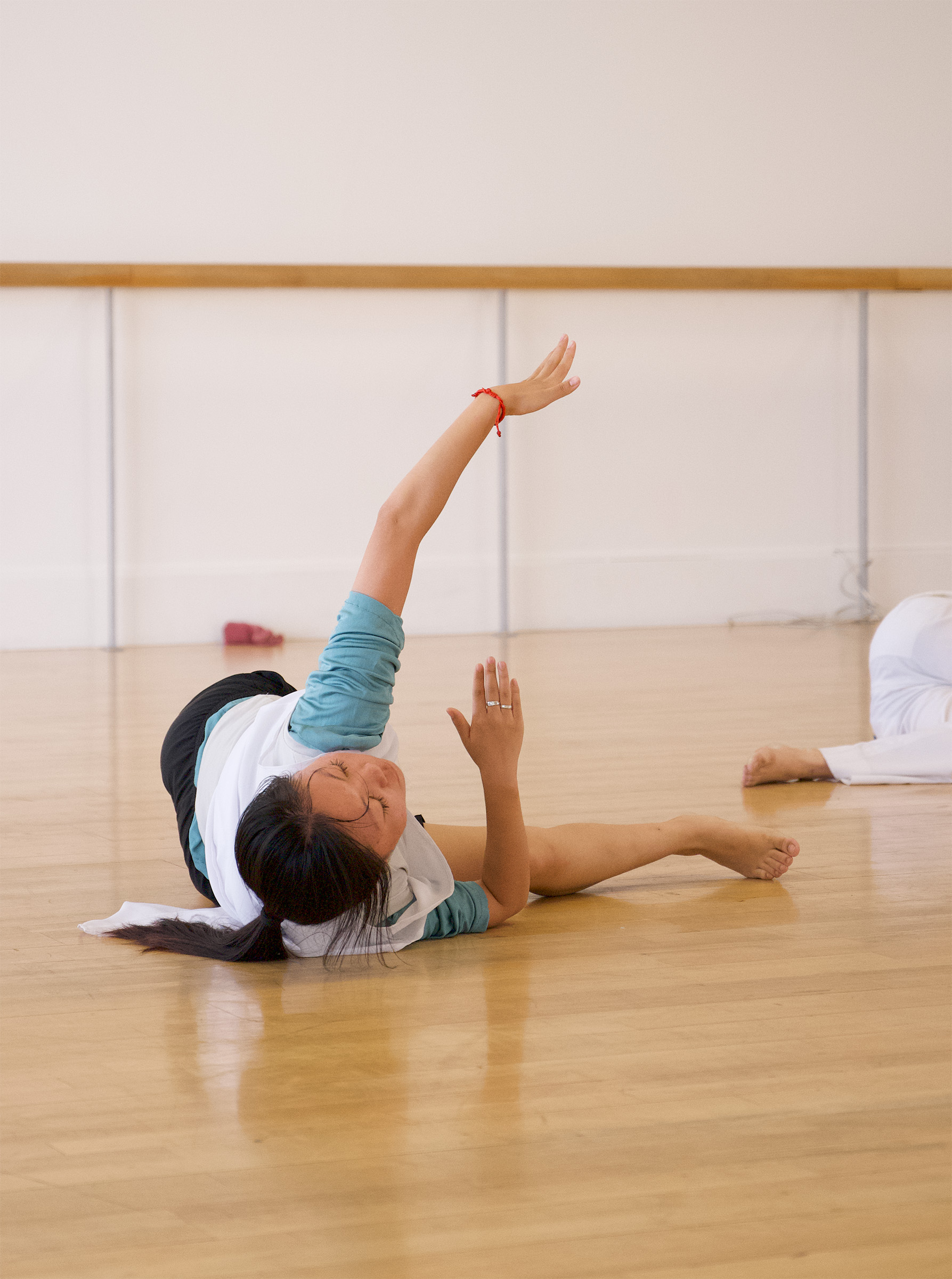

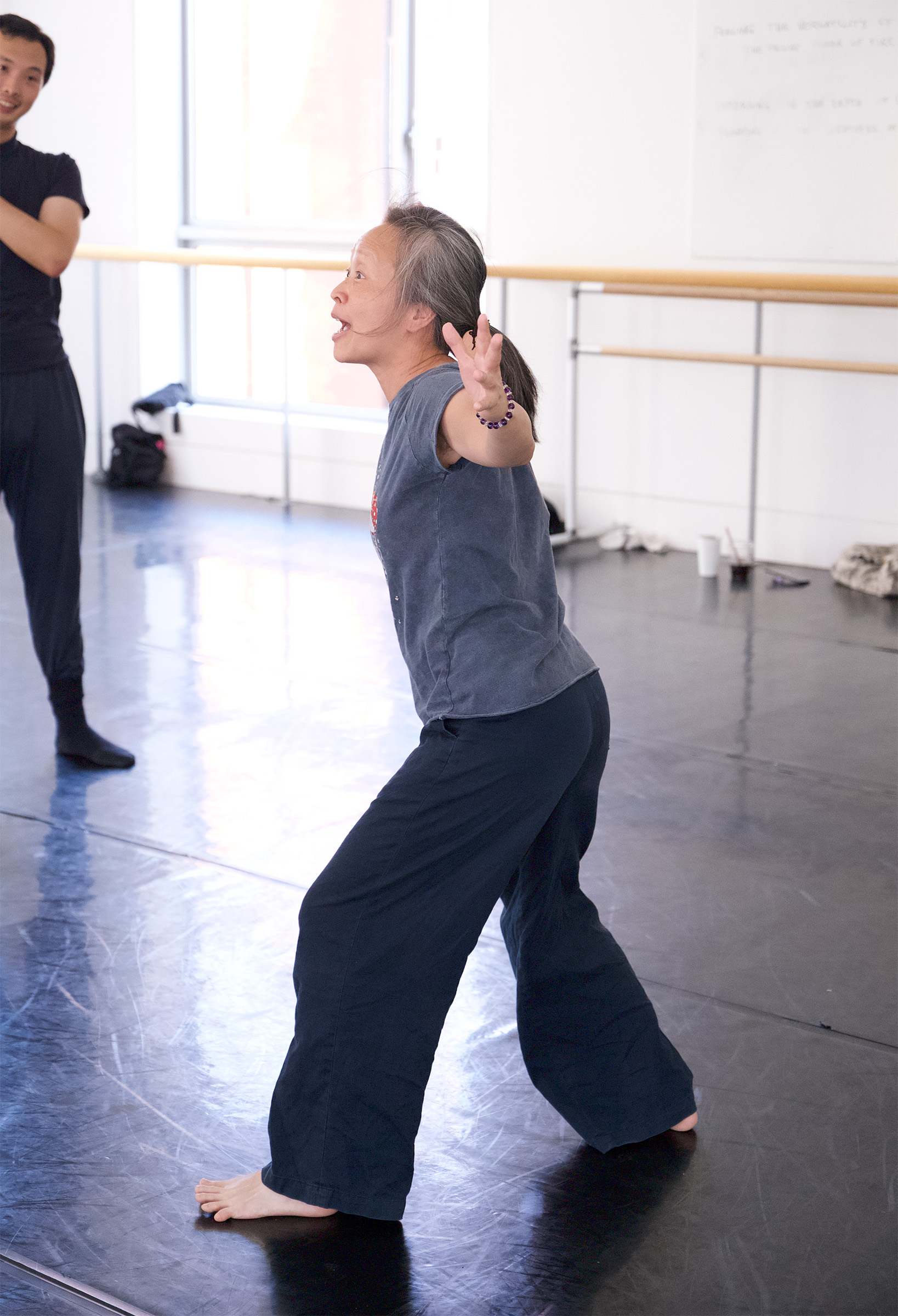
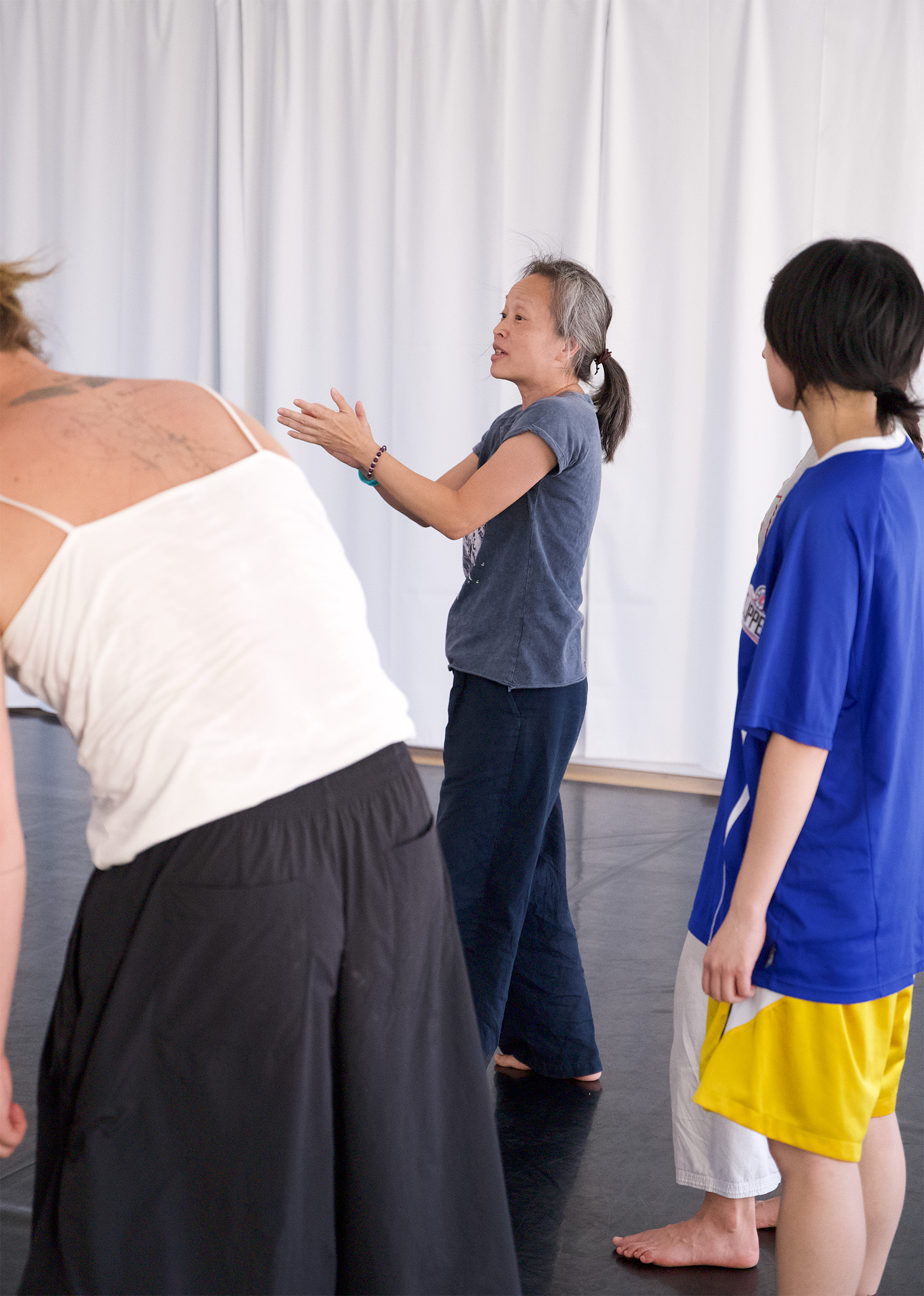
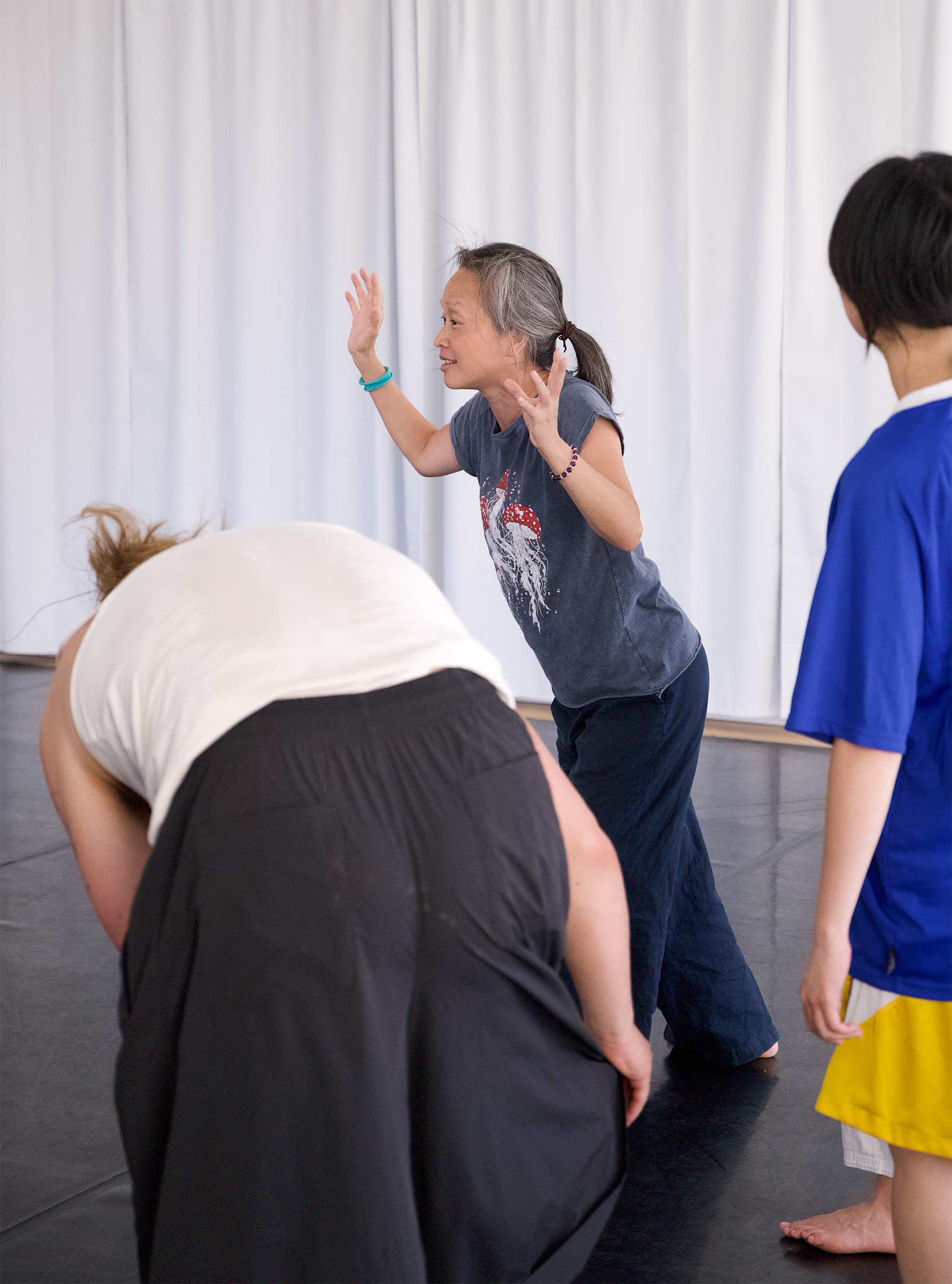
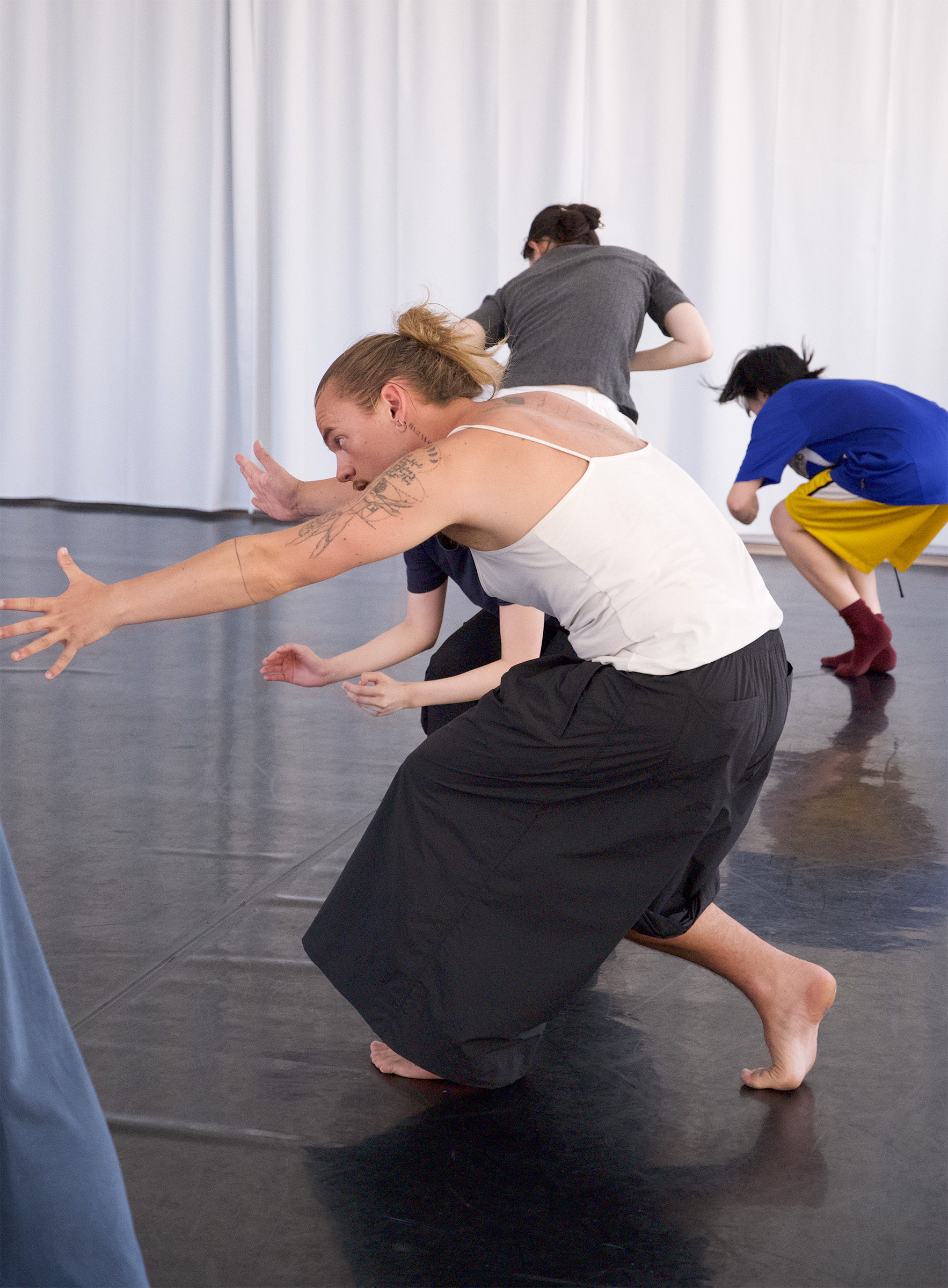
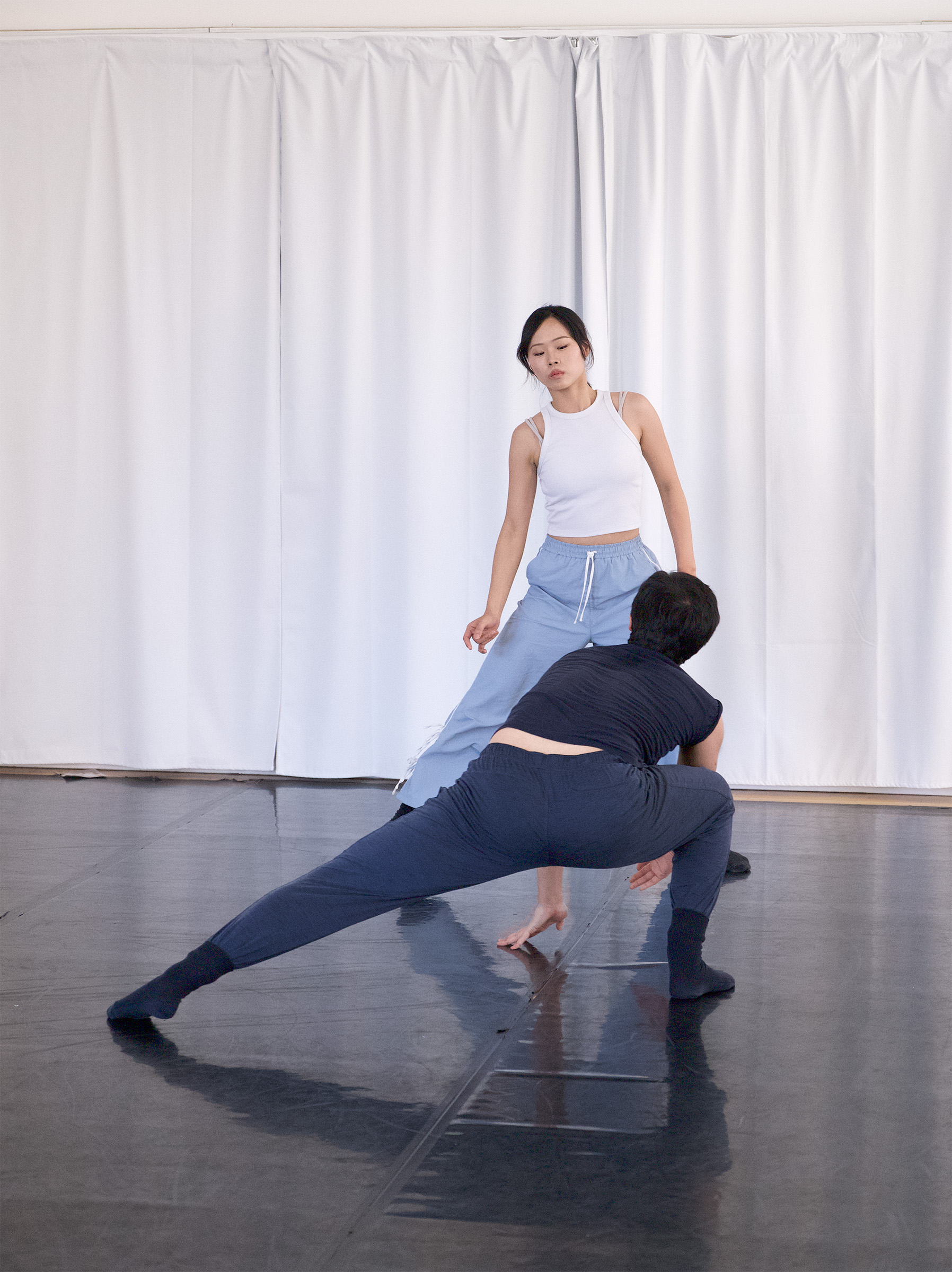
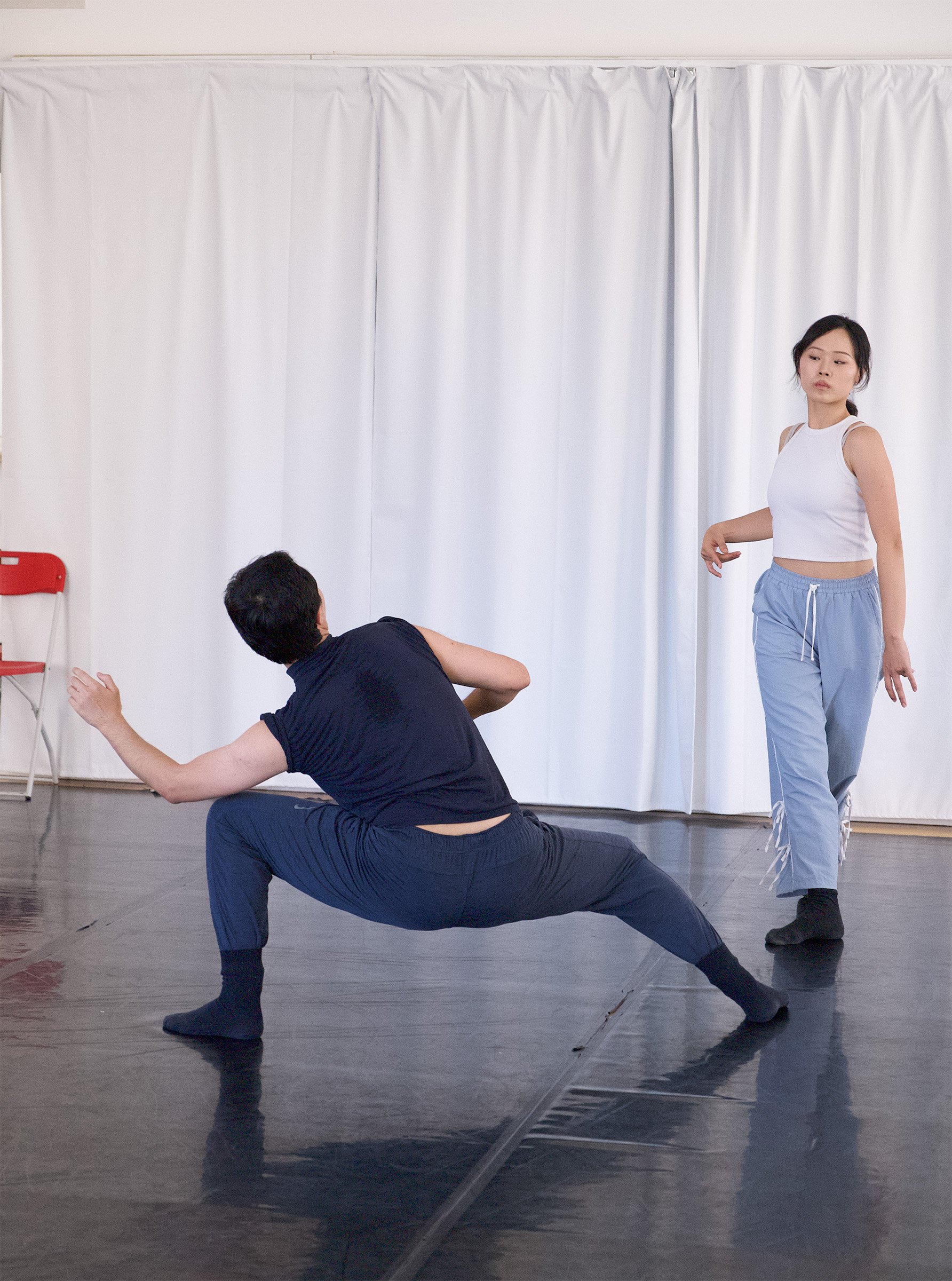
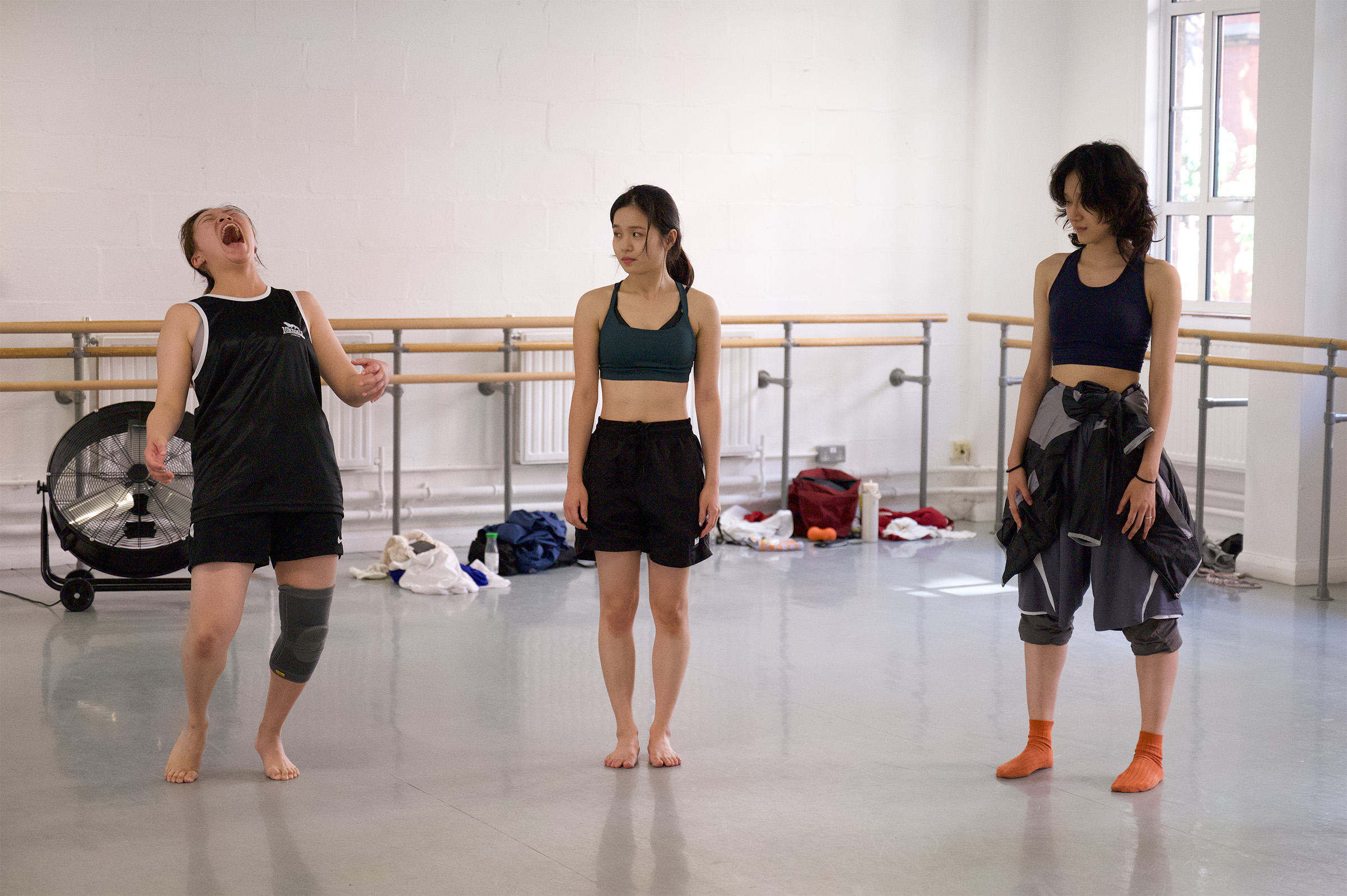
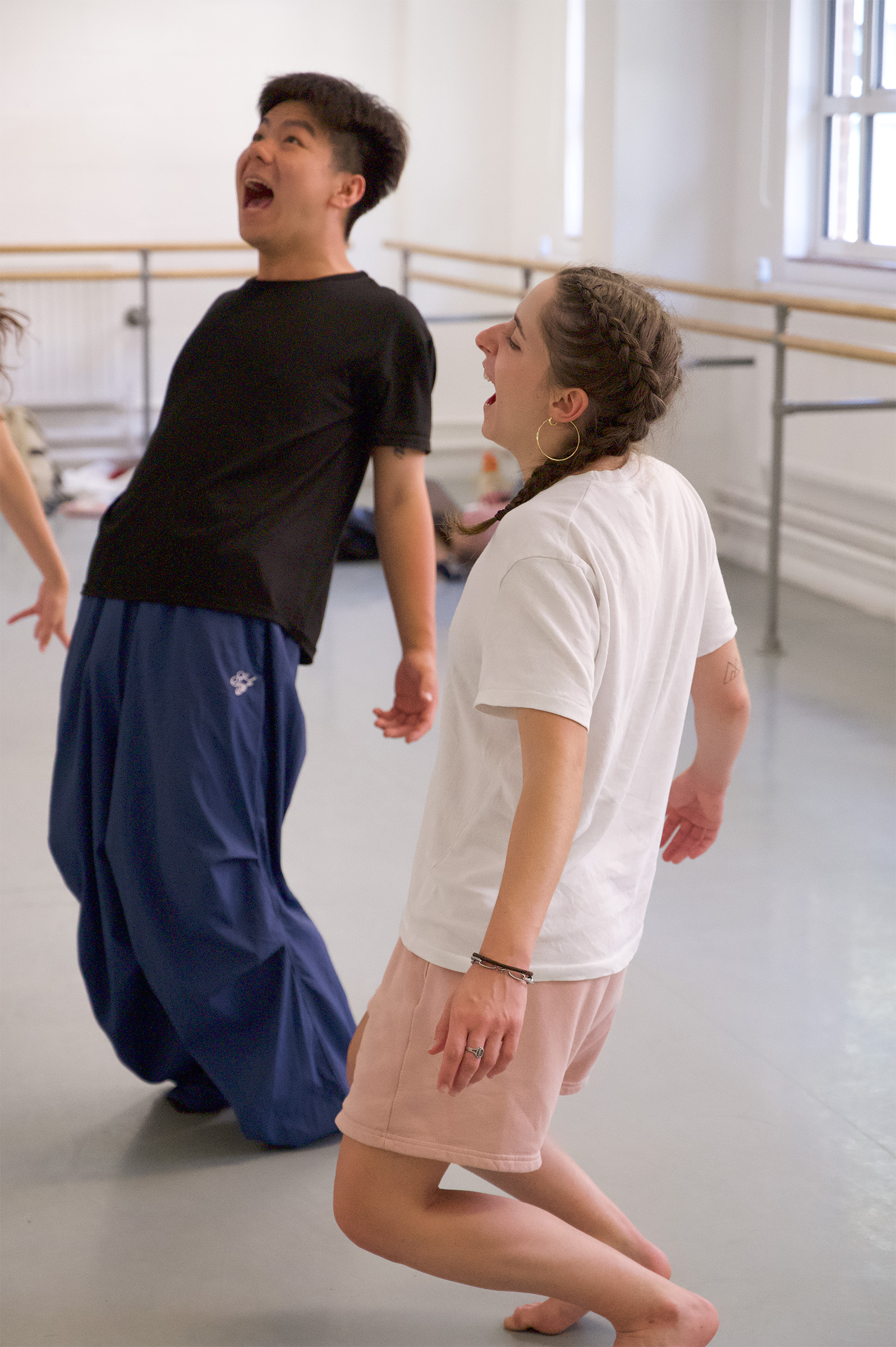
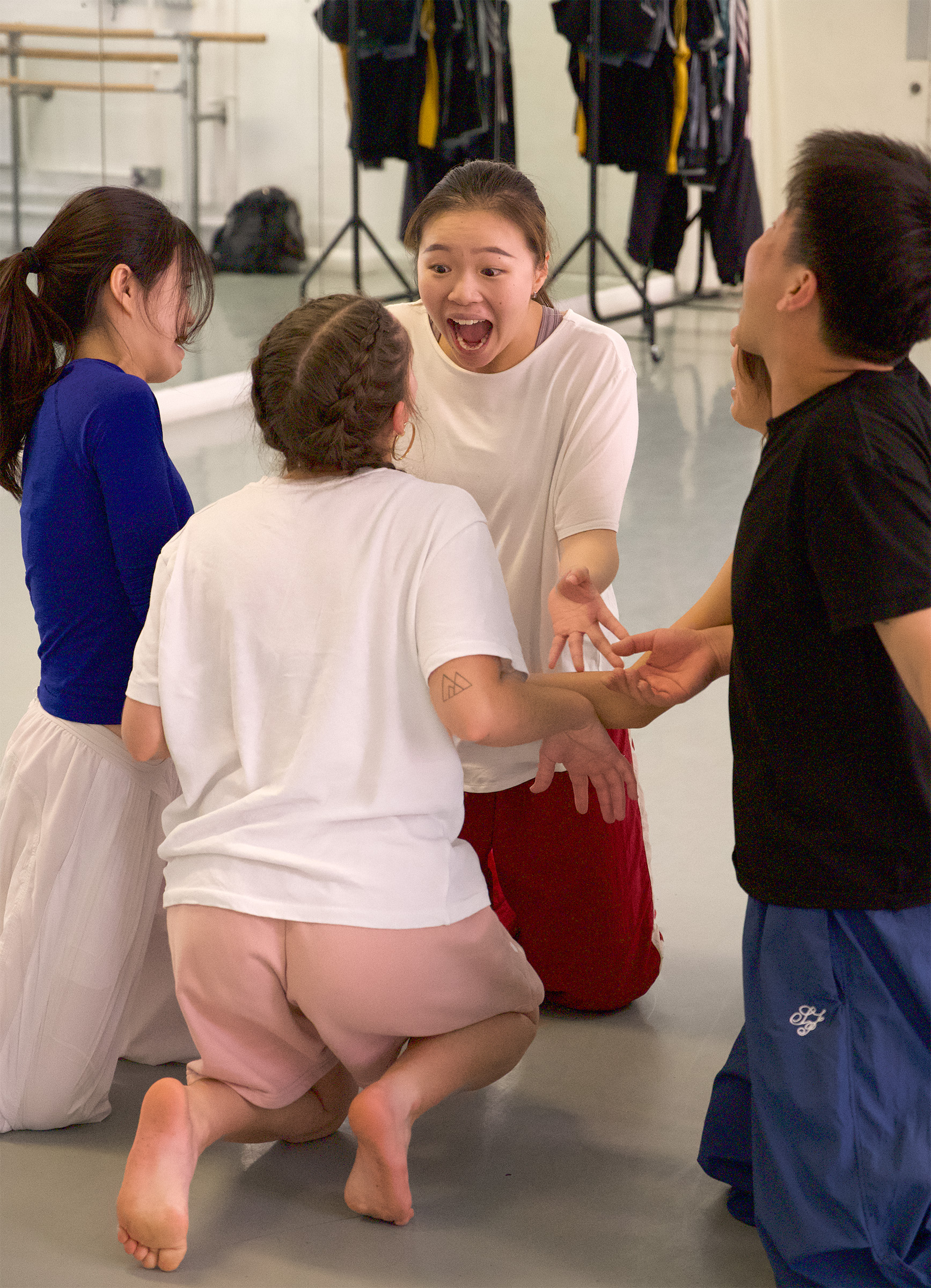
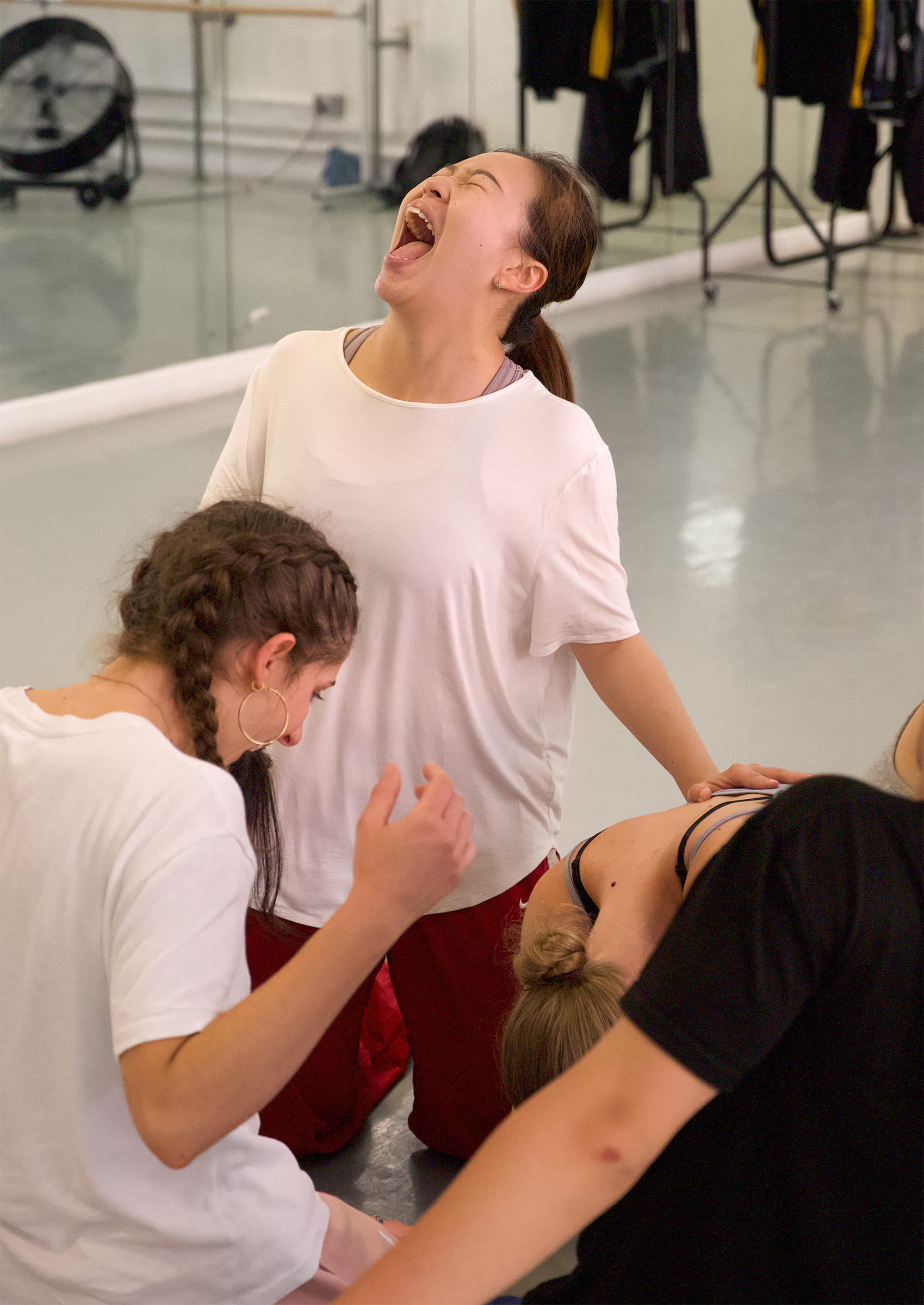
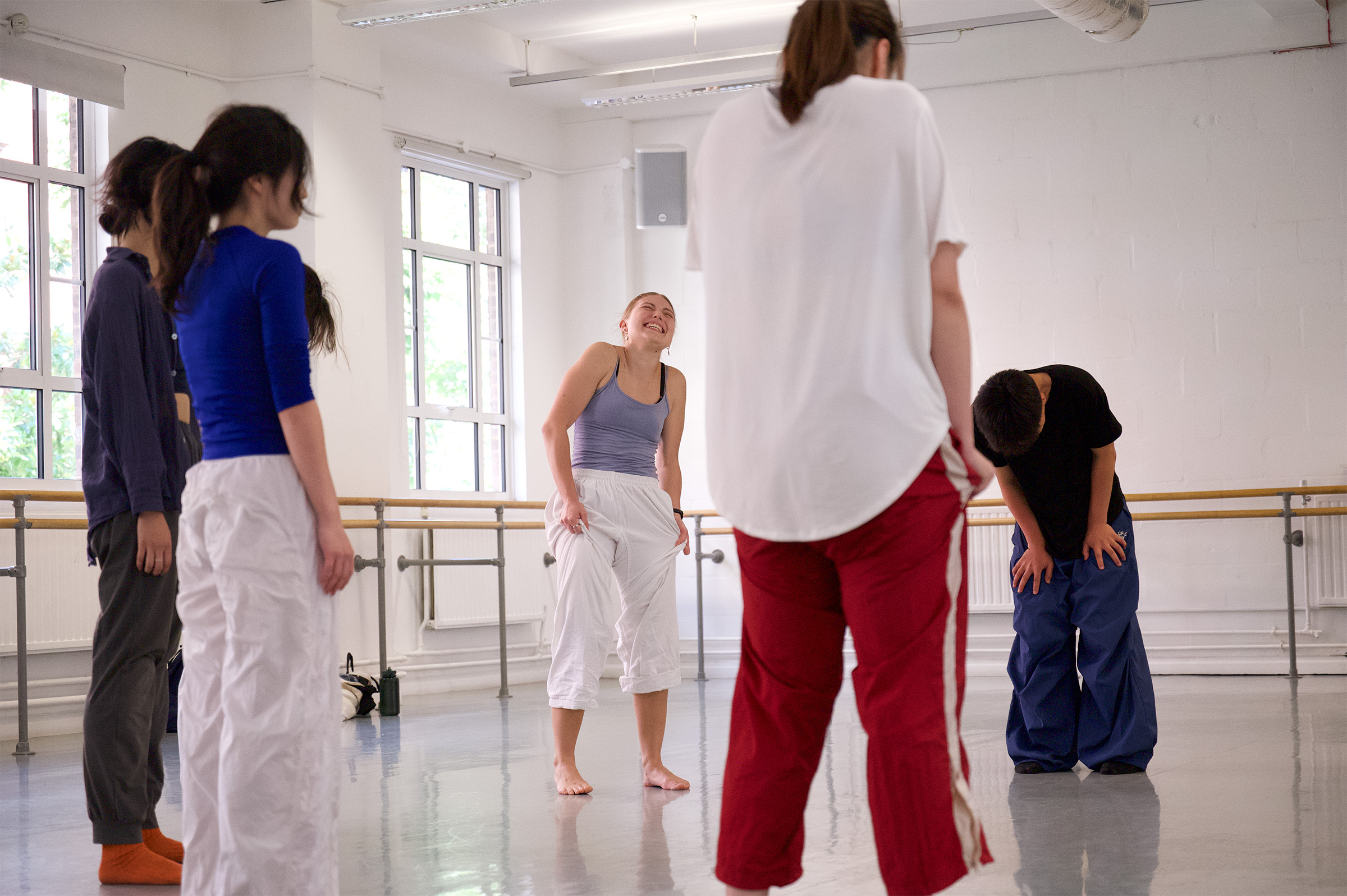


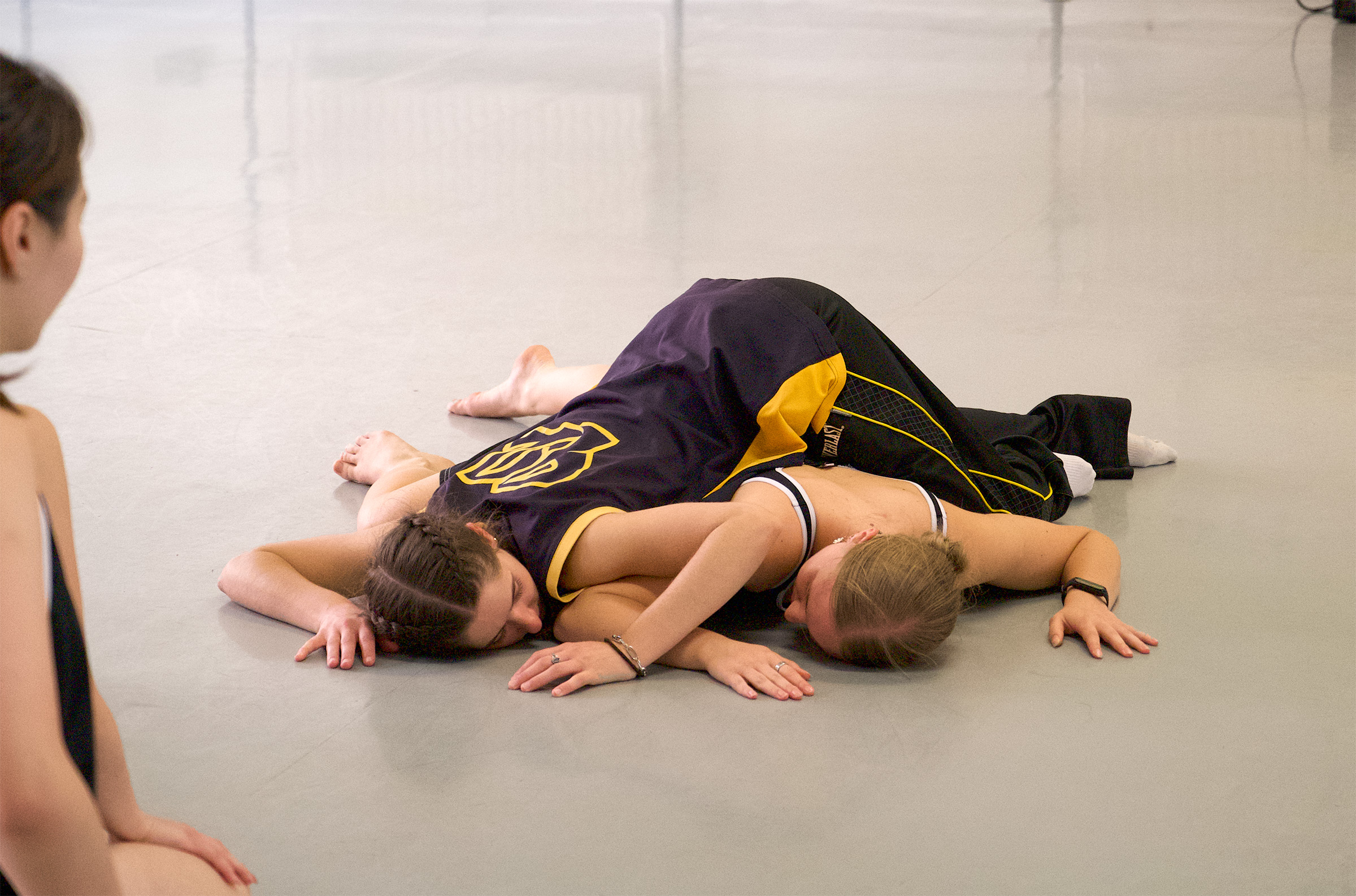
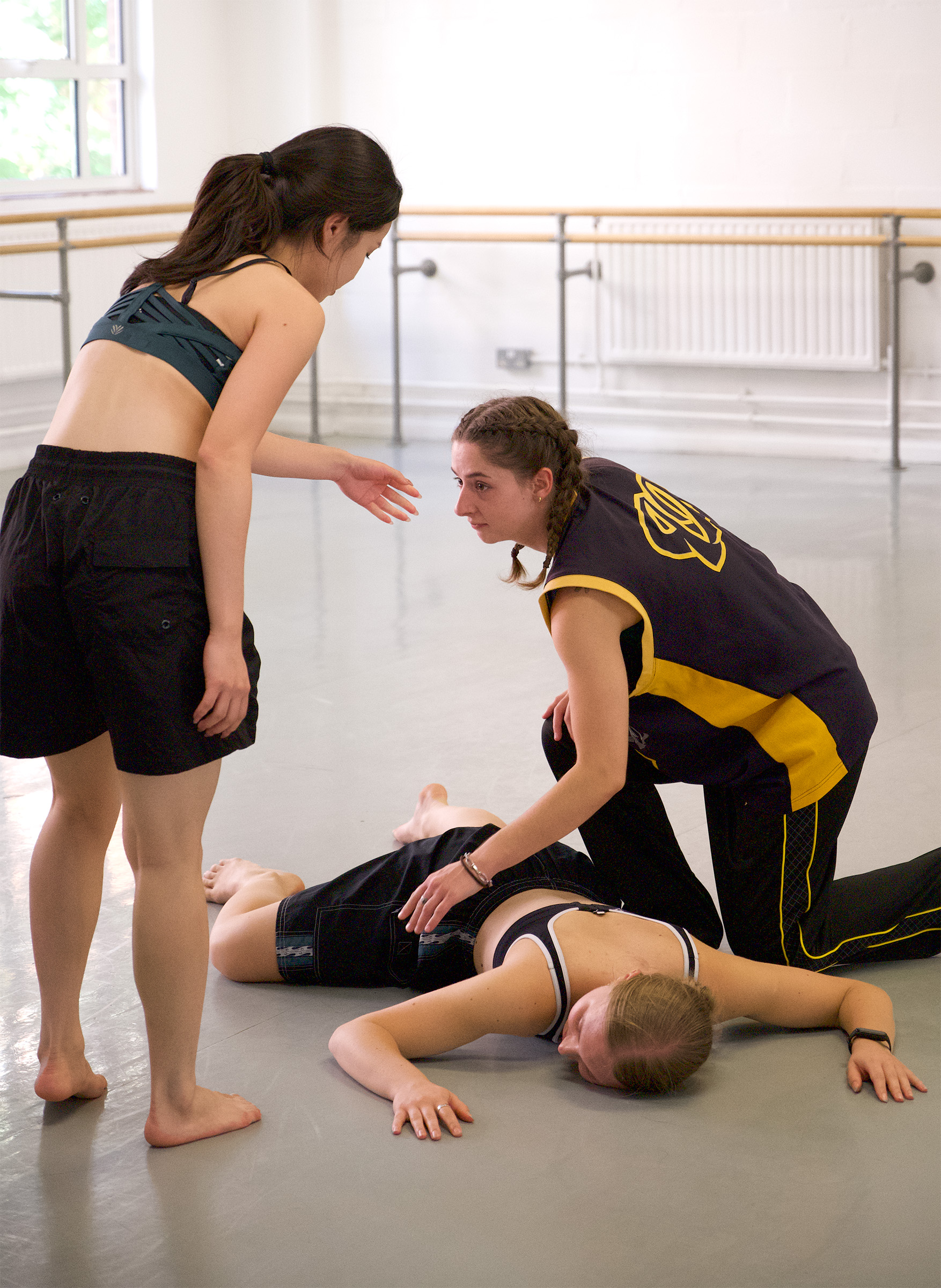
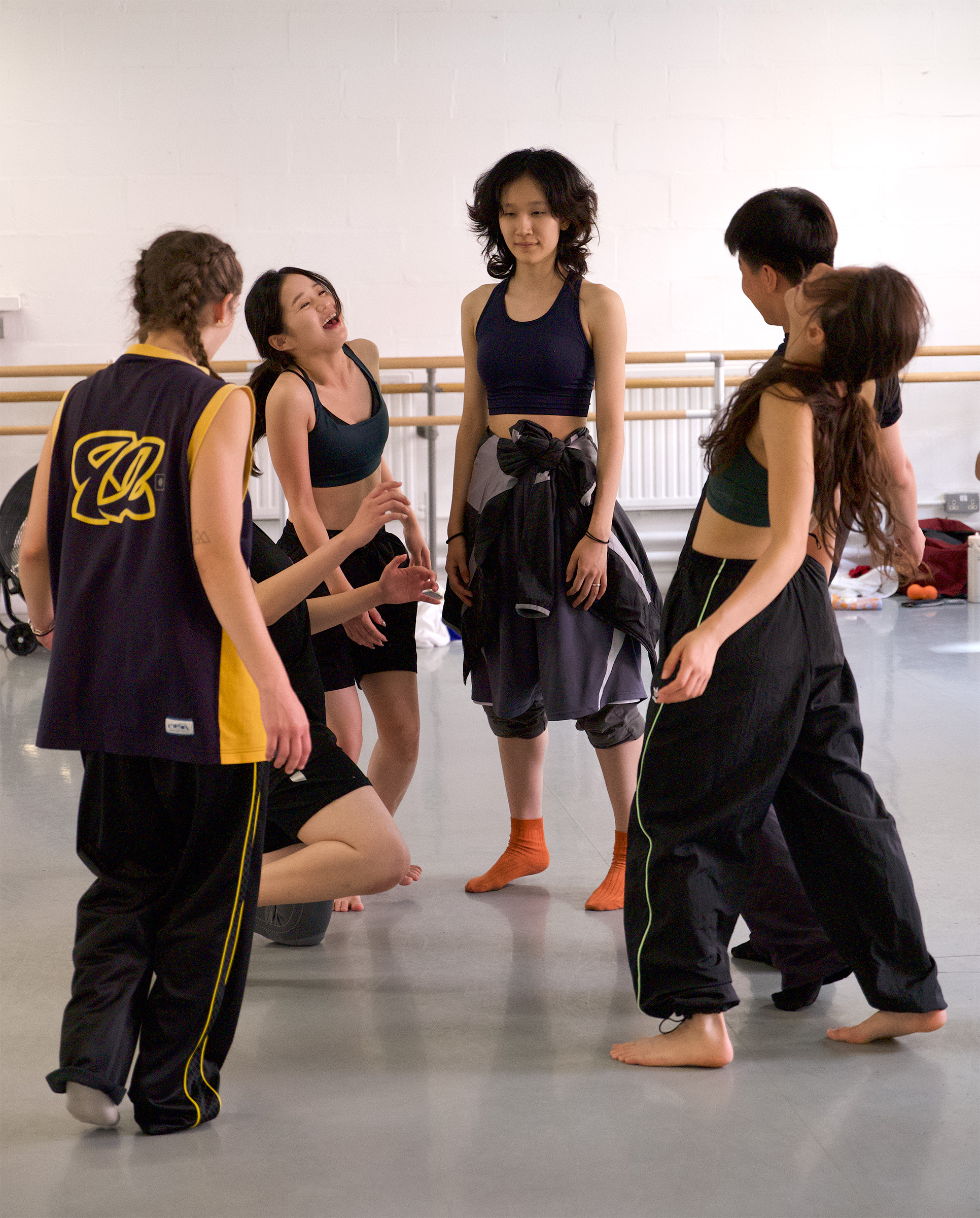
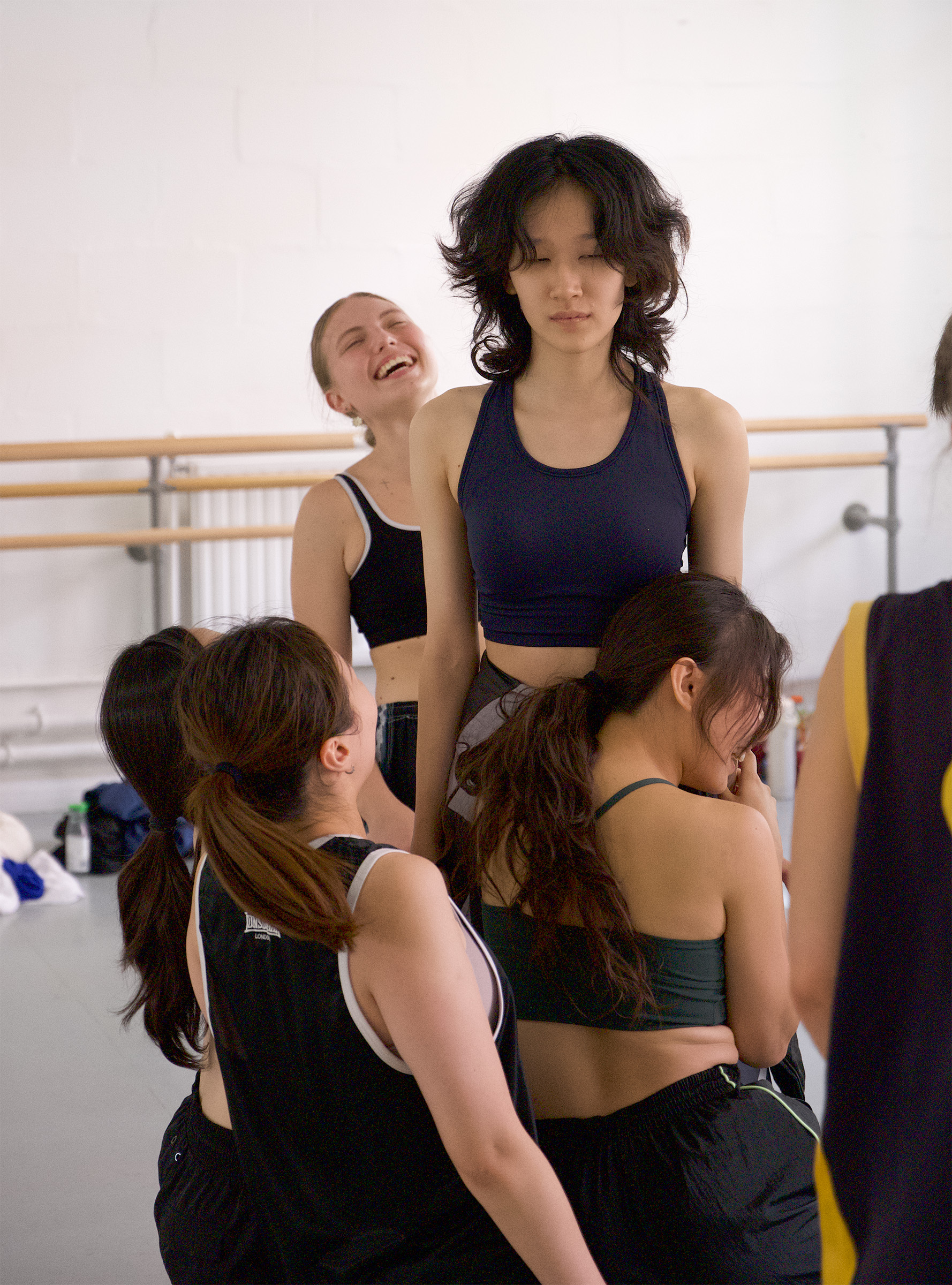
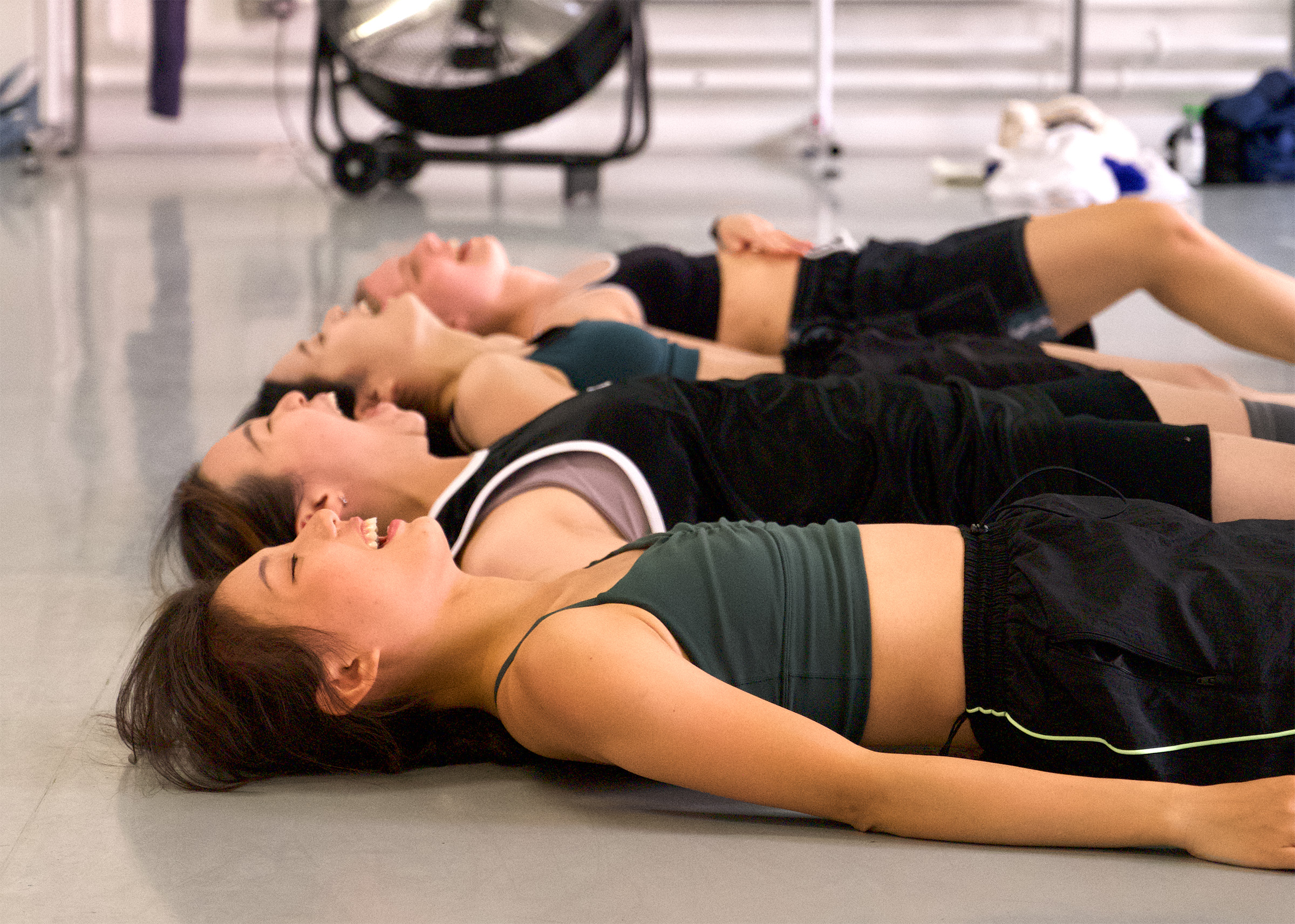
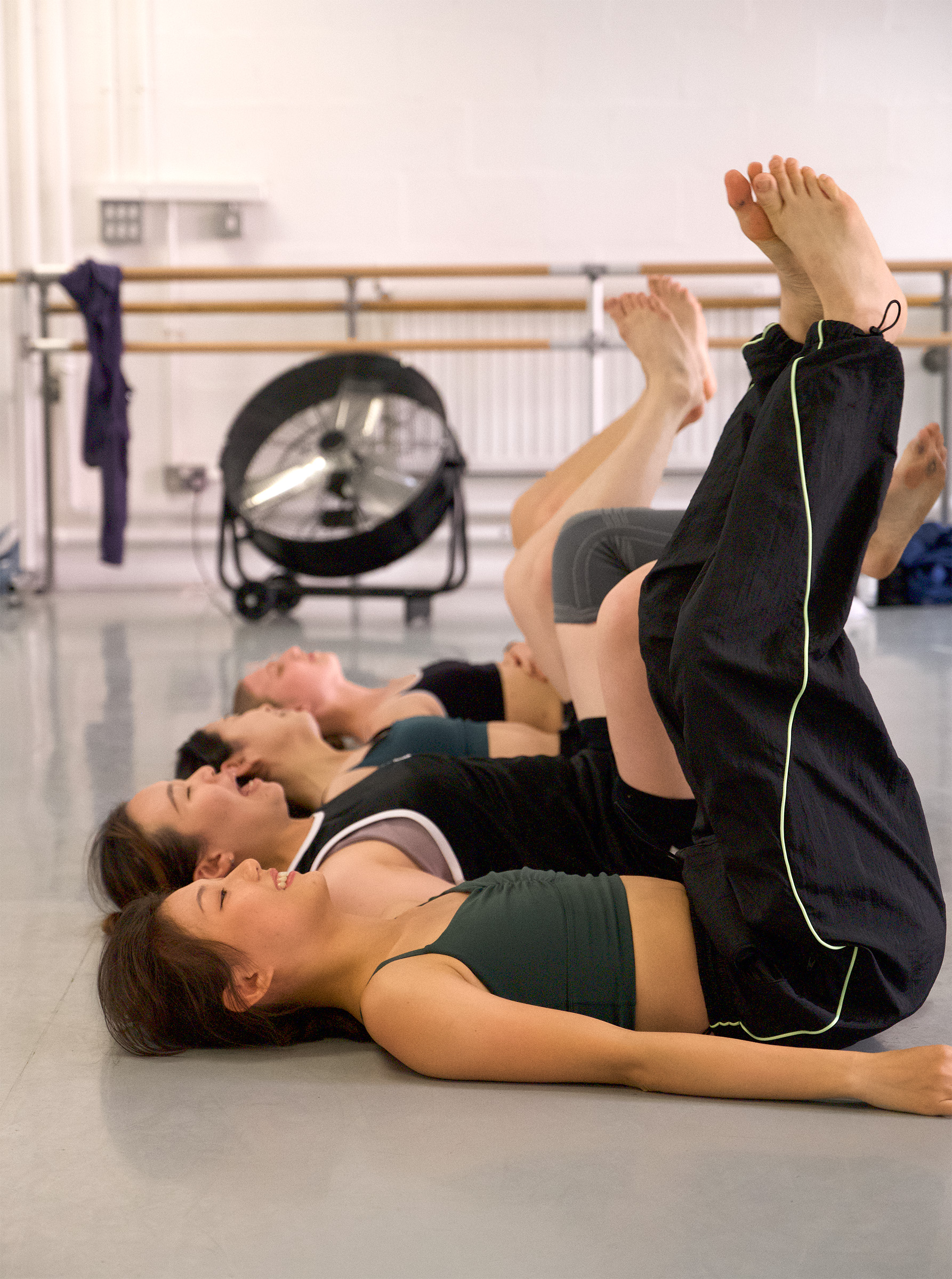


Learning to Spray Water – Zhenzhen Yan
Group 7 Cheng Yongping
3 July Friday afternoon
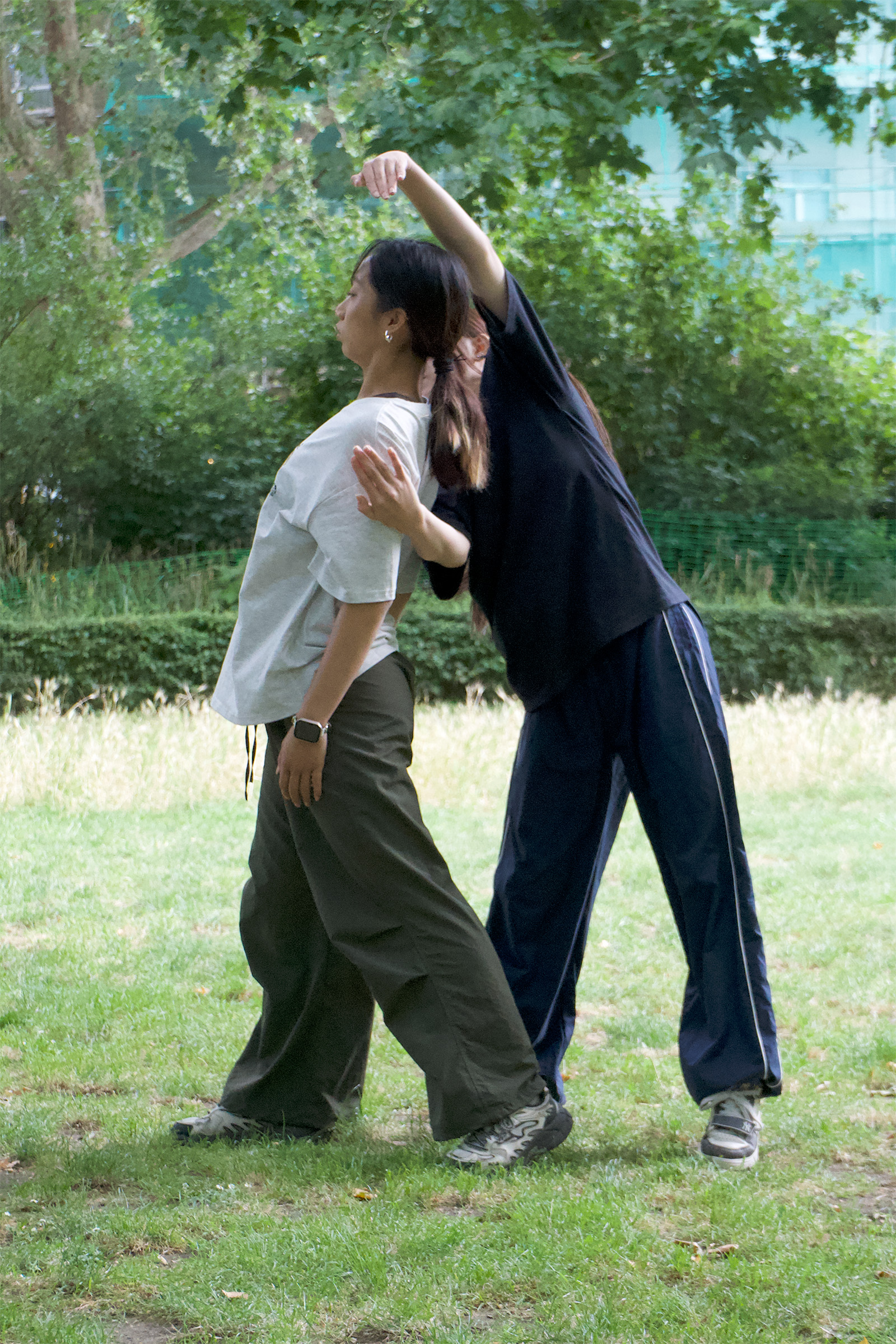
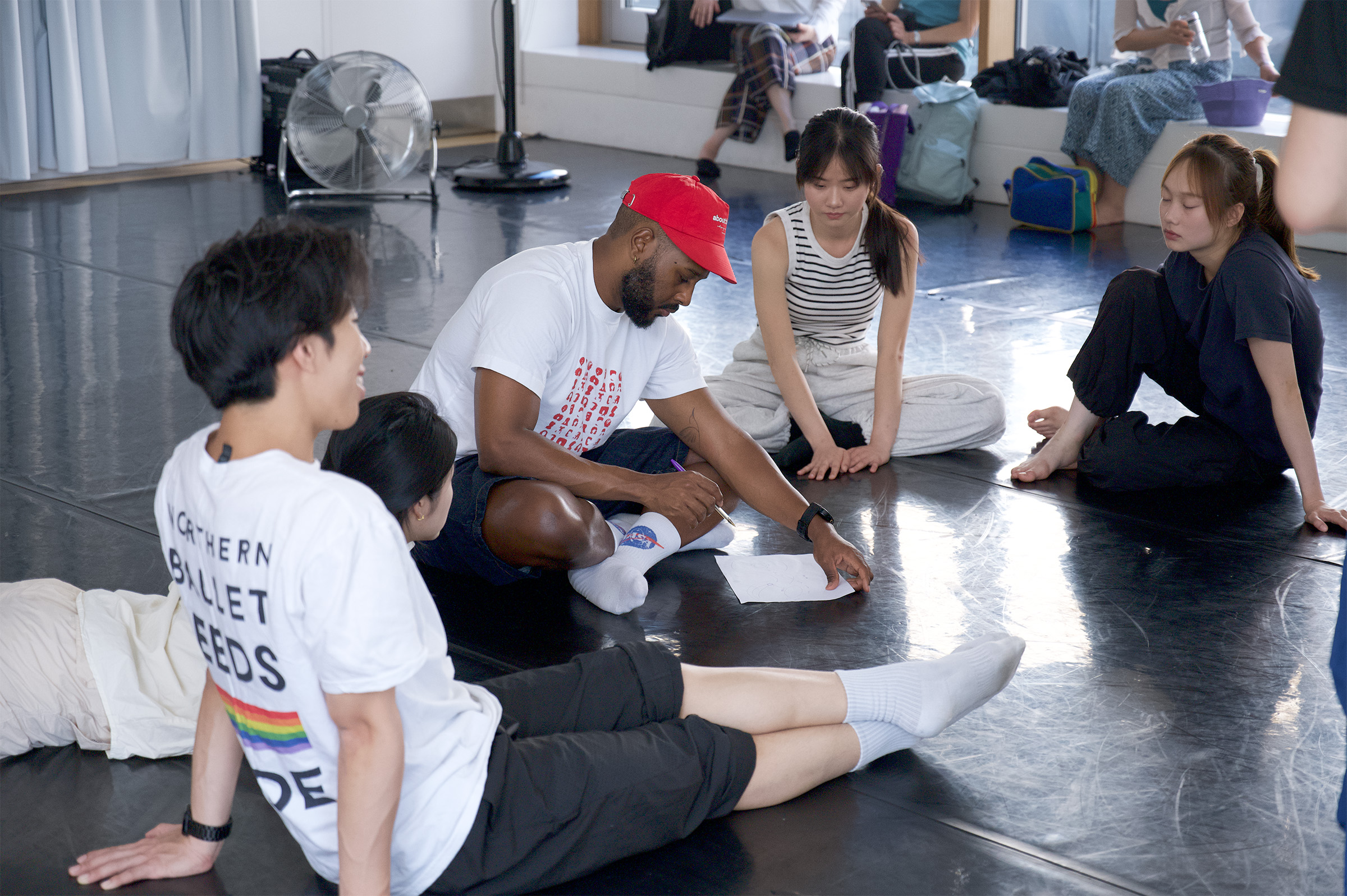
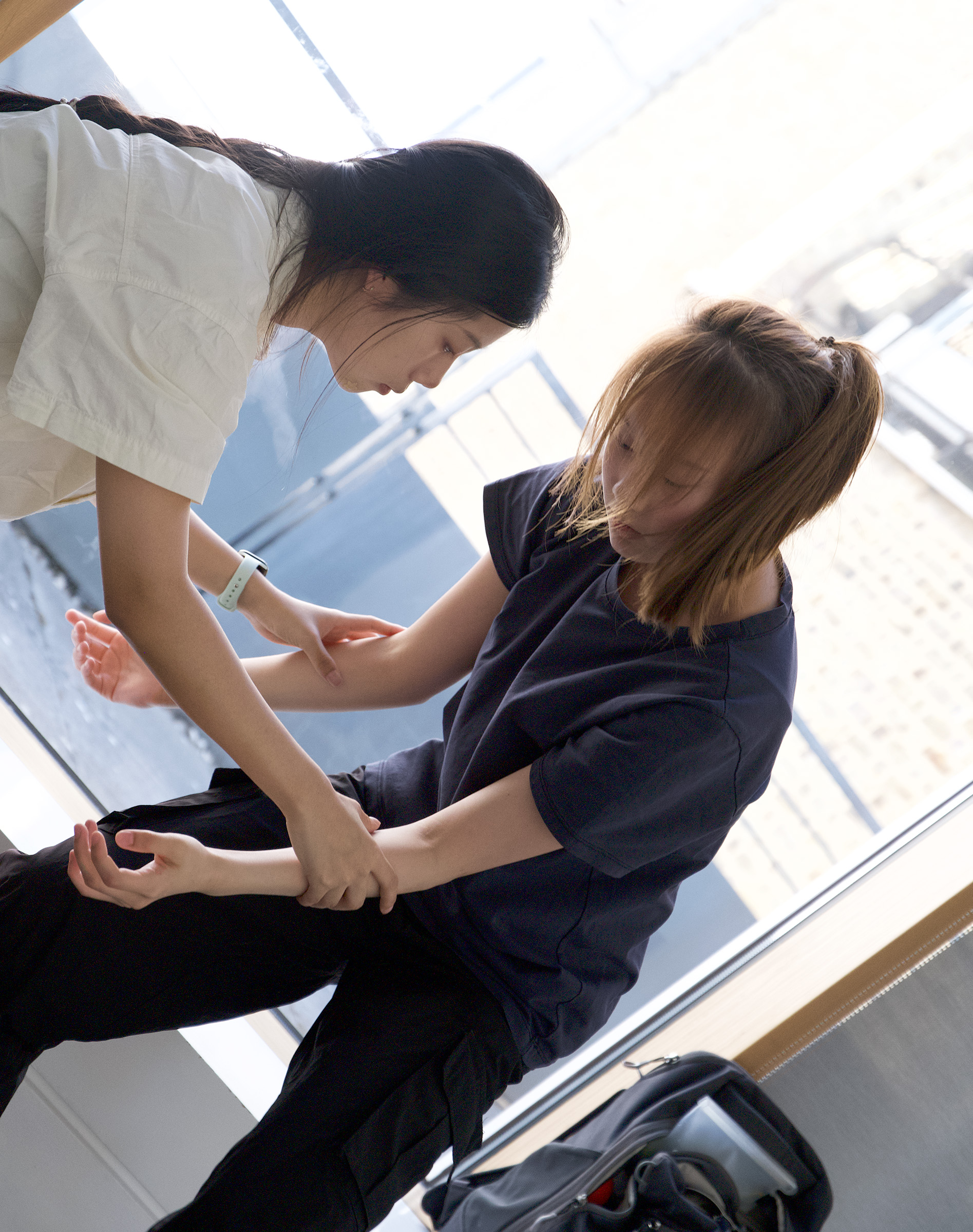
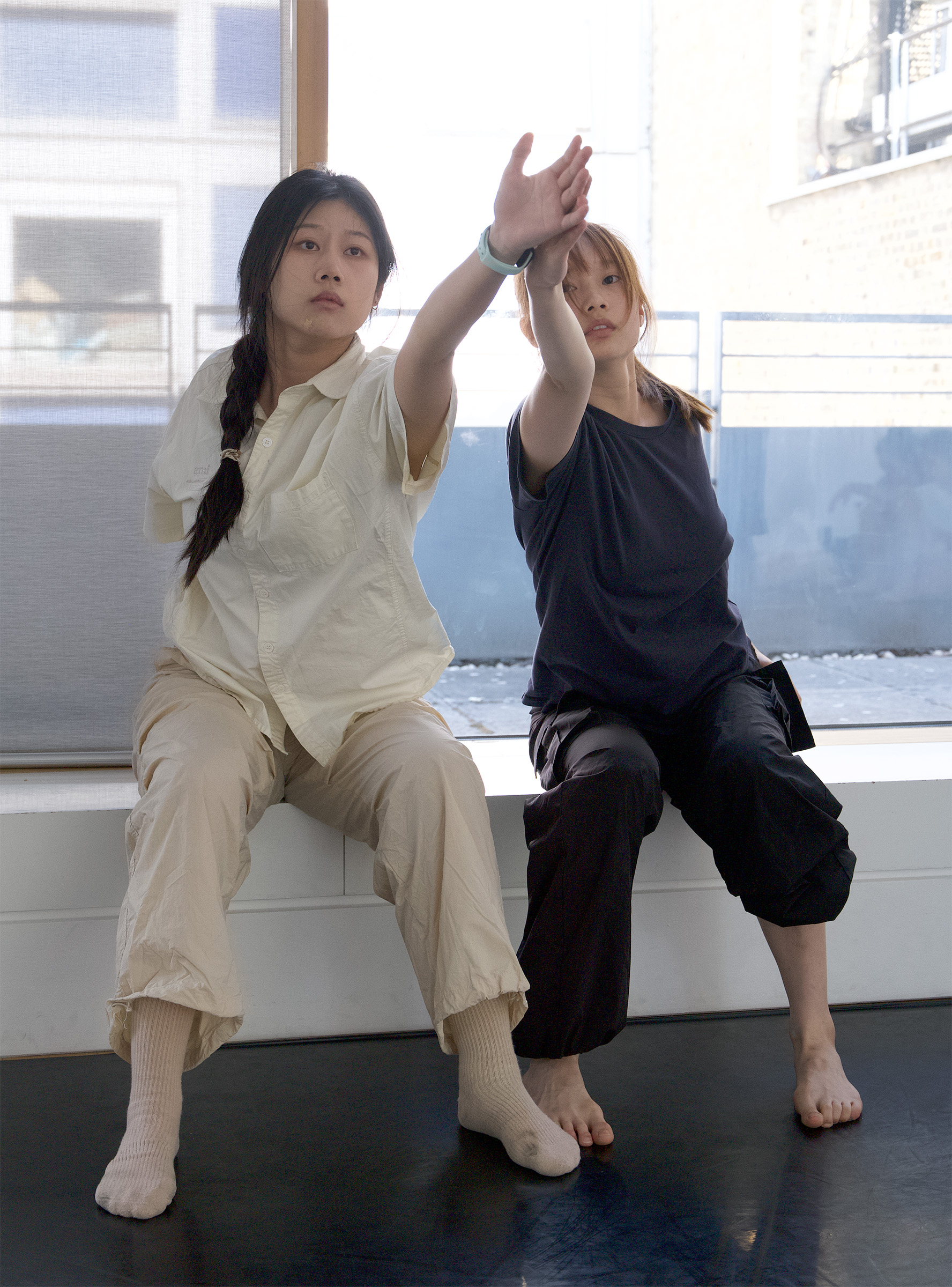
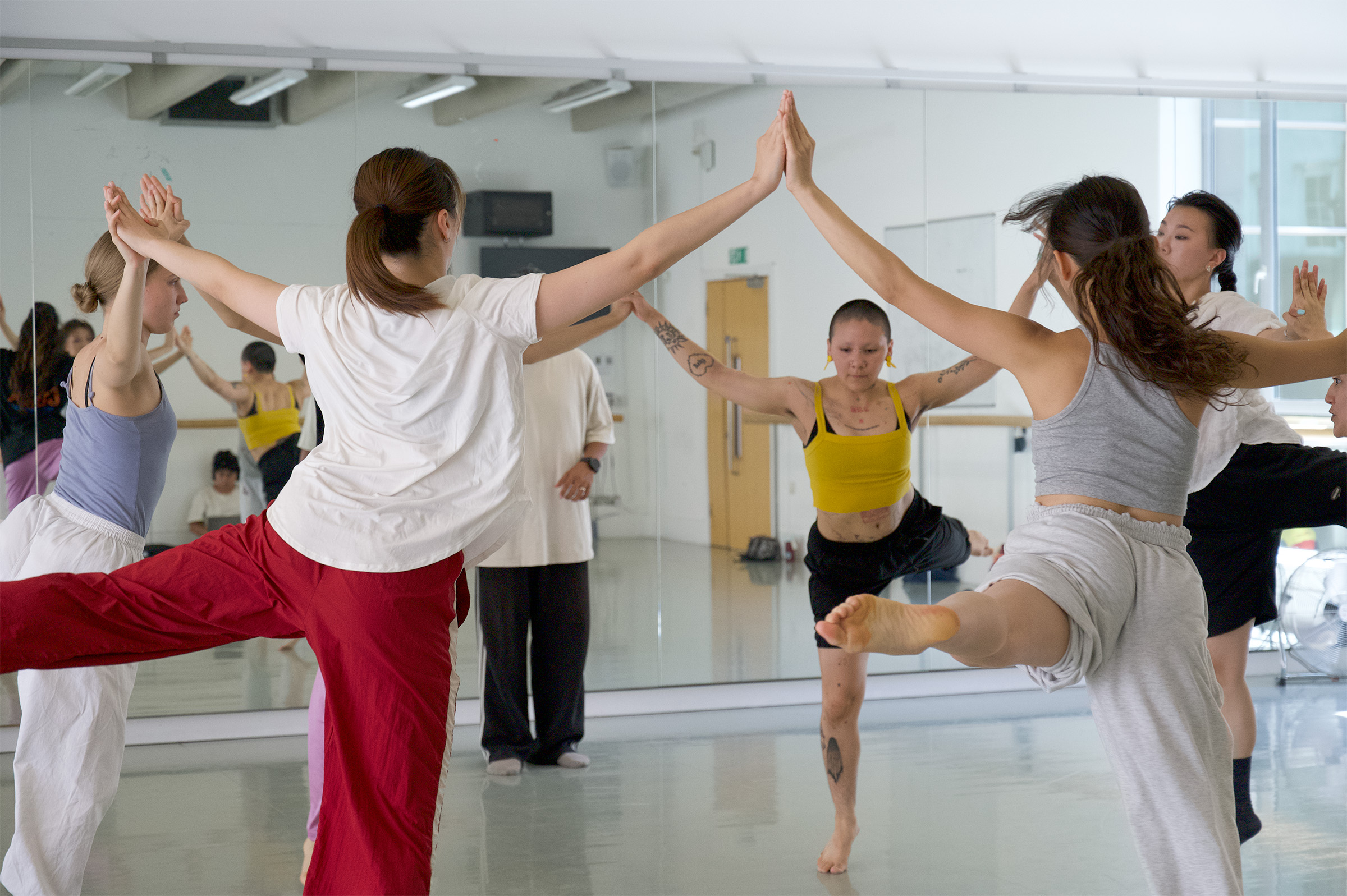
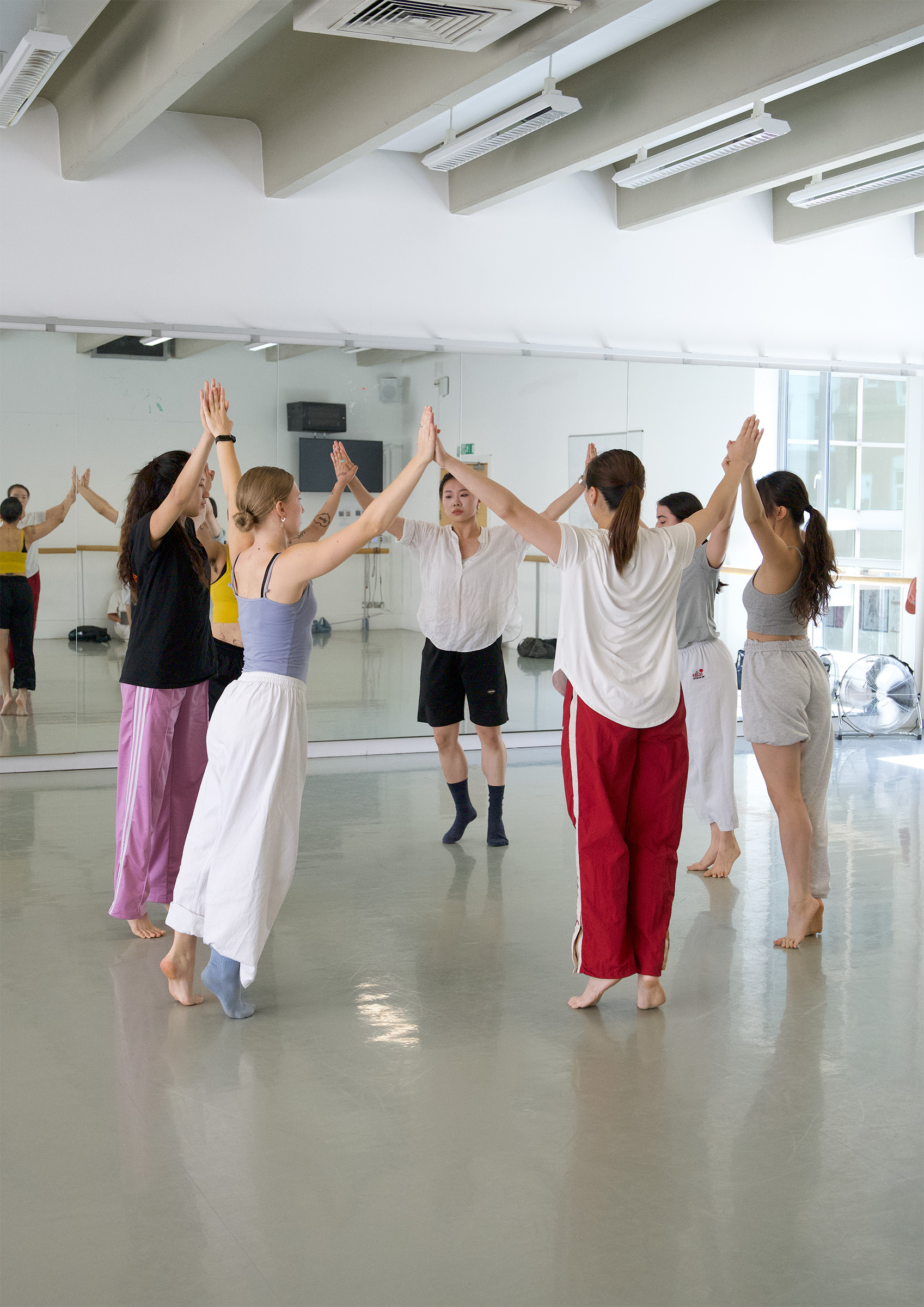
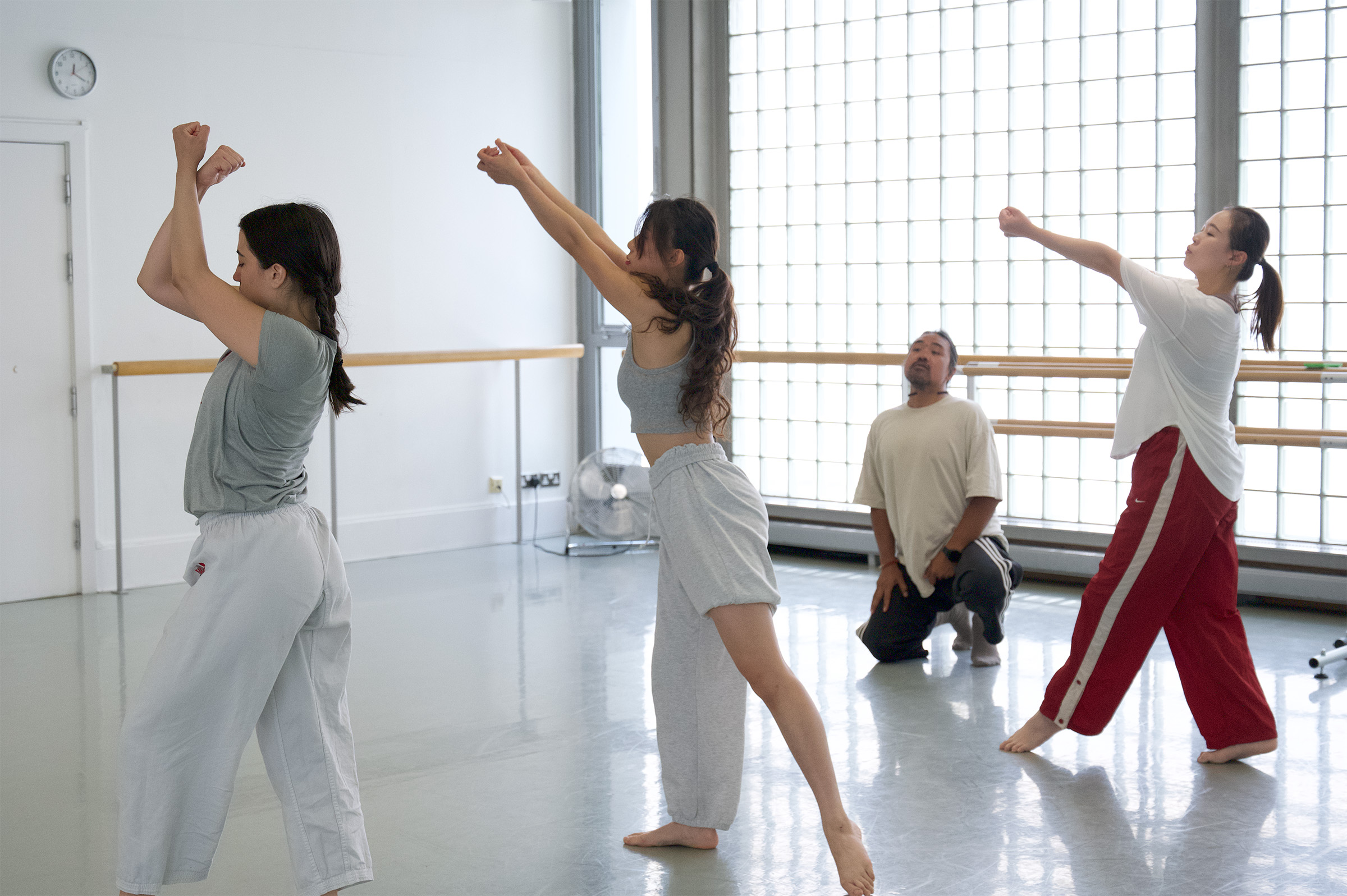
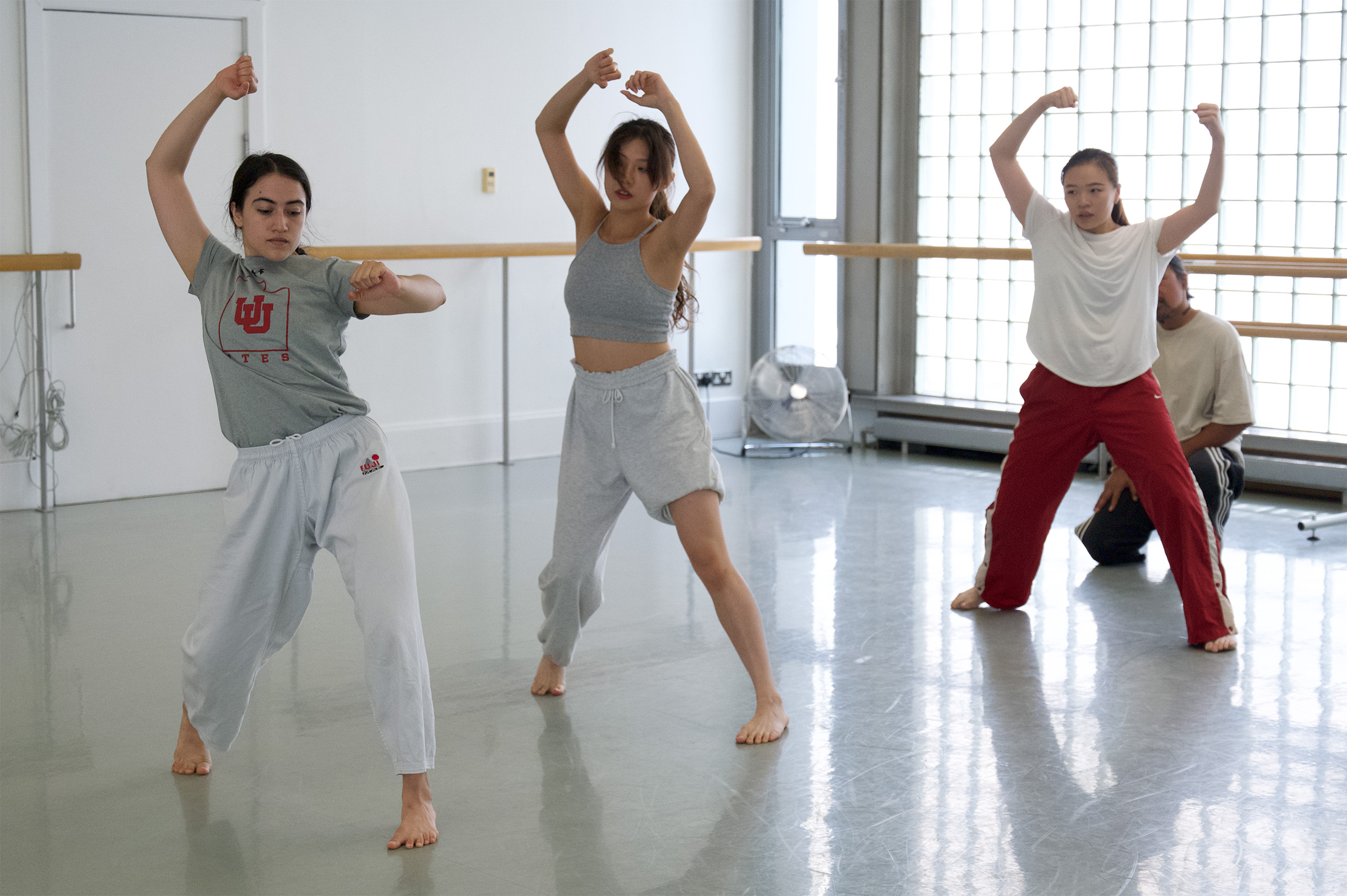
下午的阳光,树影婆娑。今天下午参加排练的演员并不整齐,编导决定用一些时间和舞者们一起讨论作品中的一个场景设置。这个场景中,一个舞者侧躺在地上,似乎是因为炎热的天气(在采访中,永萍说“伦敦太热了”是此次作品的主题),为了帮助同伴,另外一位舞者需要使用一个用来喷水的瓶子。据编导说,这个瓶子是她在超市买的,并且买了一个启瓶器,用来在水瓶盖上钻了数个大小不一的孔。通过挤压瓶子,水会滋出来,像是浇灌植物一样,浇灌被“热”击倒的舞者。
永萍忽然觉得应该让“照护”同伴的舞者用嘴巴来喷水。她做了一个示范动作,将水含在口中,通过口腔的压力,喷出雾状的迷你水幕。当香港舞者尝试同样的动作时,有趣的时刻发生了:她无法喷出足够细密的水雾,水滴从她的嘴里流淌出来,不能达到足够的“射程”距离。这是我第一次意识到,原来一个喷水的动作,也并不如想象中一样可以“共享”。身体运动的的每一个瞬间(在这个时刻是口腔)都会调用我们平时无法意识到的肌肉力量和协同性的生理网络(例如呼吸配合、肺活量等等),所以即便是平常如“用嘴喷水”的动作,也完全不似我们想象中那样可以通约。
我经常认为舞蹈相比于语言,更容易跨越个体的文化边界,但是几乎没有意识到原来身体也有自己的“边界”:不是一种经过训练后的舞者身体,而是任何一个作为协同网络的身体系统。一口含在嘴里难以喷出的水,它提出了一个问题:也许我们过于高估了身体的通约性?也许,像语言一样,身体也有自己的“巴别塔”。
The afternoon sunlight filtered through the trees. Not all of the dancers were present for rehearsal, so Yongping decided to spend some time discussing one particular scene with the group.
In this scene, one dancer lies on the ground, seemingly overcome by the extreme heat. (In her interview, Yongping mentioned that “London is too hot” had become one of the inspirations for the work.) Another dancer tries to care for them using a plastic water bottle. Yongping explained that she had bought the bottle in a supermarket and pierced several small holes in the bottle cap with a bottle opener. When squeezed, the bottle releases a gentle spray, watering the exhausted dancer like a small watering can.
Then Yongping proposed a different possibility. Instead of using the bottle, the caring dancer would spray the water directly from her mouth. She demonstrated the action herself, holding a mouthful of water before releasing it as a fine mist through carefully controlled breath.
When a dancer from Hong Kong tried to repeat the movement, something unexpected happened. She could not produce the same mist. The water simply escaped from her mouth in heavy drops, falling well short of the distance the choreography required.
It was a surprisingly small failure, yet it caught my attention. Until that moment, I had assumed that such an ordinary action could simply be repeated from one body to another. Instead, it revealed itself to depend upon a subtle coordination of breath, oral muscles, pressure, timing, and countless physiological adjustments that usually remain unnoticed. What had seemed like an ordinary everyday gesture turned out to be a bodily technique.
I have often assumed that dance crosses cultural boundaries more easily than language. Yet I had rarely considered that the body might also have its own boundaries—not simply the trained body of a dancer, but the ordinary body understood as a coordinated physiological system.
A mouthful of water that refused to become a mist left me with an unexpected question: perhaps we have overestimated the body’s universality. Perhaps, like language, the body has its own Babel.
Written by Zhenzhen Yan (Documenter)
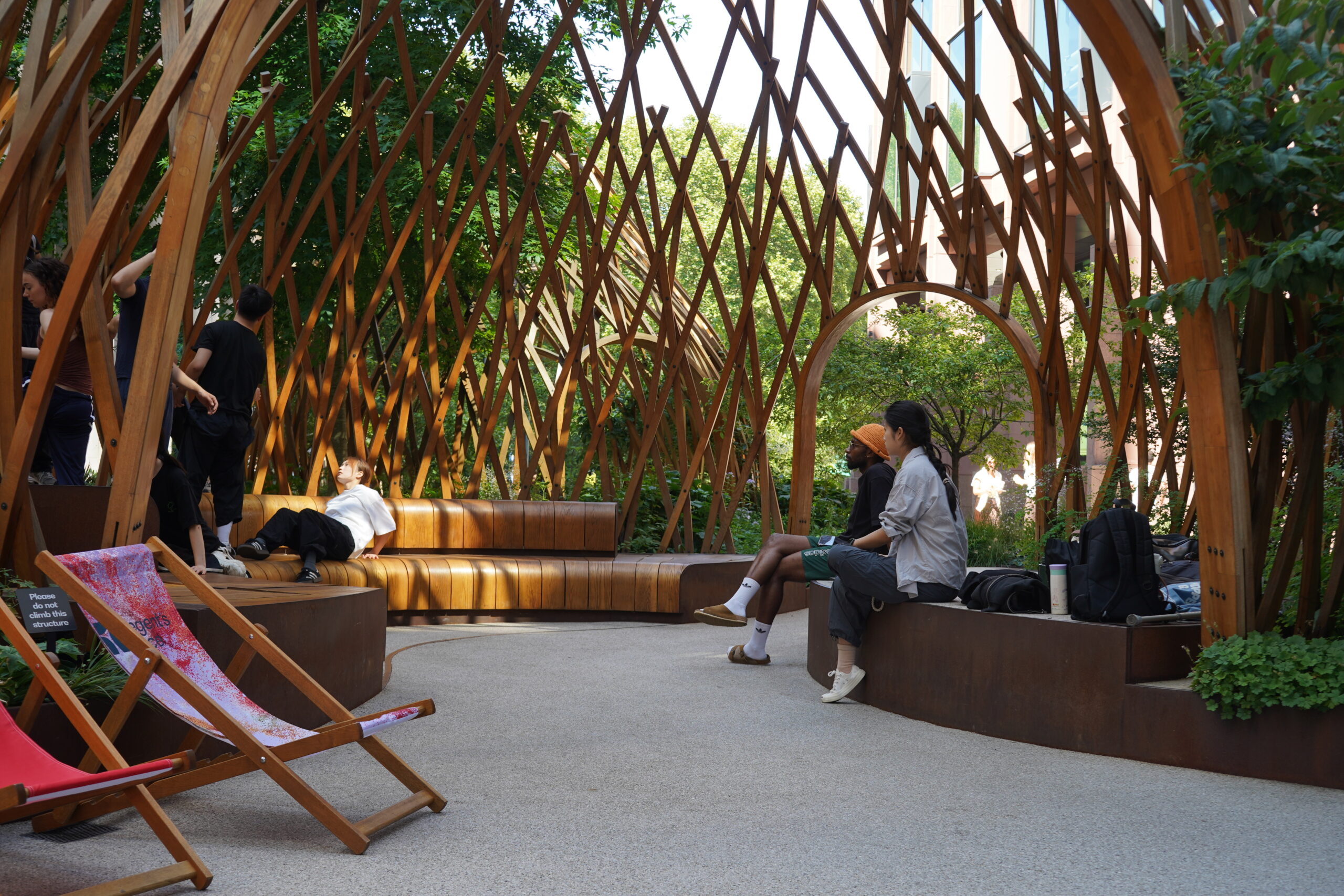
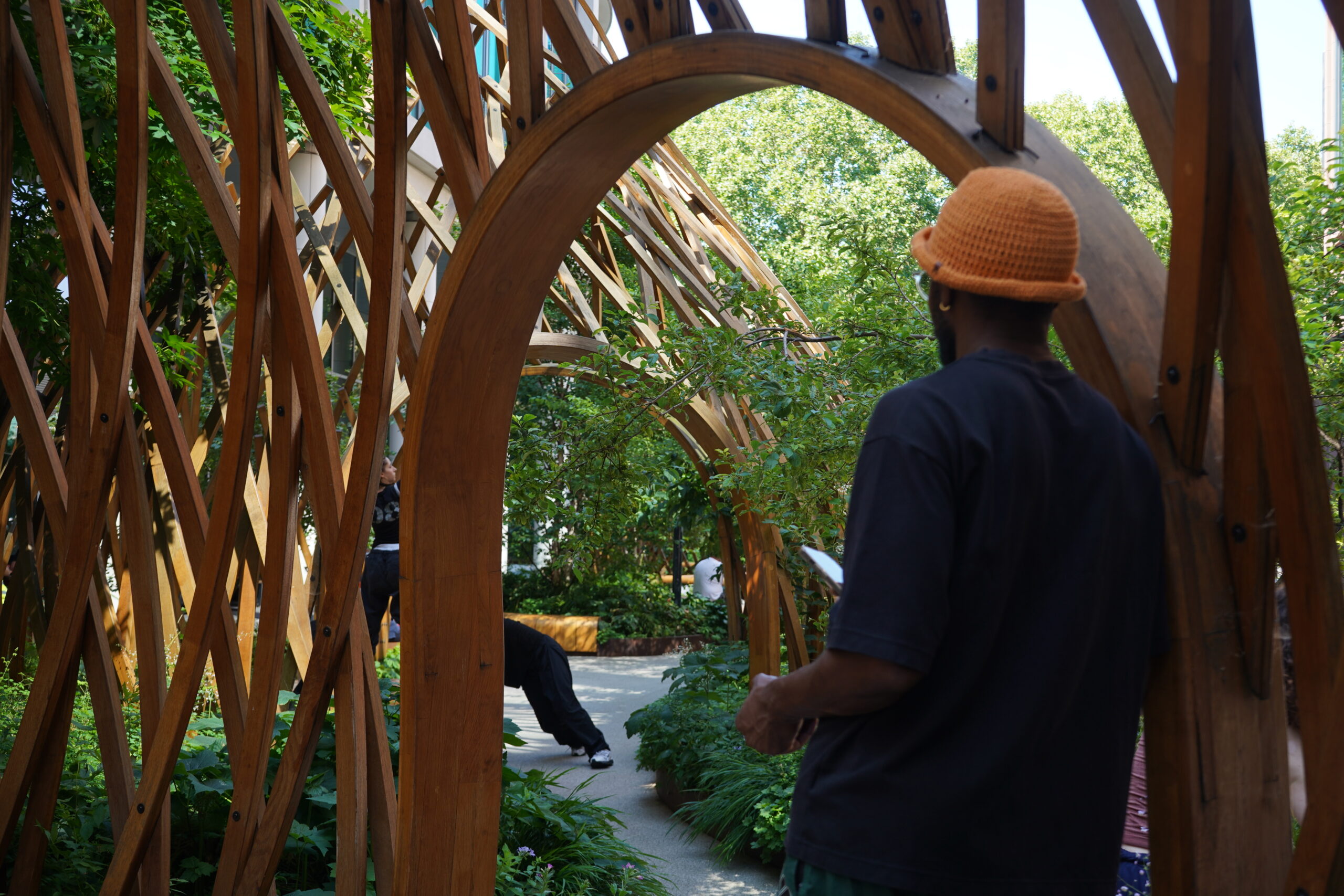
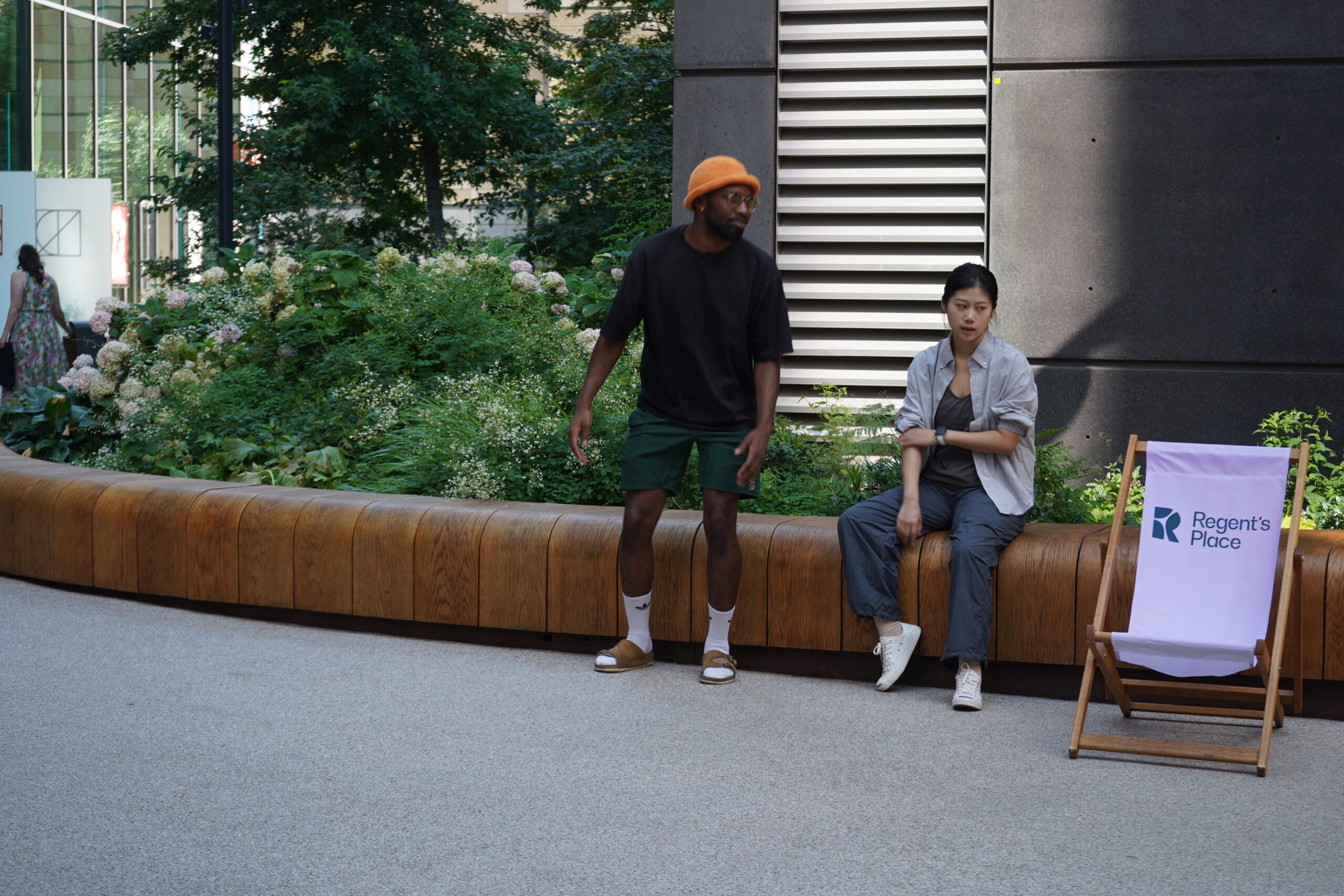

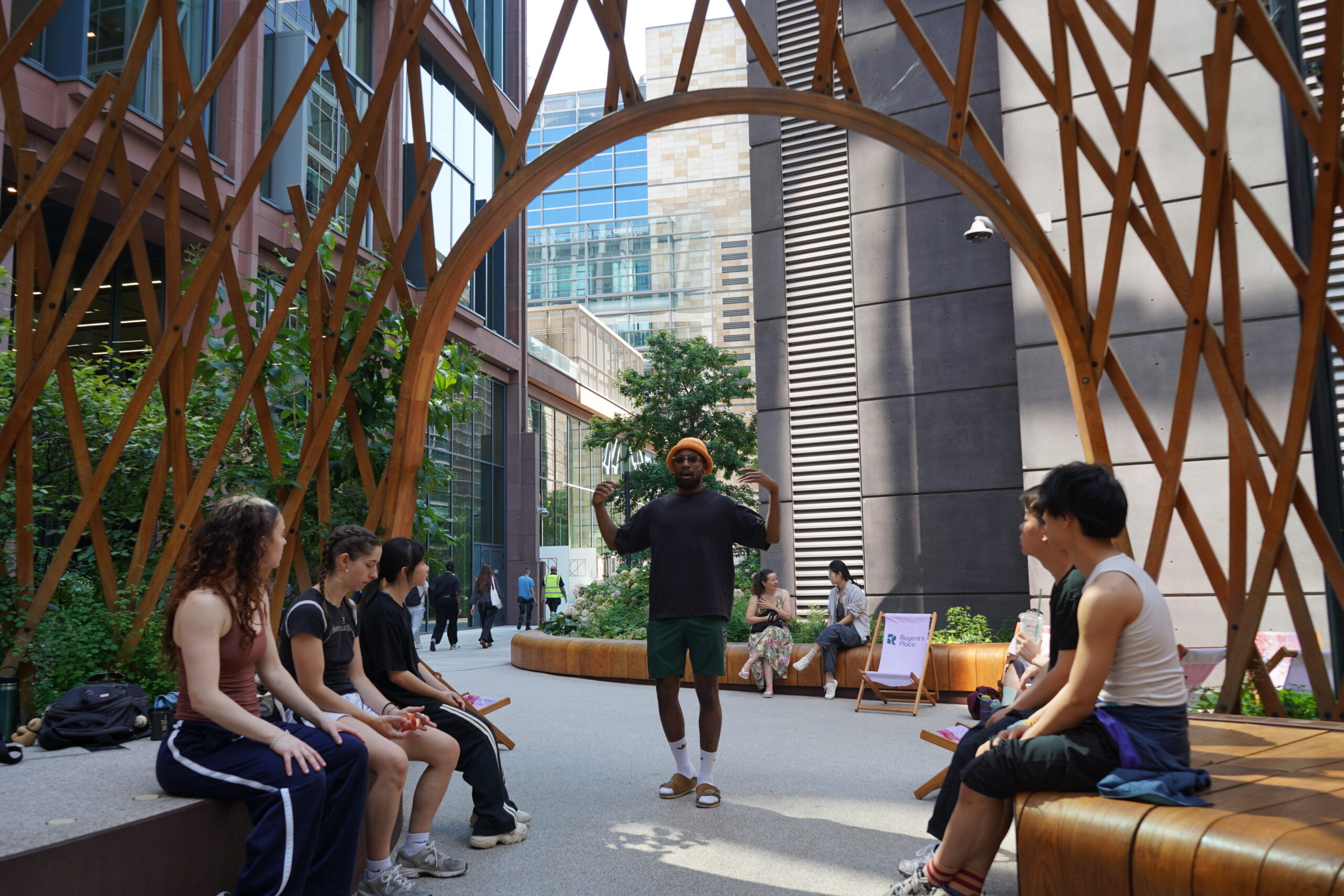


Choreographers’ Biographies
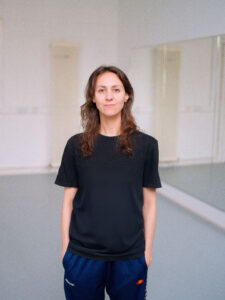
As a dancer, Léa has collaborated with a wide range of companies and choreographers in the UK and across Europe.
Her choreographic work has been presented across Europe and internationally, at festivals and platforms such as Aerowaves (CR), Tanzmesse Düsseldorf (DE), Le Festival d’Avignon at CDCN – Les Hivernales (FR), the Seoul International Dance Festival (SK), and Summerhall at the Edinburgh Fringe Festival (UK).
Commissions for companies include tanzmainz (DE) and Korea National Contemporary Dance Company (SK).
Her work is notably supported by TROIS
Outside of dance, she serves as an ambassador for The Eve Appeal, a UK charity dedicated to gynaecological health.
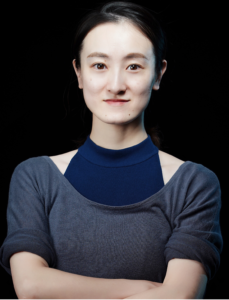 Chen Yongping
Worked at Beijing Dance Academy for 12 years as a physical training instructor and dance choreographer.
It is my honour to participate in this event.
In choreographic practice, there is a preference for expressing character emotions and relational shifts through bodily tension.
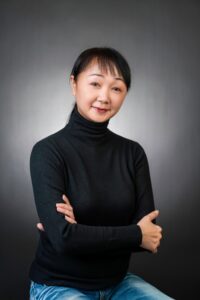 Yu Pik Yim
Yu
Lecturer and undergraduate and postgraduate supervisor at the Hong Kong Academy for
Performing Arts (HKAPA), where she also serves as Programme Leader of the Academy’s
Diploma in Dance Foundations and BA (Hons) in Dance.
She received her professional training at HKAPA and the Beijing Dance Academy, and later
obtained a Master of Creative Industries from Queensland University of Technology (QUT),
Australia. Rooted in Chinese ethnic and folk dance traditions, her practice integrates
contemporary creative approaches with
Through sustained artistic practice, academic leadership, and international engagement, Yu
continues to foster meaningful dialogue in dance education and interdisciplinary
performance across local and global contexts.
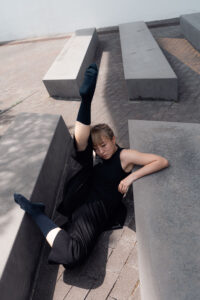
Born and raised in Hong Kong, Tsang
In 2021, Tsang received a full scholarship from The Hong Kong Jockey Club Music and Dance Fund and graduated with Distinction in the Master of Fine Arts in Dance, specialising in Choreography, at The Hong Kong Academy for Performing Arts in 2023. In 2024, she was nominated for the “Tom Brown Emerging Choreographer” award at the 25th Hong Kong Dance Awards. Currently, she focuses on researching improvisation in performances concerning spatiality, temporality, identity and language.
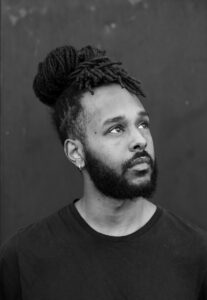
With a career rooted in movement, choreography and visual story telling that have equipped Waddah with a number of skills that have made him a well rounded and well versed artist specialising in street, hip hop and contemporary styles. His interests lie in creating honest and authentically driven work across Film, TV and theatre. He graduated from The Place with a BA Hons degree in contemporary dance and has since cofounded his own multidisciplinary dance company FUBUNATION to which he serves as artistic director. FUBUNATION were selected as Aerowaves artists in 2021 and have gone on to perform internationally and showcase work at Roundhouse, Sadlers Wells, V&A as well as featuring on platforms such as FACT Magazine and multiple film festivals and exhibitions for their film and photographic work. Commercially, Waddah has choreographed and collaborated with major artists and brands across the UK & USA. His choreographic efforts have seen him work with the likes of Nike, Gucci, Tommy Hilfiger, Soho House, Burna Boy, Travis Scott, Tyla, Glass Animals, Sky TV and Venmo.
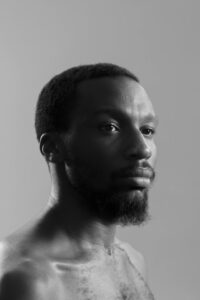 Rhys Dennis
Rhys Dennis is a
n UK and Brazil. Beginning in Street Dance before expanding into contemporary forms, his practice explores ritual, ceremony, memory, and
In 2017, Rhys
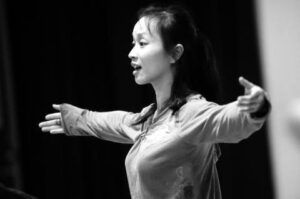 Wang Ruping
WANG, Ruping is a native of Taiwan. She has served as a
She had been a member of José Limón Dance Company, Metropolitan Opera Ballet, Mary Anthony Dance Theatre, Martha Graham Dance Company, the Repertory Dance Theatre Utah… among others. Besides teaching and performing, she enjoys freelance dancing and creating dance for her personal interest in arts and in cultures.
 Ma Nan
Professor MA Nan is mainly teaching specialized dance courses including Modern Dance Technique, Modern Dance Repertoire and Dance Choreography.
She has been honored with titles such as Beijing Municipal Excellent Young Teacher and Young Top Talent, and has developed Beijing Municipal
She has received Creation Awards, Outstanding Instructor Awards, Gardener Awards and other honors in dance competitions, and has served as a judge for numerous national and international dance competitions.
Nayaw Fangas
Born in Taitung, Taiwan. Fangas is an artist, director, choreographer, and performer. His versatile practices probe into the dynamics of audience participation and the possibilities of new technology in the performing arts, while constantly reflecting on his indigenous identity and cultural tradition as Amis.

These are seen in Don’t worry, be happy (2009), Farewell,
His directorial and choreographic work, Mailulay, won the 14th Taishin Arts Award in 2016 (as one of the five annual prize winners). He is performance coordinator of 2020 to 2022 Nuit Blanche Taipei, 2021 & 2022 Taiwan Cultural Expo. in the theme pavilion. Invited artists of 10th Asia Pacific Triennial of Contemporary Art, La XXX Punk,
An invited artist of 2023 Munich DANCE Festival and 2024 SummerWorks Performance Festival. Director of performing arts for 2025 Summer World Master Games. Betel Nut Green, live performance and
Choreographing With, Not About – Maria Salgado Llopis
Observing Tsang Wing Fai choreographic process for this year’s theme Out of Place brings to the fore not only how the theme is interpreted by the choreographer, but how, as entangled and
Fai’s exploration of Out of Place began broadly, with questions of language, culture, and contrast, but after cycling through several conceptual interpretations she returned to the site itself, and it was the site that resolved the theme. Reading Russell Square with an architect’s eye (a training she brings into her choreographic practice), she attended to its inherent structures: its pathways, its verticals, the planes formed by trees and poles, the layered horizontals of canopy, empty air, and grass. As she put it in interview: “I will choose a [set] of the structures with planes […] horizontal, vertical. What if it is something like — not in this dimension, but here? […] What if I choreograph something around there [looks at the sky] and then put the idea in here [signals the ground]?” (Fai, interview with the author, July 7, 2026). Out of that architectural reading came the decisive move: to bring the sky, and the clouds, down to the ground. The clouds, displaced from their proper dimension into Russell Square, are the piece’s answer to Out of place. The site, in other words, became the interlocutor that produced the concept.
Because clouds, as Fai notes, are known “only by observation,” the choreographer opened the process by asking the dancers to summon their memories and understanding of clouds in their places of origin, the clouds of London, Taiwan, Beijing, and Hong Kong, through writing, drawing on paper, and shared conversations. A second conversation followed, this time with material. Because clouds cannot be touched, the choreographer introduced stuffing cotton as a tactile
their articulation of the material’s behaviour in their hands. Sensation preceded vocabulary; matter proposed and the body articulated.
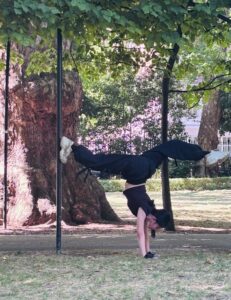 The cotton encounter is followed by others, as the dancers meet the park’s actants improvisationally, one by one, the bench, the poles, the trees. Each thing solicits a different response: a pole invites suspension; a bench, levels and shifts of weight; a tree, orbit and pressure. The relation runs both ways: as the dancers respond to what a pole affords, the pole becomes, for the duration of the piece, something other than a pole. These are agents whose material specificity shapes what movement can be made with them. Motifs and pathways through the site are the sediment of these conversations and encounters, a
A final conversation opens overhead. The canopy of trees under which the piece unfolds is not scenery but structure: its low ceiling, its dappled and shifting light, its shaded interior set against the exposed grass, its arrangement of trunks and gaps — all offer the choreographer and the dancers another point of

What this process makes visible is not a list of collaborators, cotton, pole, bench, tree, canopy, pathway, but a way of working in which agency does not sit with any one of them. Following Barad, “agency is a matter of 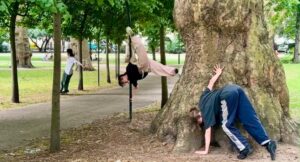 ers an effective space to taste and practice such considerations” (Kramer,2012, p.85). Fai’s process is one such space. It is a practice of
Written by Maria Salgado Llopis (Scholar)
Where Bodies Meet: Searching for Belonging in the Metropolitan Jungle – Wu Yi-Jung
In the corner of a large commercial building lies a quiet, hidden
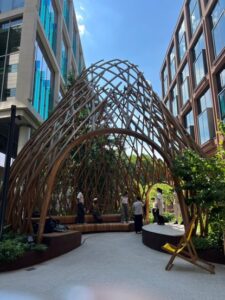 Today, I had the opportunity to observe the choreographic duo FUBUNATION working with three duets — two male dancers, two female dancers, and a
Throughout the rehearsal, the choreographers calmly observed the dancers’ movement exploration and then provided subtle guidance to reveal the qualities of intimacy, care, and bonding. They kept reminding the dancers:
“Slower.”
“Lighter.”
“Don’t make it too performative.”
“Make the movement smaller; don’t extend it too much.”
“Don’t project your gaze outward so strongly.”
“Don’t simply perform the movements while allowing nothing to happen. There needs to be a dialogue within the contact.”
“Breathe together.”
“Feel connected to each other, even when you are far apart.”
“Just think about breathing within movement transitions — don’t intentionally add unnecessary movements.”
The choreographers transformed the profound connections between people into these subtle qualities of movement, allowing the entire piece to reveal a sense of warmth, care, and mutual support.
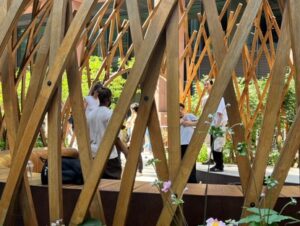 The fact that this dance takes place within a peaceful natural environment hidden inside an urban commercial building makes this relationship even more meaningful. In the second half of the work, as jazz music gently emerges, all the dancers begin walking together, performing gestures that shift between strength and tenderness — from powerful physical expressions to delicate moments of touching the face. These contrasts speak to the integration of nature and humanity, revealing both the vulnerability and resilience of contemporary urban individuals, as well as the emotional connections we seek within the metropolitan jungle.
After the rehearsal, I had a short conversation with the choreographers. Moving beyond the conventional theatre space and entering the city itself, they seek to preserve a sense of simplicity through the repetition of movement phrases while gradually building subtle qualities within them. Through the presence of live bodies, this dance may reach people in unexpected moments — offering a sense of connection and belonging to every
Written by Wu
Navigating the Troubled Water 穿越波濤洶湧的水域
By
The 2026 London ArtsCross presents 8 outdoor performances (July 10th 12:30 at Regent’s Place, and 16:00 at Russell Square) under the theme of ‘Out of Place’ (舞越異境 in traditional Chinese, or 舞越异境 in simplified Chinese).The theme in traditional Chinese indicates dancing cross the ‘strange realm’. The traditional Chinese character for ‘strange’ (異) is the combination of two characters: ‘field’ (田, in the form of 4 squares) on top of ‘share’ (共). This matches the joint venture of 4 cities in ArtsCross and the spirit of ‘harmony in diversity’ (和而不同).
2026年倫敦「跨藝」計畫(ArtsCross)以 ‘Out of Place’(繁體中文:舞越異境,簡體中文:舞越异境)為主題,呈現8場戶外表演(7月10日12:30在攝政廣場,16:00在羅素廣場)。繁體中文的主題意指舞蹈跨越「異域」。 「異」字是由在上方的「田」(由四個方格組成)和在下方的「共」兩個字組成,這與「跨藝」計畫由四個城市聯合參與,以及「和而不同」的精神相契合。
In the period of three weeks, dance artists from four cities (in particular eight choreographers and their selected dancers) worked under time pressure and heat waves, to create experimental, collaborative and intercultural works. For them, the English theme ‘Out of Place’ can be taken literally, meaning performing their dance works outside of the traditional theatre, black box or dance studios. After lengthy exploration and negotiation, alternative space, in this year’s case urban settings, such as Regent’s Place (a business plaza in Euston) and Russell Square (a Georgian garden in Bloomsbury) are secured for the 8 outdoor
在三週的時間裡,來自四個城市的舞蹈藝術家(特別是八位編舞家及其挑選的舞者)在時間和熱浪的雙重壓力下,創作出實驗性、合作性和跨文化的作品。對他們來說,本計劃的英文主題 ‘Out of Place’ 可作字面理解,意指在傳統劇場、黑盒子劇場或舞蹈工作室外進行舞蹈表演。經過長時間的探索和協商,最終確定了替代空間,今年的演出場地為城市景觀,例如尤斯頓(Euston)的攝政廣場(Regent’s Place)和布魯姆斯伯里(Bloomsbury)的羅素廣場(Russell Square)。這八場戶外特定場域演出,均在此舉行。
For visiting dance artists and locals alike, this intense project with it’s intentional mixing of groups and breaking of boundaries, generates uncertain conditions, hybrid creations and alternative solutions. Everyone involved are genuinely ‘out of place’. They are out of their comfort zone. The visitors are not in their original time zone. They do not live in their familiar linguistic, cultural, and societal territory. The intense heat certainly made the locals feel very tropical.
對於來訪和當地的舞蹈藝術家來說,這個刻意融合不同群體、打破界限的密集項目,催生了不確定的局面、混血的創作和另類的解決方案。所有參與者都感到格格不入,離開了舒適圈。來訪者不在原本的時區,也不在他們熟悉的語言、文化和社會環境中。而酷熱的天氣,無疑讓在地人士感受到了濃厚的熱帶風情。
Testing the water is essential.
Exploration is fundamental.
Adaptation is foundational.
Adjustment is normal.
Both the choreographer and the dancer are navigating the troubled water of ‘arts’, and trying to ‘cross’ this river of constant state of flux.
試探水溫至關重要。
探索是根本。
適應是基礎。
調整是常態。
編舞家和舞者都在「藝術」這片波濤洶湧的水域中航行,試圖「渡過」這條不斷變化的河流。
Thus, as an observing scholar, I am interested in the practice of ‘fluidity’. I am curious about how it is adopted, initiated, facilitated or embodied by the dance artists. 因此,作為一名觀察學者,我對「流動性」的操作很感興趣。我很好奇舞蹈藝術家們是如何採納、發起、促進或體現這種「流動性」。
~~~~~~~~~~~~~~~~~~~~~~~~~~~~~
Note(註):
The term ‘fluidity’ primarily encompasses mobility, smoothness, and variability.
「流動性」的含義主要包括移動性、流暢性和變易性。
The specific meaning depends on the context.
具體的含義取決於語境。
In physics and chemistry: it refers to the fluidity of matter, that is, the property of matter being easily movable. (e.g., water has good fluidity.)
在物理和化學:它指的是物質的流動性,也就是物質易於移動的特性。(例如,水的流動性佳)。
In action, language, or art: it refers to fluency or smoothness (e.g., graceful dance moves, fluent language expression).
在行動、語言或藝術:它指的是流暢或順暢(例如,優雅的舞蹈動作,流利的語言表達)。
In economics or finance: it refers to the liquidity (e.g., ability to convert assets into cash).
在經濟或金融:它指的是流動性(例如,將資產轉化為現金的能力)。
In states and situations: it refers to the uncertainty, variability, or flexibility of things (e.g., unpredictable changes in the situation).
在國家與機構:它指的是事物的不確定性、易變性或靈活性(例如,局勢變化不定)
~~~~~~~~~~~~~~~~~~~~~~~~~~~~~
Programme Notes: Russell Square
ArtsCross London 2026
Out of Place / 舞越異境 / 舞越异境
Friday 10 July 2026 4:00 p.m
Russell Square
Running Order
《我们之间》《 Among Us》by Ma Nan 马南
⭕ by Wang Ruping 王如萍
The Laughters by Léa Tirabasso
(
Programme
《我们之间》《 Among Us》
Choreographer: Ma Nan 马南
Dancers: Sun Ruixuan, Zhu Xiyue, Pan Zhiyi, Wu
七人纯肢体群舞,以身体丈量彼此的距离,在聚拢与分离间,演绎群体流动的空间边界。A
Music: Philip Glass, Metamorphosis — Hao Shen
⭕
Choreography: Wang, Ruping 王如萍
Dancers: Chin
We dance to echo the theme of 2026 ArtsCross,
Special thanks to all the dancers,
The Laughters (research)
Choreographer: Léa Tirabasso
In collaboration with the dancers: Zhu Jiahong, Cui Baiwenyue, Wang
We are sharing a first research into the act of laughing. During our time together we explored what happens in the body when we laugh, observed each other laughing, and gradually opened up to one another.
(
Choreographer: Tsang Wing Fai 曾詠暉
Dancers: Wen Wen, Xue Yiyang, Yang
Music: Composed by Step Ip (Hong Kong)
Programme Notes: Regent’s Place
ArtsCross London 2026
Out of Place / 舞越異境 / 舞越异境
Friday 10 July 2026 12:30p.m
Regent’s Place
Running Order
La XXX Punk:
A Moment Just for Me — Yu Pik Yim 余碧艷
So Hot by Cheng Yongping 成永苹
What a difference a day makes by FUBUNATION
Programme
La XXX Punk:
Choreographer: Fangas Nayaw
Dancers: Zhu Xiyue, Wang
I took this choreographic experience at ArtsCross London as a potential practice of Amis migration—one that generates cultural exchange and transmission. Together, we hope to envision a future within an unnamed collective, attempting to discover cultural codes and reconstruct the imagination of what future Indigenous’ ceremonial music and dance might become. Thus, the Indigenous Punk series emerges.
Cultural fluidity is a collective behavior, recreated through our continuous interactions with the environment. The discoveries made by myself and the dancers during this migration constitute the unique version and creative interpretation for this iteration. Together, we examine and enact existing traditional forms of music and dance, interweaving each dancer’s unique background and movement phrases to develop the possibilities of
From traditional collective circle dances to individual ascending and descending spirals; from visibly holding hands to invisible linear connections; from bound flow movement to free flow movement, revealing the kinetic energy oscillating among the elbows, spine, and center of weight; from traditional stepping and jumping to
The live work La XXX Punk:
Every part of the La XXX Punk series starts with a manifesto. This is because the series is our search to think about how indigenous dance can be in the future. It will be different, and must be different because we are fed up with how popular imagination of the indigenous dance is limited to certain selected highlights and images.
La XXX Punk series
MANIFESTO:
Climax is illusionary.
Tradition is individual.
Effortlessness is misleading.
Bound flow movement releases the body.
The aging body holds experience.
Homogeneity is a myth.
Culture lies in the every day.
Disappearing happens quietly.
Glitch is a gift.
This journey in ArtsCross with all participants around the world is a huge gift, also a massive “Glitch”.
Music:
Artist:putox secos
Title:DiscoSour — KCCK_PutosSecos
Live act @Passos Manuel_ NOV_2022 No mastering KCCK Putos Secos
Electronics: Rui Lima, Sérgio Martins, Jorge Quintela
from SoundCloud https://on.soundcloud.com/N6j5jWzQ1bkvLD4srX
A Moment Just for Me
Choreographer: Yu Pik Yim 余碧艷
Dancers: Cui Baiwenyue, Xue Yiyang, Yang
An oil‑paper umbrella gradually warms in my palm, opening a quiet space beyond watchful eyes.
The afternoon light softens, and shadows slowly lengthen.
Beneath the umbrella, I joyfully immerse myself in this fleeting moment.
The city remains unchanged —
yet within this small circle of shade,
I stand, if only for a while,
at my own pace.
油紙傘在掌心漸漸焐出溫度,展開一處不被注視的靜謐空間
午後的光線柔和下來,影子慢慢拉長
在傘下,我愉快地沉浸於這短暫的片刻
城市依舊未變——
然而在這小小的一圈蔭影裡
我只是短暫地
以自己的步調站立了一回
Music: Composer unknown
So Hot
Choreographer: Cheng Yongping 成永苹
Dancers: Wen Wen, Sun Ruixuan, Wu
Inspired by the rare heatwave in London. The air is scorching, even a light touch burns. Yet the innate human longing for connection prevails—we choose to embrace each other, no matter how hot it gets.
Music:哈基米月光奏鸣曲第三乐章,
Composer: Wulfram
Andante spianato et Grande Polonaise brillante In E Flat Op.22:Andante spianato, Composer: 韩小驰
Seasoned Oak, Composer: Daniel Pemberton
What a difference a day makes
by FUBUNATION
A piece loosely based on the theme of connection, relationships and the relationship one has with themselves. Where subtlety is everything and less is more, one can search for great detail inside the experience.
This work was created in collaboration with the cast who generously gave so much of themselves throughout the creation.
Choreographer: Waddah Sinada
Assistant choreographer: Rhys Dennis
Collaborators & performers: Zhu Jiahong, Pan Zhiyi, Jing Hui, Zhao Xintian Zhao, Lian
From Inner To Outer by Huang Shu Lien
07 July 2026
During Fai’s rehearsal process (2 July), I observed how he guided dancers to explore the Head–Tail connection as a way of developing a more integrated bodily awareness. Dancer A engaged in free movement exploration, investigating internal sensations and movement possibilities through the dynamic relationship between the head and the tail. Through this process, a highly personal movement vocabulary began to emerge. Meanwhile, Dancer B gently placed their hands on A’s head and tail, offering tactile feedback and support throughout the exploration.
What stood out to me was how A gradually expanded from Personal Space into the surrounding environment. The pathways, directions, and bodily extensions became increasingly expansive, creating a visible transition between Personal Space and General Space. The movement seemed to unfold from an inner bodily awareness toward an outward engagement with the environment. This practice not only heightened awareness of movement initiation and connectivity, but also deepened the dancer’s sensitivity to spatial use and embodied expression.
A different approach to spatial exploration emerged in Ruping’s rehearsal process. Using the image of a flock of birds in motion, she invited dancers to investigate collective movement and spatial relationships through improvisation. Although the movement material was not
One section was particularly striking. Dancers began by attending to their own Shape within Personal Space, observing how forms emerged and transformed through movement. Gradually, this awareness expanded into General Space as dancers travelled through the environment while searching for new leaders. Whenever directions or pathways shifted, dancers were required to identify a new leader and adjust their responses accordingly.
Throughout the process, Ruping (2 July) repeatedly emphasised the importance of Awareness. Dancers were asked not only to attend to the quality, direction, and clarity of their own movement and Shape, but also to remain sensitive to the positions, trajectories, and changing dynamics of those around them. As leadership roles shifted, dancers relied on visual, spatial, and movement cues to navigate these transitions while maintaining a sense of collective connection.
Watching this process prompted me to reflect on a central question: How can dancers retain their individuality while remaining deeply connected to a collective? Perhaps this tension between personal expression and group belonging is one of the most compelling aspects of improvisational choreography.
Written by Huang Shu Lien (Scholar)
Negotiating Space in an Outdoor Environment Huang Shu Lien
3 July 2026
At Regent’s Place, Fangas guided the dancers through a series of explorations focused on the relationship between the collective body and space. The creative process began with a circular formation, where dancers established a shared sense of group awareness through synchronized and repetitive movement patterns. Within this circular structure, all dancers oriented toward a common spatial focus, creating a clear sense of collective order and centripetal spatial organization.
As the process unfolded, the formation gradually shifted from a circle into linear arrangements. The spatial relationships that had initially drawn dancers inward began to expand outward, generating new directions, pathways, and possibilities for movement. Fangas then further divided the ensemble into duets and small groups of three or four dancers. Through the interactions and transitions between these smaller groupings, multiple spatial focal points emerged, creating a richer and more layered spatial landscape.
From a spatial perspective, this choreographic process revealed a gradual transition from a singular spatial orientation toward a more multidirectional use of space. Rather than maintaining a unified facing direction or shared orientation, dancers navigated between different pathways, directions, and group relationships. Through continual reconfiguration and regrouping, the space became increasingly fluid, open, and decentralized, allowing multiple centers of activity to coexist simultaneously.
Toward the end of the creative sequence, Fangas organized the dancers into a square formation with one performer positioned at the centre. This geometrically structured arrangement established a strong visual focus and spatial hierarchy within the open outdoor environment. Even in a site without clearly defined stage boundaries, the choreographer used formal composition to create a sense of order and spatial clarity.
What I found particularly interesting was that, despite the highly structured formations, the dancers were not confined to a single viewing direction. Instead, they continuously projected their movement, gaze, and attention outward in multiple directions, allowing their kinetic energy to radiate throughout the surrounding environment. This multidirectional awareness seemed to respond directly to the openness and complexity of the outdoor setting.
Throughout the process, the dancers’ bodies were not simply oriented toward an imagined front or a conventional stage perspective. Rather, they established an ongoing dialogue with the surrounding environment, creating a more expansive relationship between body and place. The work appeared to balance structure and openness, revealing how an outdoor site can become an active participant in choreographic thinking rather than merely a backdrop for performance.
Written by Huang Shu Lien (Scholar)
Collection of thoughts by Wang Xin
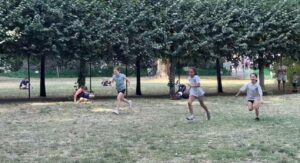 For fluidity to truly occur, the entire environment must be in harmony. Every element in the chain of transmission must become a conduit; energy must not get stuck anywhere.
I was particularly fascinated by the responses of passersby. Would their reactions interrupt or break the flow? Londoners, to my great delight, proved to be remarkably “professional” spectators. They did not disrupt the flow; instead, they became part of the work itself.
One image stays with me from rehearsal: in the middle of the lawn where Work of Fai was being performed, a young man sat reading a book. Completely undisturbed. Even as dancers surrounded him in a circle, he did not so much as look up. He was not ignoring the performance — he was, in his own quiet way, part of it.
Ruping’s Work had no music. An elderly man nearby turned his own radio to maximum volume, adding music to the piece in his own interpretation. Children ran back and forth, eager to join the dance. During Ma’s rehearsal, a gust of wind swept dry grass and dust from the ground into my eyes. These random occurrences — utterly impossible in a theater — were precisely what made the experience so thrillingly unique. The accidental became part of the aesthetic.
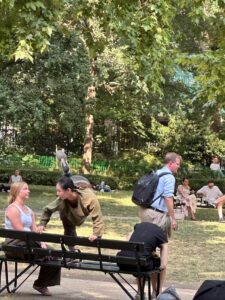
Lately, I have been reflecting deeply on the definition of contingency. Our group has held discussions around this term. I am drawn to this concept, for I believe events do not unfold following preset logic. Variable factors emerge spontaneously on site. They are encounters arising from external circumstances, beyond the control of choreographed scripts.
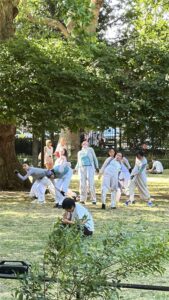
Distinct from a mere accident, contingency denotes latent possibilities inherent within a given situation.
Within the open public space of Danscross (Artscross is known as DansCross in Beijing), shifting light and shadow, wandering pedestrians, wind, onlookers’ gazes and ambient sound all count as inherent onsite conditions. Dancers do not strictly follow fixed movement sequences. Instead, they embrace real‑time variables and incorporate spontaneous encounters into creation. Each performance evolves into a one‑off, instant‑generated moment.
Written by Wang Xin (Scholar)
Something about “A Moment Just for Me” 《片刻》
It is my first time participating in ArtsCross London 2026, and it has truly been a pleasure. These three weeks have been filled with both joy and challenge. One of the main challenges both dancers and choreographers faced was the heat wave. However, I am grateful for it, as it unexpectedly gave me an extra day and a half to pause, refine, and further develop my ideas. Nonetheless, I appreciate the rewarding process that was wrapped within a few weeks as the outcome of the choreography blossomed from the time spent working together.
Originally, I arrived with some initial concepts. However, once I met my dancers and visited the site, I decided to let go of my original plan. I realised that here, in London, the site and the dancers themselves are not meant to fit within the mould I had imagined but hold their own individual characteristics. This reveal of individuality and the unique self became my most significant inspiration.
Eventually, the mix of this year’s ArtsCross theme “Out of Place” and ideas strung a final proposal. I decided to look upon the lives of humans and how we are squashed by the expectations and confinements of society, like a bird trapped in a cage unable to fly freely. Many people long to escape this environment, even if only briefly — to find a moment of rest or to enter a different mental or physical space where they can breathe freely. Yet such moments are temporary; reality inevitably calls them back to their daily lives.
To choose a commercial district, I looked for the surrounding rows of office buildings as the setting for my work. Through this urban landscape, I aim to capture the pace, atmosphere, and emotional state of people living and working in the city. Modern urban life is often defined by constant pressure and demanding routines, creating a sense of tension and confinement. To enhance this meaning, I introduced the
Bringing an object from Eastern culture into a Western context does not mean I intend to impose it on a Western stage or insist on its continued use. In this work, it is simply a stage prop. I believe any prop can hold multiple possibilities. Here, it serves a metaphorical purpose — nothing more, nothing less.
In the article “Week 1: Appropriation or Respect?”, Adriana Garcia Pinilla reflects on cultural exchange in dance, exploring the delicate balance between respect and appropriation. She emphasises the importance of humility, curiosity, and reflective learning when engaging with traditions beyond one’s own culture. In her observations of my rehearsal process, she noted that my work with umbrellas appeared to have “a heavy base in Chinese traditional dance forms.”
I appreciate the intention behind this reflection, as questions of cultural responsibility are both important and necessary. However, I would like to clarify that my choreography is not grounded in traditional Chinese dance vocabulary. While certain movement qualities or the umbrella itself may evoke associations with Chinese culture, this was never the structural foundation of the work. The movement language emerges from a contemporary practice shaped by the site, the dancers, and the collaborative process in London. Similarly, this judgement was rooted early, as this was documented during the first week without any conversation behind the plan’s
When we encounter something unfamiliar, it is natural to form immediate impressions. We may assign it fixed meanings or interpret it through our own perspectives, which are subjective. Perhaps the value of cultural exchange lies precisely in this space of ambiguity — where meanings remain open, and dialogue allows us to move beyond our first assumptions.
Coming from the East to create work in a Western context inevitably raises questions for me: Should I adapt my work to fit a local aesthetic? Should I modify my artistic language to be more easily understood or accepted? Or should I remain true to my own artistic voice while continuing to explore and challenge it through dialogue with different cultures? Perhaps I am overthinking it. In the end, I choose simply to create the work I believe in.
For me, ArtsCross is not about representing or reproducing a culture in its “pure” form. It is about creating a space where different cultural perspectives can meet, influence one another, and generate new artistic possibilities.
I believe art should be open and inclusive. That, to me, is exactly what ArtsCross embodies — cultural exchange. With four dance academies participating, three of them from the East, the meeting of Eastern and Western cultures feels both natural and inevitable.
Perhaps we do not need to resolve every question about culture and identity so quickly. Perhaps it is enough to remain attentive, respectful, and open. Art does not always provide answers. Sometimes, it simply creates a space to pause — and to breathe.
Written by Pik Yim Yu – Choreographer from the Hong Kong Academy for Performing Arts

What If Dance Could Change an Ordinary Moment? – WU Yi-Jung
A Provocation on ArtsCross,
Presented by WU
11 July, 2026
Good afternoon, everyone.
As the Chair of the Dance Department at the University of Taipei, I have spent the past few years thinking about one question:
What does University Social Responsibility actually look like in dance education?
We often talk about research, teaching, and community engagement. But I have always wondered: beyond educating future artists, what can a dance department genuinely contribute to society?
When I arrived in London and began observing the rehearsals for ArtsCross 2026: Out of Place, I felt that perhaps I had found one possible answer.
University Social Responsibility asks higher education institutions to move beyond their campuses and contribute to the
This is precisely what impressed me about The Place. Beyond being home to the internationally renowned London Contemporary Dance School, it has long created opportunities for people of different ages, backgrounds, and abilities to engage with dance. Through community classes, outreach programmes, and performances beyond conventional theatre spaces, dance becomes something people encounter as part of everyday urban life rather than as an exclusive cultural event.
This year’s ArtsCross embraces that same spirit. Out of Place invites artists to create
During the past two weeks, while observing rehearsals in Regent’s Place and Russell Square, I found myself asking a simple question:
What happens when someone who never planned to see dance suddenly encounters it on the way to work, during lunch, or while walking through the city?
Can such an unexpected moment carry meaning?
One rehearsal particularly stayed with me.
I observed the choreographic duo FUBUNATION working with three duets. What fascinated me was that they rarely corrected what the dancers were doing. Instead, they focused on how they moved.
They repeatedly reminded the dancers:
“Slower.”
“Lighter.”
“Breathe together.”
“Feel connected, even when you are far apart.”
The choreography was not simply about movement. It was about cultivating qualities of care, intimacy, trust, and human connection.
Those qualities became even more powerful because they unfolded within a quiet green sanctuary hidden among London’s commercial buildings. The city itself became part of the choreography.
I also witnessed those qualities shared by other choreography works in different ways.
But what fascinated me in outdoor rehearsals and performances even more was the audience’s reactions.
Some people continued walking, completely absorbed in their daily routines.
Some noticed the performance but quickly moved on.
Others stopped for only a few seconds before leaving.
And then there were the children.
Without hesitation, they laughed, danced at a back corner along the performance, and even continued repeating the movements after the performance had ended.
Watching them, I was reminded of John Dewey’s (1934) idea that aesthetic experience interrupts the ordinary flow of everyday life. It invites us to pause, to notice, and to experience the world differently. Richard Shusterman (1997) further suggests that through bodily awareness, such moments can transform not only how we move, but also how we relate to ourselves and to others.
Perhaps children respond so immediately because they have not yet learned to separate art from everyday life.
Adults, on the other hand, may hesitate.
Yet even a brief pause—a few moments of watching, listening, smiling, or wondering—may already be meaningful.
So perhaps the value of
Perhaps its greatest contribution lies in creating small interruptions within everyday life—moments that invite us to see familiar places differently, to notice one another, and to imagine new possibilities for human connection.
If that is true, then ArtsCross is more than an international artistic collaboration.
It is also a practice of University Social Responsibility.
So I would like to leave you with one final question.
I am not going to ask whether dance can change a city.
But maybe the question is whether dance can change one ordinary moment within that city.
Thank you.
Written by WU
References
Dewey, J. (1934). Art as experience. EBSCO. https://www.ebsco.com/
Shusterman, R. (1997). The end of aesthetic experience. Journal of Aesthetics and Art Criticism, 55(1), 29–41. DOI:10.2307/431602
What Remains, and What It Makes: Creative Practice Out of Place
To call the ArtsCross website out of place is not to say the creative process has been misplaced or lost. It is to name an ontological condition. Two modes of being are at play: the creative process and performance as an embodied, present-tense experience unfolding over three weeks, and the website as an archive persistent, textual, retrievable, held together by hyperlinks rather than by bodies. The website is not a version of the process; the two belong to different orders of being. This provocation begins after the studio and the park have emptied. Its territory is what remains, and its particular case is the presence of FUBUNATION. What out of place describes is the passage between these two realms: how a doing, having ended, continues to exist as remains under conditions its original mode of being did not set.
Diana Taylor’s distinction between archive and repertoire offers the cleanest way to name this passage. The repertoire holds “embodied memory conveyed in gestures, the spoken word, movement” (Taylor, 2003). FUBUNATION’s studio process was repertoire: breath, weight, the involuntariness of a decision arriving in a spine, the dwelling on a gesture, the improvised interpretation of a movement. On the website, that repertoire has become archive: video material and scholarly entries, the remains of a practice that once took place. Yet these remains do not merely represent the event. For those who meet the work only through the website, they constitute it (Auslander, 2015).
The archive performs a means of access, and in doing so it turns remains into the primary reality. On the ArtsCross site, FUBUNATION’s presence is to date small yet significant: a brief rehearsal video from day two, a few seconds within a weekly recapitulation, and two entries by scholars. Neither entry is the whole; each is what the process has become through the attention of the scholar or filmmaker who captured, edited and uploaded it. Tom Hastings records the interior of a somatic studio session, holding onto Waddah’s words to the dancers “just move to feel, not to perform… feel the involuntariness of it” (Hastings, 2026). Wu Yi-Jung observes a rehearsal of three duets at Regents Place Plaza, catching the choreographers’ subtle corrections “Slower, Lighter, Breathe together” and offering a reading of the work as portraying “the vulnerability and resilience of contemporary urban individuals” (Wu, 2026). For a future viewer who was not in those spaces, these fragments are not partial records; they are what can be read and understood of FUBUNATION’s process, and of the meanings that emerge from its remains. Both entries have become instruments, and what they instrument is future encounter.
It is here that André Lepecki’s reframing of the dance archive becomes generative. For Lepecki, “the end of a performance is the new beginning of a dance’s afterlife, which permits the work to undergo numerous permutations and manifestations” (Lepecki, 2010). The archive, in this account, is not the end of the dance but “the vertiginous skin where all sorts of onto-political ‘rewritings’ take place, including the re-writing of movement, including the re-writing of the archive itself” (Lepecki, 2010). Read through Lepecki, the ArtsCross site is one of FUBUNATION’s afterlives, and its remains are not backward-looking traces. Waddah’s “just move to feel, not to perform” is available now to any dancer who reads it and may enter a practice on terms the studio session could not have set.
The choreographers’ “breathe together” might travel into scholarly writing, into teaching, into future workings-with. The remains can become instruments of future practice, and that capacity is a property of the mode of being they now inhabit. What out of place names, then, for the creative process at ArtsCross London 2026, is the ontological condition under which a doing continues to exist by becoming something else. Persistent where it was temporary, retrievable where it was present, textual where it was embodied and can, from that new mode of being, do work in the world. The site is where the making now happens for those who come after: not because the making is repeated there, but because the remains are the form the making has taken.
These ideas open questions that this provocation wants to hold open rather than close. How do creative processes now circulate on the site? And what kind of history is being written by an archive whose evidence is somatic instruction and scholarly attention? The question it ends on is more immediate, and it is addressed to those of us still writing. The site is not finished. Its remains are still being made, by hands that are ours including, this afternoon, by the discussions held in this symposium.
As we continue to write and to populate the ArtsCross website as scholars still with access to the dancers, still catching what we catch: What afterlives will these new entries create? Which embodied experiences of the room are made into remains, and how? Knowing what we know today, how are we acting now so that, when we look back on this process, we can say what it was?
Postscript: This entry, once uploaded, is no longer only a reading of the ArtsCross archive; it is part of it. Written after the studio emptied, it has itself become one of the remains it describes: a fragment through which some future reader, who was not in the room, will meet FUBUNATION at ArtsCross London 2026. It does not stand outside the archive to judge it; it is folded into the same generative work. And so, it invites the next scholar-observer to read it, and to write past it, as one more of the process’s afterlives.
Written by Maria Salgado Llopis (Scholar)